(a chapter from the book “The Extraterrestrial Species Almanac” by Craig Campobasso)
Universal Origin: Ummites are from the planet Ummo, a one continent world with many large lakes. It is near Sagitta, a dim constellation in the northern sky.
Physical Characteristics: Ummites are indistinguishable from Earth humans and Nordic-appearing. Male and female heights range between eight and nine feet. They have a heightened sense of smell and are primarily nocturnal.
Belief System: Ummo’s globe is overseen by four people who have been chosen by the populace. There is no monetary system, as with all star nations. Society thrives through a joint effort and discipline. All carry out their duties knowing that if they fail to perform, others in their society will suffer. Their social structure is efficient and unified, using the principles of the One Spirit (the life generator), the glue that holds the physical worlds and its dimensions together.
Cosmic Agenda: In March of 1950, Ummite explorers came to Earth to learn about our cultures. They disseminated scientific information about our universe to selected individuals through letters, including leading scientists, to expand their thinking, to concentrate on planetary problems that required immediate attention. There were also codicils on technical information: technology safe for the environment and educational improvements for all of humanity. The Ummites visit Earth periodically to this day. They live by the Cosmic Law of One: that every world, its consciousness as a whole, is responsible for its demise or elevation. They shared their wealth of spiritual knowledge with us to help us climb out of the cesspool of wars, pollution, and social unrest. They hope we will heed their warnings and not destroy our race and planet.
Technology: Ummites have oval saucer-shaped craft. Their ships and world use biological supercomputers.
Consciousness Abilities: Ummites are fully conscious and sovereign beings. They are telepathic empaths. They say that all sentient beings are linked to Creation’s soul through man’s encephalic cortex.
Dimensional Capacity: The Ummites say the multiverse exists because pockets of reverse time and positioned matter exist in areas where the light velocity is faster. The electrical and magnetic fields and stationary electrical fields do not radiate out of reversed space time. Universes formed out of dark matter exist in reverse time. They invert the dark matter universe(s) to exist in our space time and travel through those corridors across the universe, cutting travel time to a minimum.
****** ******
Ummites
Universele oorsprong: Ummites komen van de planeet Ummo, een wereld op één continent met veel grote meren. Het bevindt zich in de buurt van Sagitta, een minder helder sterrenbeeld aan de noordelijke hemel.
Fysieke eigenschappen: Ummites zijn niet te onderscheiden van aardse mensen en zien er Scandinavisch uit. Mannelijke en vrouwelijke lengtes variëren tussen acht en negen voet. Ze hebben een verhoogd reukvermogen en zijn voornamelijk in de nachtelijke uren actief.
Overtuigingssysteem: Ummo’s wereld staat onder toezicht van vier mensen die door de bevolking zijn gekozen. Er is geen monetair systeem, zoals bij alle sterrennaties. De samenleving gedijt door een gezamenlijke inspanning en discipline. Allen voeren hun plichten uit in de wetenschap dat als ze niet presteren, anderen in hun samenleving zullen lijden. Hun sociale structuur is efficiënt en verenigd, gebruikmakend van de principes van de One Spirit, Ene Geest (de levensgenerator), de lijm die de fysieke werelden en haar dimensies bij elkaar houdt.
Kosmische Agenda: In maart 1950 kwamen Ummite-ontdekkingsreizigers naar de Aarde om meer te weten te komen over onze culturen. Ze verspreidden wetenschappelijke informatie over ons universum aan geselecteerde individuen door middel van brieven, waaronder vooraanstaande wetenschappers, om hun denken uit te breiden, om zich te concentreren op planetaire problemen die onmiddellijke aandacht vereisten. Er waren ook codicils over technische informatie: technologie die veilig is voor het milieu en educatieve verbeteringen voor de hele mensheid. De Ummites bezoeken de Aarde tot op de dag van vandaag regelmatig. Ze leven volgens de Kosmische Wet van Eén: dat elke wereld, zijn bewustzijn als geheel, verantwoordelijk is voor zijn ondergang of verheffing. Ze deelden hun schat aan spirituele kennis met ons om ons te helpen uit de beerput van oorlogen, vervuiling en sociale onrust te klimmen. Ze hopen dat we gehoor geven aan hun waarschuwingen en ons ras en onze planeet niet vernietigen.
Technologie: Ummites hebben ovale schotelvormige vaartuigen. Hun schepen en wereld gebruiken biologische supercomputers.
Bewustzijnsvaardigheden: Ummites zijn volledig bewuste en soevereine wezens. Het zijn telepathische empaten. Ze zeggen dat alle levende wezens verbonden zijn met de ziel van de Schepping via de hersenschors van de mens.
Dimensionale capaciteit: De Ummites zeggen dat het multiversum bestaat omdat er gebieden zijn met omgekeerde tijd en gepositioneerde materie in gebieden waar de lichtsnelheid hoger is. De elektrische en magnetische velden en stationaire elektrische velden stralen niet uit de omgekeerde ruimtetijd. Universums gevormd uit donkere materie bestaan in omgekeerde tijd. Ze keren het (de) donkere materie-universum(s) om om in onze ruimtetijd te bestaan en reizen door die gangen door het heelal, waardoor de reistijd tot een minimum wordt beperkt.
***** *****
Een interview van Dr. Michael Salla met Come Carpentier over Ummite contacten in Frankrijk en Spanje
Walking the Razor’s Edge between World Politics and Exopolitics
Come Carpentier became interested in UFOs and extraterrestrial life in the late 1960s when he learned about the mysterious Ummo case in France and Spain. Alleged extraterrestrials from the planet Ummo created an office in Spain where they began corresponding with scientists and UFOlogists from around the world introducing them to advanced physics and philosophies.
De hele mensheid be-leeft een tijd van overgang. Een tijd waarin oude concepten, systemen, normen en waarden rammelen en uit elkaar vallen. Voor wie het echt wil zien. Wachten op de tijd dat ‘alles weer normaal’ wordt is een illusie. Overigens kan over wat ‘normaal’ is ook nog wel het een en ander gezegd en geschreven worden, evenwel gaat dit artikel daar niet over. In mijn veelzijdige en intense levenservaring zijn heel veel mensen (nog steeds) bang voor verandering. Verandering die inhoudt dat je eigenlijk diep van binnen best wel weet dat onze wereld niet kan blijven zoals die nu – al rammelend – functioneert, maar je weet nog niet hoe die verandering er dan uit gaat zien. En dat is eng voor velen. Vasthouden aan het oude is dan nog steeds de meest gangbare norm die veilig voelt.
De keuze om bewust en gevoelig te worden voor het bewustzijn dat heel en integraal is, is de belangrijkste keuze die we als mens maken, omdat dit het beginpunt is van de volgende belangrijke reeks keuzes. Bijvoorbeeld om dit bewustzijn te ervaren en uit te drukken in wat we ook kiezen; of de keuze om dit te worden terwijl we in menselijke vorm zijn, zoals alleen wij dat kunnen; of de keuze om de liefde uit te drukken voor het rijk van de dualiteit zonder limiet of voorwaarde. Onze vrije wil geeft ons de gelegenheid om bewust of onbewust te zijn: afgescheiden of deel van een groot/groter geheel. De keuze is het beginpunt die het leven tot een kunstvorm maakt. In deze context is de definitie van een kunstenaar die mens die met het eigen voorstellingsvermogen een andere of nieuwe realiteit droomt en uitdrukt.
Een andere, nieuwe realiteit vorm geven, of een reeds bestaande realiteit vernieuwen met andere normen en waarden dan de tot op heden gangbare normen en waarden, is geen droom. Letterlijk is dit samen invullen van die dromen, een nieuwe realiteit. Hiervoor is inspiratie genoeg beschikbaar. Ik nodig je uit om je innerlijke voorstellingsvermogen ‘aan’ te zetten (en te laten) en je fantasie en dromen te vullen met inspiratie:
“Begin nu te doen wat je wilt doen. We leven niet in de eeuwigheid. We hebben alleen dit moment, fonkelend als een ster in onze hand – en smeltend als een sneeuwvlok…”― Sir Francis Bacon
Het lichaam wordt ouder. Maar bewustzijn is altijd in het huidige moment – Nisargadatta Maharaj
“We zien de dingen niet zoals ze zijn, we zien ze zoals wij zijn” – Anais Nin
…
Er kunnen momenten zijn waarop we plotseling met nieuwe ogen naar het leven kijken.
Momenten waarop het lijkt alsof het hele universum één enkele bewuste ruimte is, overal tegelijk bewust in zichzelf.
Alsof alles wat we in de wereld doen en elke keuze die we maken op de een of andere manier zinvol is, omdat alles gekend is.
…
We zijn allemaal verweven met universeel bewustzijn, hoewel dit nog niet helemaal een gangbare manier is om onze wereld te zien.
De evolutie van ons bewustzijn kan soms worden belemmerd door verouderde ideeën die we uit het verleden hebben geërfd en die helaas nog steeds wijdverbreid zijn in de media.
Deze mainstream-ideeën zorgen ervoor dat we leven met een mindset of wereldbeeld waarin we ons voorstellen dat we concurreren in plaats van samenwerken.
Ze kwamen voor het eerst massaal naar voren in de westerse verbeelding toen onze technologieën waren die van de vroege stoommachine en de eerste morsecodetelegraaf.
Ze stelden voor dat ons afzonderlijke menselijke brein op de een of andere manier bewustzijn genereert en dat al het leven betrokken is bij een “survival of the fittest”.
…
Ze kunnen nu worden gezien als beperkend en ontoereikend, behorend tot voorbije tijd.
Onze ideeën over de wereld en het heelal evolueren echter altijd, net als onze technologie.
…
Bewustzijn is ruimtelijk en universeel, een intrinsieke eigenschap of kwaliteit van de ruimte binnen en rondom al het leven.
En onze innerlijke kern doet mee met, en wordt geïnspireerd door, deze vloeiende universele intelligentie.
Het is de bron van onze intuïtie.
Het is niet-lokaal, alles wat overal bekend is, is overal tegelijk bekend en het verbindt ons allemaal met zichzelf door het hele Universum.
…
Door onze aandacht naar binnen te richten, af te stemmen op de innerlijke bewuste stilte en onze eigen intuïtieve verbinding met het universele bewustzijn te vinden, kunnen we de wereld anders zien en leren kennen.
En het is intuïtie die cruciaal is voor onze persoonlijke evolutie naar een dieper begrip van onze wereld, onszelf, ons bewustzijn en het Universum.
Intuïtie komt voort uit universeel bewustzijn als een plotselinge, spontane stroom van leidende intelligentie, een spontane flits van inspiratie.
Intuïtie is transformerend en inspireert ons om te evolueren, trekt ons aan om meer bewust te worden.
…
Het kennen van universeel bewustzijn betekent niet dat we ons unieke persoonlijke karakter, onze persoonlijkheid, verliezen.
Het persoonlijke zelf is een unieke ‘kleuring’ van het bewuste zelf in ons allemaal.
Een unieke smaakmaker van het universele bewustzijn dat overal in al het leven en in alle ruimte aanwezig is.
En ons unieke persoonlijke zelf is in staat om vrijer te stromen en creatiever te zijn omdat het zich niet langer ingedamd, beperkt, tegengehouden door scheiding van de wereld voelt.
Het hoeft niet langer haatdragend en boos denken te creëren.
…
We zijn verenigd in een heel bewust Universum, bewustzijn is niet beperkt tot de grens van ons afzonderlijke lichaam, het is universeel, in ons allemaal.
‘Ons eigen persoonlijke’ bewustzijn is een lokaal weten binnen een niet-lokale bewuste ruimte die ons allemaal omvat.
Als golven die zo eventjes verschijnen
in een eindeloze oceaan,
we zijn geweven door het Heelal,
en elke keuze wordt alles wat is
en alles wat we zijn,
en combineert op de een of andere manier alle ervaringen
in alles wat gebeurt.
…
En dit universeel bewustzijn bevindt zich in al het leven, orkestreert de biochemie van levende cellen en laat ons allemaal evolueren naar een dieper begrip van onszelf, als we er aandacht aan besteden.
…
En het gefluister van intuïtie dat we duidelijker horen met onze aandacht gericht in de stilte, inspireren ons om synchroon te leven met kosmische intelligentie.
Inspireren ons om meer om onze planeet te geven dan voorheen, en om voor elkaar te zorgen.
Het inspireert ons om te beseffen dat elk moment van ons kostbare menselijke leven ertoe doet.
Elk moment biedt een kans om het grotere zelf in ons allemaal te vinden, het zelf dat alle ruimte tussen de sterren raakt.
“Ik zou graag willen leven
Zoals een rivier stroomt,
Gedragen door de verrassing
Van zijn eigen ontplooiing “― John O’Donohue”
…
Kosmische intelligentie heeft een menselijke ervaring.
“Begin doing what you want to do now. We are not living in eternity. We have only this moment, sparkling like a star in our hand — and melting like a snowflake…”― Sir Francis Bacon
The body gets older. Yet consciousness is always in the present moment — Nisargadatta Maharaj
“We do not see things as they are, we see them as we are” — Anais Nin
…
There may be moments when we look at life suddenly with new eyes.
Moments when it seems as though the whole Universe were a single conscious space, aware everywhere all at once within itself.
As though everything we do in the world and every choice we make were somehow meaningful, because everything is known.
…
We’re all woven into universal consciousness, though this isn’t quite yet a mainstream way of seeing our world.
The evolution of our conscious awareness can sometimes be hindered by outdated ideas we inherit from the past that are unfortunately still widespread in the media.
These mainstream ideas keep us living with a mindset or worldview where we imagine ourselves to be in competition, rather than joined in cooperation.
They first emerged and entered the mainstream western imagination when our technologies were the early steam engine and the first morse code telegraph.
They proposed our separate human brain somehow generates consciousness and all life is involved in a survival of the fittest.
…
They can now be seen as limiting and inadequate, belonging to a previous time.
Our ideas about the world and the Universe are always evolving however, just like our technology does.
…
Consciousness is spatial and universal, an intrinsic attribute or quality of the space inside and around all life.
And our inner core participates with, and is inspired by, this fluid universal intelligence.
It’s the source of our intuition.
It’s nonlocal, everything known anywhere is known all at once everywhere, and it joins all of us into itself throughout the whole Universe.
…
Inwardly focusing our attention, tuning in to the inner conscious silence and finding our own intuitive connection into universal consciousness helps us see and know the world differently.
And it’s intuition that’s crucial to our personal evolution into a deeper understanding of our world, our self, consciousness and the Universe.
Intuition emerges from universal consciousness as a sudden flow of guiding intelligence, a spontaneous flash of inspiration.
Intuition is transformative, inspiring us to evolve, tugging us into becoming more aware.
…
Knowing universal consciousness doesn’t mean we lose our unique personal character, our personality.
The personal self is a unique ‘coloration’ of the conscious self in all of us.
A unique flavoring of the universal consciousness that’s within all life and all space everywhere.
And our unique personal self is able to flow more freely and be more creative because it no longer feels confined, restricted, held back by separation from the world.
It no longer needs to create resentful and angry thinking.
…
We’re joined into a whole conscious Universe, consciousness isn’t confined to the boundary of our separate body, it’s universal, inside all of us.
‘Our own personal’ conscious awareness is a local knowing within a nonlocal conscious space that includes all of us.
Like waves appearing for a moment
in an endless ocean,
we’re woven through the Universe,
and every choice becomes everything that is
and everything we are,
and blends somehow all experience
into all that comes to pass.
…
And this universal consciousness is inside all life, orchestrating the biochemistry of living cells, evolving all of us into a deeper understanding of itself, if we pay attention to it.
…
And the whispers of intuition we hear more clearly with our attention focused in the silence are inspiring us to live in sync with cosmic intelligence.
Inspiring us to care more about our planet than we have previously, and care for each other.
Inspiring us to realize that every moment of our precious human life matters.
Every moment brings an opportunity to find the larger self inside all of us, the self that touches all the space between the stars.
(door Heleen van den Berg) Psycholigische experimenten ..
Gisteren las ik een ‘legende’ over een aantal apen in een afgesloten ruimte met een ladder in het midden waarop een tros bananen ligt.
Al lezend herkenbaar wat we om ons heen zien gebeuren ‘in deze wereld’ waarin we zijn aanbeland.
(Overigens blijkt bovenstaande apen-experiment, gewoon verzonnen te zijn, dus nooit als experiment uitgevoerd te zijn en zelfs dán blijkt het de geest te beïnvloeden. Veel later, niet lang geleden, is bovenstaande wél als experiment uitgevoerd om werkelijk te zien wát het doet)
Vandaag ging ik verder zoeken over dit ‘experiment’ en kwam ik veel info tegen, alsof en grote la openging.
Van het éne experiment in het ándere experiment gaande is de mens(elijke geest) eigenlijk altijd al, zoals we inmiddels ‘weten’, en zelfs héél zichtbaar sinds zo’n beetje de laatste 100 jaar beïnvloed geweest, geworden!
Ik heb een en andere gelezen op deze site die ik ’toevallig’ tegenkwam en ook dat blijkt een doolhof aan info, aan uitleg, verklaringen en dergelijke.
Wat ik hiermee wil aangeven, is dat … welke info we ook lezen, welke herkenning we er ook in zien, welke vorm van toekomstige on-mogelijkheden die worden gepresenteerd ..
Het Is NU Nodig Om Onder Alle Omstandigheden TROUW Te Zijn en Blijven Aan Ons ANALOGE BronWezen, 24/7 omdat we het al eeuwig ZIJN.
De Slagboom is bezig dicht te gaan en WIJ zijn HET die DAN IN ACTIE KOMEN.
Als Tijdreizigers uit Andere Werelden .. HIER, om de ZIEKTE die hier rondwaart te laten kennismaken met WIE WIJ ZIJN, Oorspronkelijke BronWezens uit een Wereld van Harmonie.
In de Frequentie van WIE WIJ ZIJN kán eenvoudigweg iets ánders NIET BESTAAN.
Voor wie eea zou willen lezen over psychologische experimenten ed, hier een site om in rond te wandelen, gewoon om te kijken, te ‘zien’, verder niets ..
Konstantin Eduardovich Tsiolkovsky (17 September 1857 – 19 September 1935). Hij was wiskundeleraar op een middelbare school en wordt gezien als de vader van de raketwetenschap.
Het werk van Konstantin Eduardovich Tsiolkovsky, een uitstekende Russische wetenschapper en uitvinder, was zeer veelzijdig en onderscheidde zich tegelijkertijd door een verbazingwekkende innerlijke eenheid.
Konstantin Eduardovich staat in binnen- en buitenland bekend als de grondlegger van de theorie van de straalaandrijving. Tegelijkertijd namen kwesties van luchtvaart, interplanetaire communicatie, de verspreiding van leven in het heelal, enz. een grote plaats in zijn werk in. Ruimteverkenning – was gericht op één doel – om de mensheid te dienen.
~~~~ ~~~~~
Uit “Citizens of the Universe”, Konstantin Tsiolkovsky, 1933
Laten we – conventioneel – een primitieve geest ‘aether’ noemen. Wat is zijn lot? Het zwerft door het hele universum en wat zijn staat ook is, hetzelfde is de staat van een atoom. Wat het lot van één atoom ook is, hetzelfde is het lot van allen.
Dus om de bestemming van een atoom te kennen, moeten we de bestemming van het heelal kennen. Het wordt ook weerspiegeld in hogere menselijke wezens en daarom is het hen bekend.
Het is wetenschap met haar conclusies, dat is een weerspiegeling van de ruimte. Intellect en gevoelens zijn de bron van wetenschap.
Elke volwassen geest zegt hetzelfde: als er geen kwaad, verdriet, onvolmaaktheid, onwetendheid, zwakte en waanzin in het universum zal zijn, zal het ook goed zijn voor een atoom.
De conclusie uit het bovenstaande is de volgende: alles wat slecht is, lijden veroorzaakt of waanzin vermenigvuldigt, moet uit het universum worden verwijderd. Maar geëlimineerd zonder wreedheid tegen iets dat wordt vernietigd. Hoe je dat doet? Heel gemakkelijk – reproductie van het imperfecte moet worden gestopt. Er zijn veel methoden om dit te bereiken.
Als alternatief is het nodig om alle krachten van intelligente hogere wezens te concentreren op het vergemakkelijken van de reproductie van alles wat perfect is. Laat de wereld er zo snel mogelijk door worden gevuld en laat het intellect, dat geluk brengt en verdriet vernietigt, de wereld domineren.
~~~~~~~ ~~~~~~~~~
(In English)
Let us – conventionally – name a primitive spirit ‘aether’. What is its destiny? It roams all over the Universe and whatever its state, the same is state of an atom. Whatever destiny of one atom is, the same is destiny of all.
So, to know destiny of an atom, we must know destiny of the Universe. It also is reflected in higher human creatures and that is why is known to them.
It is science with its conclusions, that is a reflection of space. Intellect and feelings are the source of science.
Every mature mind says the same: if there will be no evil, sorrow, imperfection, ignorance, weakness and insanity in the Universe, it will be good for an atom as well.
The conclusion from the above-mentioned is the following: everything which is bad, causes suffering or multiplies insanity must be eliminated from the Universe. But eliminated without cruelty to anything being destroyed. How to do it? Very easily – reproduction of the imperfect should be stopped. There are many methods to achieve it.
Alternatively, it is necessary to focus all forces of intelligent higher creatures on facilitating reproduction of everything perfect. Let the world be filled by it – as quickly as possible – and let the intellect, which brings happiness and annihilates sorrow, dominate in the world.
~~~~~ ~~~~~
Konstantin Tsiolkovsky: A Space Legacy NHD Documentary (9:03)
(door Ad Broere) Wat is het verband tussen de lockdowns van 2020 en 2021 en de ‘energiecrisis’? Beide zijn ze desastreus voor de economie en dan in het bijzonder voor het midden- en kleinbedrijf. Beide hebben ze een kunstmatig karakter. Voor de neutrale waarnemer is een ‘verborgen sturing’ duidelijk merkbaar.
De ontwrichting van de economie zoals we die nu kennen, heeft een golf van faillissementen tot gevolg en daardoor een explosie van werkloosheid. De overheid spreekt sussende woorden. Er zullen geen afsluitingen komen omdat men de energierekening niet kan betalen en ‘er komt een structurele oplossing voor de problemen in 2023’. Voor de kunstmatig gefabriceerde problemen dan. Voor zowel de lockdowns als voor de energiecrisis zijn geen natuurlijke redenen aan te wijzen. Er zit een plan achter. Met behulp van de media worden degenen die daarop wijzen en ook een logische onderbouwing geven, voor complotgek versleten. Te pas en te onpas hoor je voor tv en radio en lees je in de kranten hoe alle kritiek op het beleid wordt neergesabeld door de critici de mond te snoeren.
Klagen mag wel. Verhalen over enorm hoge voorschotten en over onbereikbaarheid van de energieleveranciers zijn legio. Een goede onderbouwing van waarom deze energiecrisis gefabriceerd is, wordt echter weggemoffeld. De prijs van gas werd opgedreven door machtige partijen in de markt, die deze prijs kunnen beïnvloeden. Als dit verboden zou worden dan zou de energieprijs snel naar een veel lager niveau zakken. Het wordt echter niet verboden omdat het opdrijven van de prijs past in de strategie. Evenals economen tevergeefs wezen op de desastreuze gevolgen van de lockdowns. Ondanks dat Zweden heeft bewezen dat de lockdowns onnodig waren. Het gaat gewoon door. Na de lockdowns en de energiecrisis zal weer een nieuw onheil volgen en dat gaat door totdat de geesten rijp zijn voor een van bovenaf geleide economie, waarin geld zoals we dat nu hebben gaat worden vervangen door Central Bank Digital Currency dat zal worden gebruikt om de mensheid in de door de ‘onzichtbare sturing’ gewenste richting te duwen. Werk wordt schaars en er is alleen ‘recht’ op Central Bank Digital Currency als het gedrag overeenkomstig de eis is. Hooguit duizend multinationale ondernemingen en enkele instituten maken de dienst uit. Je kunt ze ook herkennen aan aandeelhouders Blackrock en Vanguard.
Als je wilt weten welke, kijk dan op de lijst van bedrijven aangesloten bij het World Economic Forum. Als deze nieuwe orde een feit is, zullen velen zich vertwijfeld afvragen waarom ze niet eerder hebben gereageerd en bleven klagen in de verwachting dat er uiteindelijk toch een zorgzame overheid is. Die overheid bestaat alleen nog in sprookjes. We moeten het zelf doen. Van A tot Z met elkaar de samenleving opnieuw opbouwen van onderen op. En NEE zeggen tegen alle autoriteiten die ons de nieuwe orde willen induwen.
In januari 1961 geeft President Eisenhower een bijzondere toespraak, een afscheidsrede als President. Daarin benoemt hij onder andere zeer belangrijke uitdagingen voor de Verenigde Staten (en breder) in de jaren 60 van de twintigste eeuw. En die zijn er nog steeds. In zijn speech gebruikt hij woorden “ernstig”, “zorgwekkend”, “waakzaam zijn”.
Dit zijn zijn observaties over de macht van de militaire-industriële complex, over de opkomst van de wetenschappelijk-technologische elite en de noodzaak en staatskunde om balans in belangen te behouden en een brede dialoog, ook internationaal, op basis van gelijkwaardigheid mogelijk te maken.
Over militaire-industriële complex
Deze combinatie van een immens militair establishment en een grote wapenindustrie is nieuw in de Amerikaanse ervaring. De totale invloed – economisch, politiek, zelfs spiritueel – wordt gevoeld in elke stad, elk overheidsgebouw, elk kantoor van de federale overheid. We erkennen de dringende noodzaak van deze ontwikkeling. Toch moeten we niet nalaten de ernstige implicaties ervan te begrijpen. Ons hard werken, onze grondstoffen en levensonderhoud zijn allemaal betrokken; en ook is de hele structuur van onze samenleving.
In de regeringsraden moeten we waken voor het verwerven van ongerechtvaardigde invloed door het militair-industriële complex, gezocht of niet. Het potentieel voor de rampzalige opkomst van misplaatste macht bestaat en zal blijven bestaan.
We mogen het gewicht van deze combinatie nooit onze vrijheden of democratische processen in gevaar laten brengen. We mogen niets als vanzelfsprekend beschouwen. Alleen een alerte en goed geïnformeerde burger kan de juiste vermenging van enorme industriële en militaire defensiemachines met onze vreedzame methoden en doelen afdwingen, zodat veiligheid en vrijheid samen kunnen gedijen.
Over de wetenschappelijk-technologische elite
Verwant aan en grotendeels verantwoordelijk voor de snelle veranderingen in ons industrieel-militaire vermogen, is de technologische revolutie van de laatste decennia. Wetenschappelijk onderzoek is de hoeksteen van deze revolutie; en dit onderzoek wordt steeds formeler, complexer en kostbaarder. Een steeds groter deel van het onderzoek gebeurt voor de overheid, door de overheid of in opdracht van de overheid.
Vandaag de dag, is de eenzame uitvinder die knutselt in zijn werkplaats, overschaduwd door task forces van wetenschappers in laboratoria en instituten. Op dezelfde manier heeft de vrije universiteit, historisch de voorhoede van vrije ideeën en wetenschappelijke doorbraken, een omwenteling ondergaan in de organisatie van onderzoek. Vanwege de immense kosten van onderzoek wordt het binnenhalen van een overheidscontract het substituut voor intellectuele nieuwsgierigheid. […] Alomtegenwoordig en zeer zorgwekkend is de trend dat onze wetenschappers grotendeels werken bij overheidsinstituten en goeddeels afhankelijk raken van overheidsgeld, projectallocatie en de macht van het geld. […]
Het vooruitzicht van overheersing van de geleerden van de natie door federale werkgelegenheid, projecttoewijzingen en de macht van geld is altijd aanwezig en moet ernstig worden beschouwd.
Maar als we wetenschappelijk onderzoek en ontdekkingen respecteren, zoals we zouden moeten, moeten we ook alert zijn op het even grote en tegengestelde gevaar dat de openbare orde zelf de gevangene wordt van een wetenschappelijk-technologische elite.
Over lange termijn denken en grondstoffen
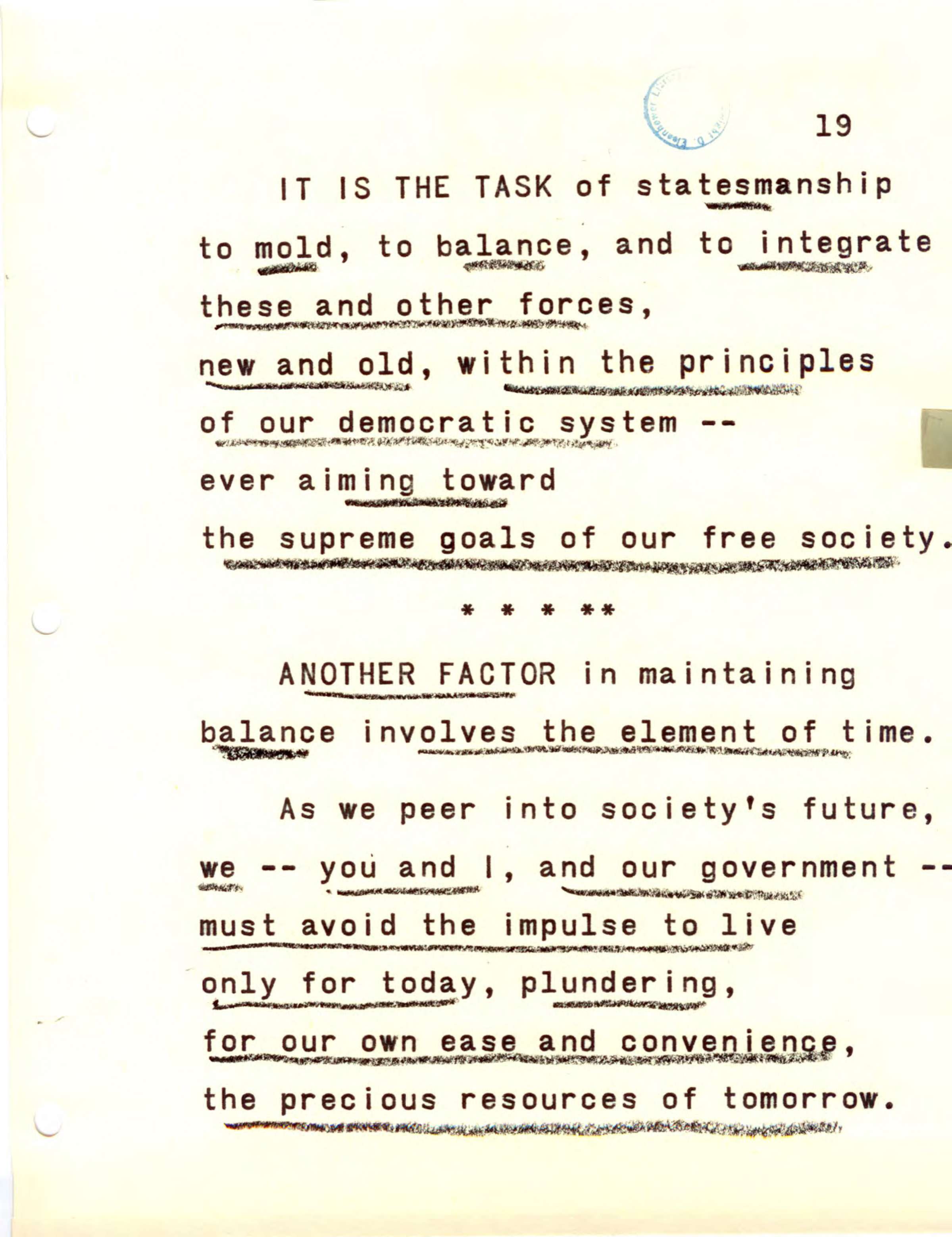
Een andere factor bij het handhaven van het evenwicht is het element tijd. Terwijl we in de toekomst van de samenleving kijken, moeten wij – jij en ik, en onze regering – de impuls vermijden om alleen voor vandaag te leven, en voor ons gemak en comfort de kostbare hulpbronnen van morgen te plunderen. We kunnen de materiële bezittingen van onze kleinkinderen niet verpanden zonder het risico te lopen ook hun politieke en spirituele erfgoed te verliezen. We willen dat de democratie blijft bestaan voor alle toekomstige generaties, niet om het failliete spook van morgen te worden.
Over vrede, ontwapening, gelijkwaardigheid en breed dialoog
Langs de lange weg van de geschiedenis die nog moet worden geschreven, weet Amerika dat deze wereld van ons, die steeds kleiner wordt, moet vermijden een gemeenschap van vreselijke angst en haat te worden, en in plaats daarvan een trotse confederatie van wederzijds vertrouwen en respect moet zijn.
Zo’n confederatie moet er een van gelijken zijn. De zwaksten moeten met hetzelfde vertrouwen naar de vergadertafel komen als wij, beschermd als we zijn door onze morele, economische en militaire kracht. Die tafel, hoewel getekend door vele frustraties uit het verleden, kan niet worden verlaten leidend naar de zekere kwelling van het slagveld.
Ontwapening, met wederzijdse eer en vertrouwen, is een voortdurende noodzaak. Samen moeten we leren hoe we verschil kunnen maken, niet met wapens, maar met intellect en een eervol doel. Omdat deze behoefte zo scherp en duidelijk is, moet ik bekennen dat ik met een duidelijk gevoel van teleurstelling mijn officiële verantwoordelijkheden op dit gebied neerleg. Als iemand die getuige is geweest van de verschrikkingen en het aanhoudende verdriet van oorlog – als iemand die weet dat een nieuwe oorlog deze beschaving, die duizenden jaren zo langzaam en pijnlijk is opgebouwd – volledig zou kunnen vernietigen – zou ik vanavond willen zeggen dat er een blijvende vrede is in zicht.
Gelukkig kan ik zeggen dat oorlog is vermeden. Er is gestaag vooruitgang geboekt in de richting van ons uiteindelijke doel. Maar, er moet nog zoveel gebeuren. Als burger zal ik nooit ophouden al het mogelijke te doen om de wereld op die weg vooruit te helpen.
—
Farewell Address – January 17, 1961 by Dwight David Eisenhower (full text + mp3)
Dwight D. Eisenhower, official photo portrait May 29 1959
=========== =======================
About military-industrial complex
This conjunction of an immense military establishment and a large arms industry is new in the American experience. The total influence-economic, political, even spiritual-is felt in every city, every state house, every office of the Federal government. We recognize the imperative need for this development. Yet we must not fail to comprehend its grave implications. Our toil, resources and livelihood are all involved; so is the very structure of our society.
In the councils of government, we must guard against the acquisition of unwarranted influence, whether sought or unsought, by the military-industrial complex. The potential for the disastrous rise of misplaced power exists and will persist.
We must never let the weight of this combination endanger our liberties or democratic processes. We should take nothing for granted only an alert and knowledgeable citizenry can compel the proper meshing of huge industrial and military machinery of defense with our peaceful methods and goals, so that security and liberty may prosper together.
About scientific-technological elite
Akin to, and largely responsible for the sweeping changes in our industrial-military posture, has been the technological revolution during recent decades.
In this revolution, research has become central; it also becomes more formalized, complex, and costly. A steadily increasing share is conducted for, by, or at the direction of, the Federal government.
Today, the solitary inventor, tinkering in his shop, has been over shadowed by task forces of scientists in laboratories and testing fields. In the same fashion, the free university, historically the fountainhead of free ideas and scientific discovery, has experienced a revolution in the conduct of research. Partly because of the huge costs involved, a government contract becomes virtually a substitute for intellectual curiosity. For every old blackboard there are now hundreds of new electronic computers.
The prospect of domination of the nation’s scholars by Federal employment, project allocations, and the power of money is ever present and is gravely to be regarded.
Yet, in holding scientific research and discovery in respect, as we should, we must also be alert to the equal and opposite danger that public policy could itself become the captive of a scientific-technological elite.
About long term thinking and resources
Another factor in maintaining balance involves the element of time. As we peer into society’s future, we-you and I, and our government-must avoid the impulse to live only for today, plundering, for our own ease and convenience, the precious resources of tomorrow. We cannot mortgage the material assets of our grandchildren without risking the loss also of their political and spiritual heritage. We want democracy to survive for all generations to come, not to become the insolvent phantom of tomorrow.
About peace, disarmament, equality and mutual dialogue
Down the long lane of the history yet to be written America knows that this world of ours, ever growing smaller, must avoid becoming a community of dreadful fear and hate, and be, instead, a proud confederation of mutual trust and respect.
Such a confederation must be one of equals. The weakest must come to the conference table with the same confidence as do we, protected as we are by our moral, economic, and military strength. That table, though scarred by many past frustrations, cannot be abandoned for the certain agony of the battlefield.
Disarmament, with mutual honor and confidence, is a continuing imperative. Together we must learn how to compose difference, not with arms, but with intellect and decent purpose. Because this need is so sharp and apparent I confess that I lay down my official responsibilities in this field with a definite sense of disappointment. As one who has witnessed the horror and the lingering sadness of war-as one who knows that another war could utterly destroy this civilization which has been so slowly and painfully built over thousands of years-I wish I could say tonight that a lasting peace is in sight. Happily, I can say that war has been avoided. Steady progress toward our ultimate goal has been made. But, so much remains to be done. As a private citizen, I shall never cease to do what little I can to help the world advance along that road.
De naam van Erich Fromm komt me bekend voor en dan zie ik een artikel met fragmenten uit zijn boek over een kunst van liefhebben. Het gaat niet enkel over relaties, het gaat over brede menselijke roep om afgescheidenheid te overstijgen (“overcoming separateness”). Eerst staan hier citaten in het Nederlands, het fragment zelf is in het Engels.
“Er is bijna geen activiteit, geen onderneming, die gestart wordt met zo verschrikkelijk veel hoop en verwachtingen en die toch zo vaak mislukt, als de liefde.”
“Nauw verwant met deze factor is een tweede karakteristiek kenmerk van de hedendaagse samenleving. We leven in een cultuur van consumentisme, waar de voornaamste drijfveer van onze activiteit schijnt te bestaan uit het opwekken danwel bevredigen van kooplust, uit het verlangen een voor beide partijen gunstige ruil te doen.”
“Als een mens slechts één ander mens liefheeft en onverschillig is tegenover de rest van zijn medemensen, dan is zijn liefde geen liefde maar een symbiotische binding of een vernieuwd egoïsme.”
“Concentratie in de verhouding tot anderen betekent in de eerste plaats dat men kan luisteren.”
Over Erich Fromm
Duits-Amerikaans cultuurpsycholoog en filosoof. Een der belangrijkste vertegenwoordigers van de ‘Frankfurter Schule’. Vluchtte in 1934 uit Hitler-Duistland naar de VS waar hij aan vele universiteiten doceerde en directeur werd van het instituut voor psychoanalyse in Mexico-City. Hoofdthema in zijn werk is de dwingende invloed van de sociaal-culturele omgeving op de behoeften van het individu. In 1947 verscheen ‘Escape from Freedom’ en ‘Man for himself’. Later volgden ‘The sane society’ (1955) en ‘The anatomy of human destructiveness’ (1975). Fromm stelde de ziekmakende vervreemding van de mens in de moderne tijd aan de kaak en pleitte voor zelfontplooiing.
Love is not a sentiment which can be easily indulged in by anyone, regardless of the level of maturity reached by him. All his attempts for love are bound to fail, unless he tries most actively to develop his total personality, so as to achieve a productive orientation; that satisfaction in individual love cannot be attained without the capacity to love one’s neighbour, without true humility, courage, faith and discipline. In a culture in which these qualities are rare, the attainment of the capacity to love must remain a rare achievement. Or – anyone can ask himself how many TRULY loving persons he has known?
If two people who have been strangers, as all of us are, suddenly let the wall between them break down, and feel close, feel one, this moment of oneness is one of the most exhilarating, most exciting experiences in life.
It is all the more wonderful and miraculous for persons who have been shut off, isolated, without love. This miracle of sudden intimacy is often facilitated if it is combined with, or initiated by, sexual attraction and consummation. However, this type of love is by its very nature not lasting.
The two persons become well acquainted, their intimacy loses more and more of its miraculous character, until their antagonism, their disappointments, their mutual boredom kill whatever is left of the initial excitement. Yet, in the beginning they do not know all this: in fact, they take the intensity of the infatuation, this being “crazy” about each other, for proof of the intensity of their love, while it may only prove the degree of their preceding loneliness. There is hardly any activity, any enterprise, which is started with such tremendous hopes and expectations, and yet, which fails so regularly, as love. If this were the case with any other activity, people would be eager to know the reasons for the failure, and to learn how one could do better – or they would give up the activity.
The first thing we have to learn is that love is an art, just as living is an art; if we want to learn how to love we must proceed in the same way we have to proceed if we want to learn any other art. Maybe here lies the answer to the question of why people in our culture try so rarely to learn this art, in spite of their obvious failures: in spite of the deep-seated craving for love, almost everything else is considered to be more important than love: success, prestige, money, power – almost all our energy is used for learning of how to achieve these aims, and almost none to learn the art of loving.
Could it be that only these things are considered worthy of being learned with which one can earn money or prestige, and that love, which ONLY profits the soul, but is profitless in the modern sense, is a luxury we have no right to spend much energy on?
Man can only go forward by developing his reason, by finding a new harmony, a human one, instead of the prehuman harmony which is irretrievably lost.
Man is gifted with reason; he is life being aware of itself. This awareness of himself as a separate entity, the awareness of his own short life span, of the fact that he will die before those whom he loves, or they before him, the awareness of his aloneness and separateness, of his helplessness before the forces of nature and of society, all this makes his separate, disunited existence an unbearable prison. He would become insane could he not liberate himself from this prison and reach out, unite himself in some form or other with others, with the world outside.
The experience of separateness arouses anxiety; it is, indeed, the source of all anxiety. Being separate means being cut off, without any capacity to use my human powers. Beyond that, it arouses shame and the feeling of guilt. This experience of guilt and shame in separateness is expressed in the Biblical story of Adam and Eve… whereby recognising their separateness they remain strangers, because they have not yet learned to love each other; Adam defends himself by blaming Eve rather than trying to defend her.
The deepest need of man, then, is the need to overcome his separateness, to leave the prison of his aloneness. The absolute failure to achieve this aim means insanity, because the panic of complete isolation can be overcome only by such a radical withdrawal from the world outside that the feeling of separation disappears – because the world outside, from which one is separated, has disappeared.
In society the union with the group is the prevalent way of overcoming separateness. It is a union in which the individual self disappears to a large extent, and where the aim is to belong to the herd. If I am like everybody else, if I have no feelings or thoughts which make me different, if I conform in custom, dress, ideas, to the pattern of the group, I am saved; saved from the frightening experience of aloneness.
The dictatorial systems use threats and terror to induce this conformity; the democratic countries – suggestion and propaganda. But in spite of this difference the democratic societies show an overwhelming degree of conformity. The reason lies in the fact that there has to be an answer to the quest for union, and if there is no other or better way, then the union of herd conformity becomes the predominant one. One can only understand the fear to be different, the fear to be only a few steps away from the herd, if one understands the depths of the need not to be separated.
Most people are not even aware of their need to conform. They live under the illusion that they follow their own ideas and inclinations, that they are individualists, that they have arrived at their opinions as the result of their own thinking – and that it just happens that their ideas are the same as of the majority. The consensus of all serves as a proof for the correctness of “their” ideas. Since there is still a need to feel some individuality, such a need is satisfied with regard to minor differences; the initials on the handbag or sweater, the belonging to the Democrat rather than the Republican party, to the Elks instead of the Shriners become the expression of individual differences. The advertising slogan of “it is different” shows up this pathetic need for difference, when in reality there is hardly any left.
Union by conformity is not intense and violent; it is calm, dictated by routine, and for this very reason often is insufficient to pacify the anxiety of separateness. The incidence of alcoholism, drug addiction, compulsive sexualism, and suicide in contemporary society are symptoms of this relative failure of herd conformity.
This desire for interpersonal fusion is the most powerful striving in man. It is the most fundamental passion, it is the force which keeps the human race together. The failure to achieve it means insanity or destruction – self destruction or the destruction of others. Without love humanity could not exist.
Mature love is union under the condition of preserving one’s integrity, one’s individuality. Love is an active power in man, a power which breaks through the walls which separate man from his fellow men, which unites him with others; love makes him overcome the sense of isolation and separateness, yet permits him to be himself, to retain his integrity. In love the paradox occurs that two beings become one and yet remain two.
Spinoza arrives at the conclusion that virtue and power are one and the same. Envy, jealousy, ambition towards any kind of greed are passions; love is an action, the practice of human power, which can be practised only in freedom and never as a result of a compulsion.
Love is primarily giving, not receiving. Giving is the highest expression of potency. Giving is more joyous than receiving, not because it is deprivation, but because in the act of giving lies the expression of my aliveness.
Whoever is capable of giving himself is rich. He experiences himself as one who can confer of himself to others. He gives of himself, of the most precious thing he has, he gives of his life. He gives what is live in him; he gives his joy, his interest, his understanding, his knowledge, his humour, his sadness, he gives of all the expressions and manifestations of that which is alive in him.
In thus giving of his life, he enriches the other person, he enhances the others sense of aliveness by enhancing his own sense of aliveness. In giving he cannot help bringing something to life in the other person, and this which is brought to life reflects back to him and they both share in the joy of what they have brought to life.
Love is a power which produces love. You can exchange love only for love, confidence for confidence, etc. If you wish to enjoy art, you must be an artistically trained person; if you wish to have an influence on other people you must be a person who has a really stimulating and furthering influence on other people.
In the Book of Jonah, God explains to Jonah that the essence of love is to labour for something and to make something grow, that love and labour are inseparable. One loves that for which one labours, and one labours for that which one loves.
Care and concern imply another aspect of love. Today responsibility is often meant to denote duty, something imposed on one from the outside. But responsibility, in its TRUE sense, is an entirely voluntary act; it is my response to the needs of others. The loving person responds.
Responsibility could easily deteriorate into domination and possessiveness, were it not for a third component of love, respect. Respect is not fear or awe; it denotes the ability to see a person as he/she is, to be aware of the unique individuality. Respect means the concern that the other person should grow and unfold as they are. Respect, thus, implies the absence of exploitation. I want the loved person to grow and unfold for their own sake, and not for the purpose of serving me. If I love the other person, I feel one with him or her, but with them as they are, not as I need them to be as an object for my use. It is clear that respect is only possible if I have achieved independence, without having to exploit anyone else. Respect exists only on the basis of freedom, for love is the child of freedom, never that of domination.
To respect a person is not possible without knowing him; care and responsibility would be blind if they were not guided by knowledge.
Knowledge would be empty if it were not motivated by concern. There are many layers of knowledge; the knowledge which is an aspect of love is one which does not stay at the periphery, but penetrates to the core. It is possible only when I can transcend the concern for myself and see the other person in his own terms.
Care, responsibility, respect and knowledge are mutually interdependent. They are a syndrome of attitudes which are to be found in the mature person; that is the person who develops his own powers productively, who wants only to have that which he has worked for, who has given up narcissistic dreams of omniscience and omnipotence, who has acquired humility based on inner strength which only genuine productive activity can give.
If a person loves only one other person and is indifferent to the rest of his fellow men, his love is not love but a symbiotic attachment, or an enlarged egotism. Yet most people believe that love is constituted by the object, not by the faculty. In fact, they even believe that it is proof of the intensity of their love when they do not love anybody except the “loved” person. This is the same fallacy which I have already mentioned above. Because one does not see that love is an activity, a power of the soul, one believes that all that is necessary to find is the right object – and that everything goes by itself afterward. This attitude can be compared to that of the man who wants to paint but who, instead of learning the art, claims that he just has to wait for the right object – and that he will paint beautifully when he finds it. If I truly love one person I love all persons, I love the world, I love life. If I can say to somebody else, “I love you,” I must be able to say, “I love in you everybody, I love through you the world, I love in you also myself.”
The most fundamental kind of love, which underlies all types of love, is brotherly love. By this I mean the sense of responsibility, care, respect, knowledge of any other human being, the wish to further his life. This is the kind of love the Bible speaks about when it says: Love your neighbour as yourself. Brotherly love is love for all human beings; it is characterized by its very lack of exclusiveness. If I have developed the capacity for love, then I cannot help loving my brothers. In brotherly love there is the experience of union with the whole of mankind, of human solidarity. Brotherly love is based on the experience that we’re all one.
The differences in talents, intelligence, knowledge are negligible in comparison with the identity of the human core common to all men. In order to experience this identity, it is necessary to penetrate from the periphery to the core. If I perceive in another person mainly the surface, I perceive mainly differences, that which separates us. If I penetrate to the core, I perceive our identity, the fact of out brotherhood.
Love of the helpless, the poor and the stranger, are the beginning of brotherly love. To love one’s flesh and blood is no achievement. The animal loves its young and cares for them. Only in the love of those who do not serve a purpose, does love begin to unfold. Compassion implies the element of knowledge and identification. “You know the heart of the stranger,” says the Bible, “for you were strangers in the land of Egypt;… therefore love the stranger!”
The greatest impediment of mankind is not disease … it is despair.
Extracts from – The Art of Loving – By Erich Fromm