Tags: CME, moon, sun, zon, zonneactiviteit
- Dit onderwerp bevat 10 reacties, 2 deelnemers, en is laatst geüpdatet op 31 juli 2023 at 21:17 door Anna.
-
AuteurBerichten
-
-
29 oktober 2021 om 16:15 #6223Anna@akrasko97
2021 10 29 spaceweather.com
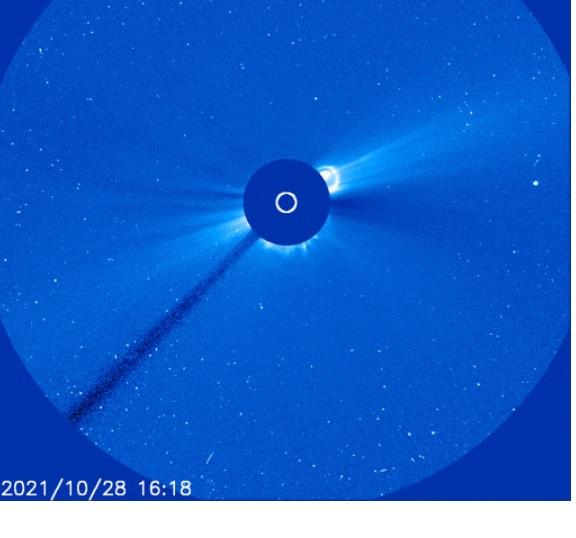
GEOMAGNETIC STORM WATCH: Een sterke geomagnetische storm van de G3-klasse is mogelijk op 30 oktober wanneer de CME (Corona Mass Ejection) van de X1-flare van gisteren naar verwachting het magnetische veld van de aarde zal raken. Dergelijke stormen kunnen aurora’s met het blote oog veroorzaken tot ver in het zuiden als Illinois en Oregon (meestal 50° geomagnetische breedtegraad) en fotografische aurora’s op nog lagere breedtegraden. Kleinere stormen van de G1- en G2-klasse kunnen tijdens Halloween aanhouden als de aarde door het kielzog van de CME gaat.
(EN) GEOMAGNETIC STORM WATCH: A strong G3-class geomagnetic storm is possible on Oct. 30th when the CME from yesterday’s X1-flare is expected to hit Earth’s magnetic field. Such storms can spark naked-eye auroras as far south as Illinois and Oregon (typically 50° geomagnetic latitude) and photographic auroras at even lower latitudes. Lesser G1 and G2-class storms could persist through Halloween as Earth passes through the CME’s wake.
Source: https://spaceweather.com/?fbclid=IwAR01DHxD17D0F3C4If-kUrRKnN3bSKNx83F7ug_mBdxoKuNI2hy8G8tvUQQ
- Dit onderwerp is gewijzigd 3 jaren, 5 maanden geleden door Anna.
-
4 maart 2022 om 10:56 #8027Anna@akrasko97
Scientists gearing up for rocket body’s March 4 moon crash
Source: https://www.space.com/rocket-moon-crash-march-4-scientific-excitement
A wayward rocket stage is poised to bombard the moon on Friday (March 4 2022), and the coming impact has earned some scientific attention.
https://www.youtube.com/watch?v=fGfSlADqxFg
Reportedly, the Goldstone Solar System Radar near Barstow, California, is set to observe the object a few days before impact. And NASA’s Lunar Reconnaissance Orbiter (LRO) will look for changes in the moon’s exosphere — a very thin layer of gases — due to the crash and then later scan the lunar surface for the impact crater itself.
The rocket stage is on track to slam into Hertzsprung Crater on the far side of the moon on Friday at 7:25 a.m. EST (1225 GMT). The impact will mark the first time a piece of space junk accidentally smacks into the lunar surface, experts say. (This doesn’t count the spacecraft that have crashed while attempting to land on the moon, or rocket bodies intentionally steered into Earth’s nearest neighbor.)
Rocket body identified
Originally, the rocket body was thought to be the upper stage of the SpaceX Falcon 9 rocket that launched the U.S. National Oceanic and Atmospheric Administration’s Deep Space Climate Observatory (DSCOVR) in 2015.
However, the object is now tied to the Chinese Long March 3C rocket that launched China’s Chang’e 5-T1 mission in 2014. Chang’e 5-T1 looped behind the moon and returned to Earth to test atmospheric re-entry capabilities for 2020’s Chang’e 5 lunar sample return mission. Chang’e 5-T1 also carried a secondary payload of scientific instruments in the upper stage of the Long March rocket on behalf of the Luxembourg-based company LuxSpace.
Among the people who have made the China connection is Bill Gray, the manager of Project Pluto, which supplies astronomical software, both commercial and free, to amateur and professional astronomers.
“There really is no good reason at this point to think the object is anything other than the Chang’e 5-T1 booster,” Gray told Inside Outer Space last month. “Anybody claiming otherwise has a pretty large hill of evidence to overcome.”
Cratering process
The March 4 crash will be broadly similar to impacts that occurred during NASA’s Apollo program, when the third stages of huge Saturn V rockets were intentionally steered into the moon. In both cases, the moon-smacking projectile is more or less a tin can, explained Jeffrey Plescia, a planetary scientist at the Johns Hopkins University’s Applied Physics Laboratory in Maryland.
“The result is that a lot of the energy goes into crushing the projectile rather than excavating the crater,” Plescia told Inside Outer Space.
The Saturn V third stages created craters that are shallower than natural craters and sport an asymmetric shape, related for the most part to the low impact angle, Plescia added. “Always good to know the parameters of the projectile for better understanding the cratering process,” he said.
Plescia noted that crater depth and other characteristics of the impact event will be more reliably measured for the March 4 crash, as pre-impact images have already been taken by LRO’s powerful camera system.
“The only uncertainty at the moment is the orientation of the booster with respect to the trajectory. It is spinning, but whether it is just turning in rotisserie mode or tumbling is not clear,” Plescia said. “I would hope the Chinese actually know this and would be forthcoming.”
-
30 juni 2022 om 19:56 #9377Anna@akrasko97
Gravitas: Mysterious rocket crash on moon baffles scientists
Video impact (met 2 kraters) https://www.youtube.com/watch?v=qFOibCRYwnI (3:17)
A mystery rocket has crashed into moon creating two large craters. Scientists are baffled, they don’t know where the rocket came from & why the impact was spread over two distinct areas. Palki Sharma reports.
-
-
5 maart 2022 om 14:10 #8049Anna@akrasko97
Massive solar telescope starts science observations
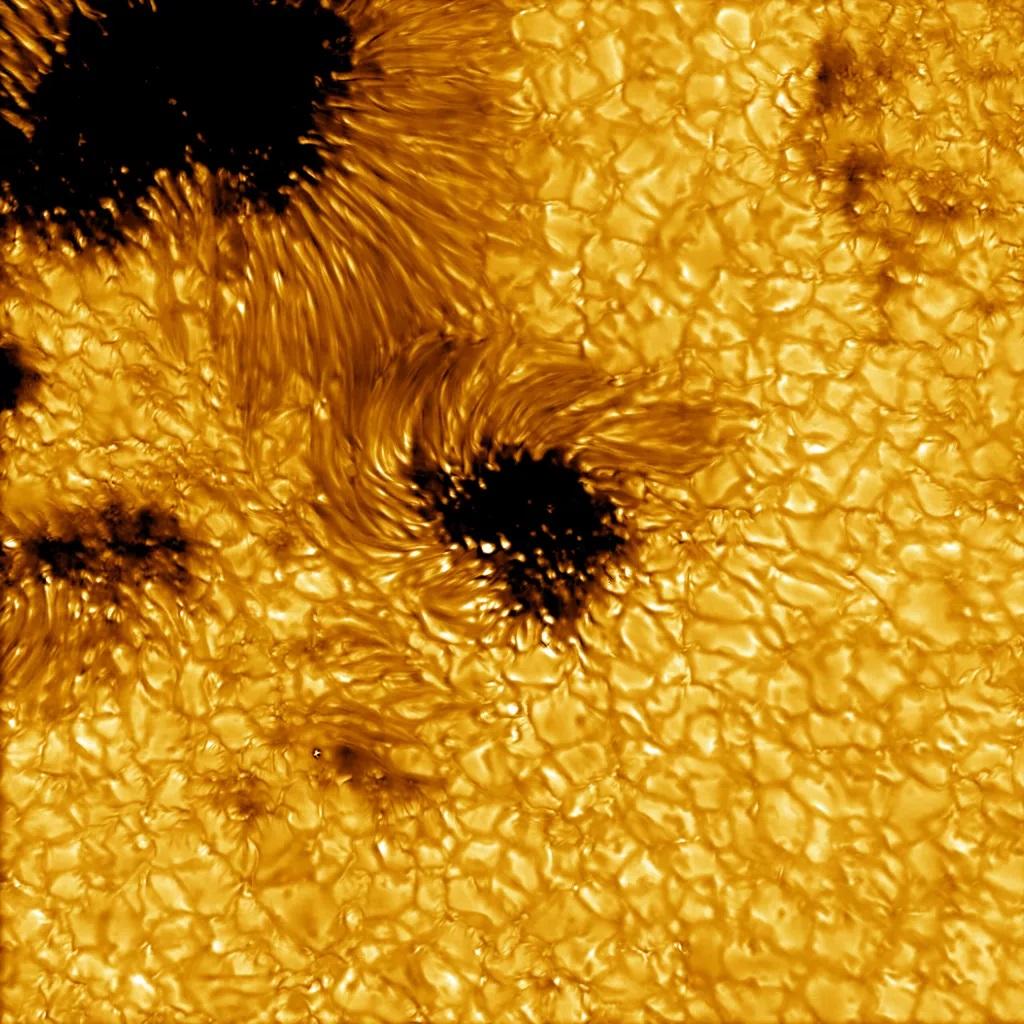
A newly released photograph of the sun captured by the Daniel K. Inouye Solar Telescope on May 11, 2021. (Image credit: NSO/AURA/NSF)
The observatory’s first experiment will look at a theorized process on the sun’s surface.
The Daniel K. Inouye Solar Telescope (DKIST) is starting its first operational science work as it embarks on a mission to better understand our sun.
DKIST is a nearly $300 million science observatory perched atop the 10,062-foot (3,067 meters) Mount Haleakalā in Maui, Hawaii. One of its main functions will be to study the corona, the incredibly hot outer atmosphere of the sun that is millions of degrees hotter than the surface.
The first experiment will study “magnetic reconnection,” which happens when solar magnetic fields suddenly reconfigure and create jets of superheated gas (or plasma) that eject from the solar atmosphere. The work is led by Tetsu Anan, principal investigator with the National Solar Observatory.
“This process has long been theorized, but has yet to be proven,” the National Science Foundation (NSF), which manages the observatory, said in a statement Thursday (Feb. 24) announcing the science commissioning phase.
“Observations from the Inouye Solar Telescope’s unique suite of instruments are allowing scientists to observe this elusive but vital phenomenon for the very first time,” NSF added of magnetic reconnection.
Space weather has come under scrutiny from numerous telescopes and spacecraft in the last few decades, including two recent missions — the U.S.-European Solar Orbiter and NASA’s Parker Solar Probe — that are conducting daring close-up orbits of the sun to study solar structure in high definition.
DKIST will work with various other telescopes and spacecraft to “take high-resolution images and make measurements of the magnetic fields of solar phenomena including sunspots, solar flares, and coronal mass ejections,” NSF said. Coronal mass ejections are explosions of charged particles from the sun that, if pointed towards Earth, can disrupt power lines and satellite communications.
The operations period will last roughly a year, bringing online key systems while allowing scientists to conduct observations with “shared risk” of technical problems that may need to be solved along the way, NSF said.
“First light” for the telescope took place in 2020, but there was an 18-month delay in completing construction due to the coronavirus pandemic, NSF noted. Unique features of the observatory include a 4-meter (13 feet) primary mirror coupled with advanced adaptive optics to correct for atmospheric effects. The telescope also has active cooling of its optics to protect against solar heat.
Source: https://www.space.com/dkist-sun-telescope-starts-science-commissioning
-
24 maart 2022 om 10:31 #8259Jort@jortus
Doet mij denken aan de zonnebloemen van Van Gogh. 😄
-
14 juni 2022 om 18:52 #9197Anna@akrasko97
Solar Orbiter captures closest ever images of the Sun
Video: https://www.youtube.com/watch?v=D15vSRtZpXs (1:08)
Solar Orbiter has returned spectacular imagery of the Sun during its first close encounter with our home star. Detailed new footage taken from within the orbit of planet Mercury shows a curious solar ‘hedgehog’, which stretches 25,000 kilometres across the Sun and has a multitude of spikes of hot and colder gas that reach out in all directions. Solar Orbiter’s mission will allow scientists to better understand space weather forecasting from Earth.
-
16 juli 2022 om 20:50 #9487Anna@akrasko97
The Fastest Comet Ever Recorded Is PASSING Earth TODAY! – 16 juli 2022
https://www.youtube.com/watch?v=Dz9fEziKMBk
=========================================
De Zon – 16-07-2022
Veel zonneactiviteit waargenomen – zonnevlekken en plasma explosies / CME of zonnewind. Een plaatje van vandaag
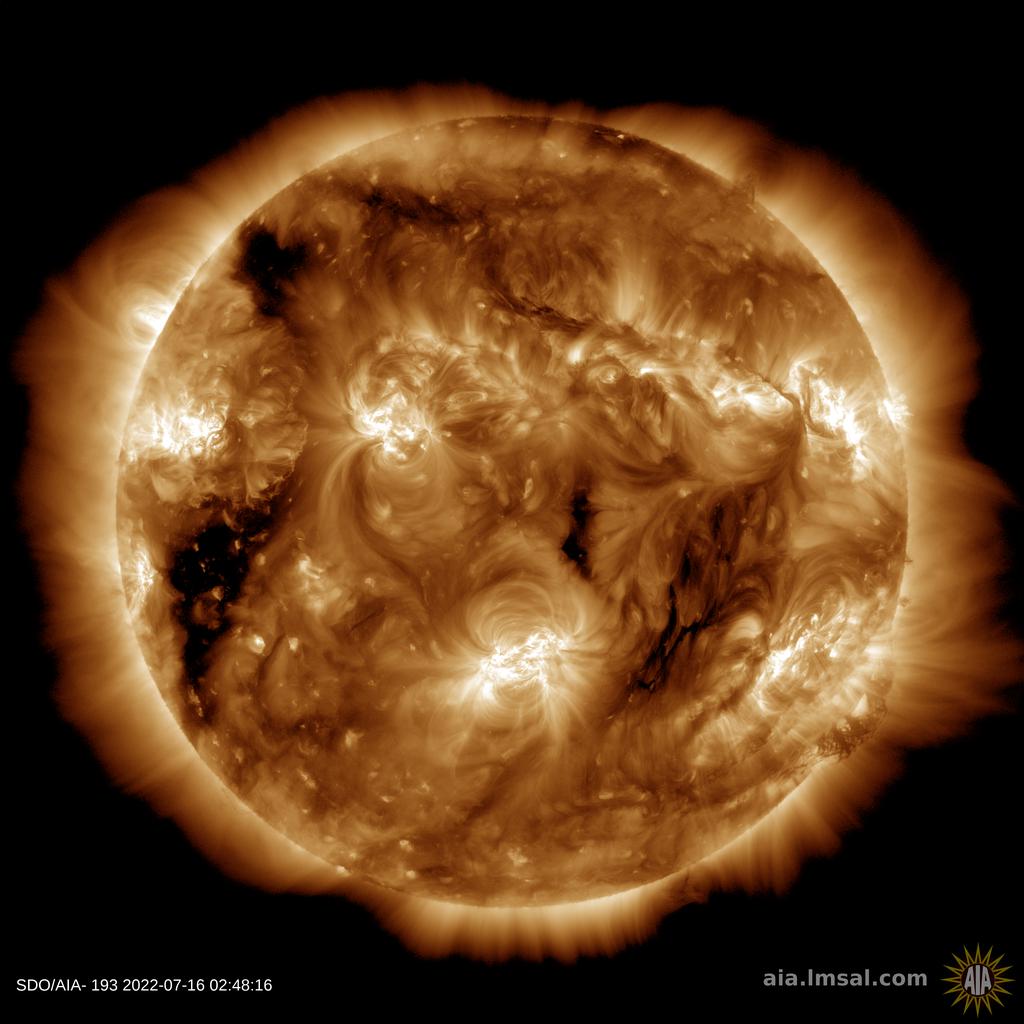
GEOMAGNETIC STORM WATCH: Minor G1-class geomagnetic storms are possible on July 20th or 21st when a slow-moving CME is expected to hit Earth’s magnetic field. The CME was hurled into space by yesterday’s ‘canyon of fire’ eruption, described below. Solar flare alerts: SMS Text.
A ‘CANYON OF FIRE’ JUST OPENED ON THE SUN: A dark filament of magnetism whipsawed out of the sun’s atmosphere on July 15th, carving a gigantic ‘canyon of fire.’ NASA’s Solar Dynamics Observatory recorded the eruption:
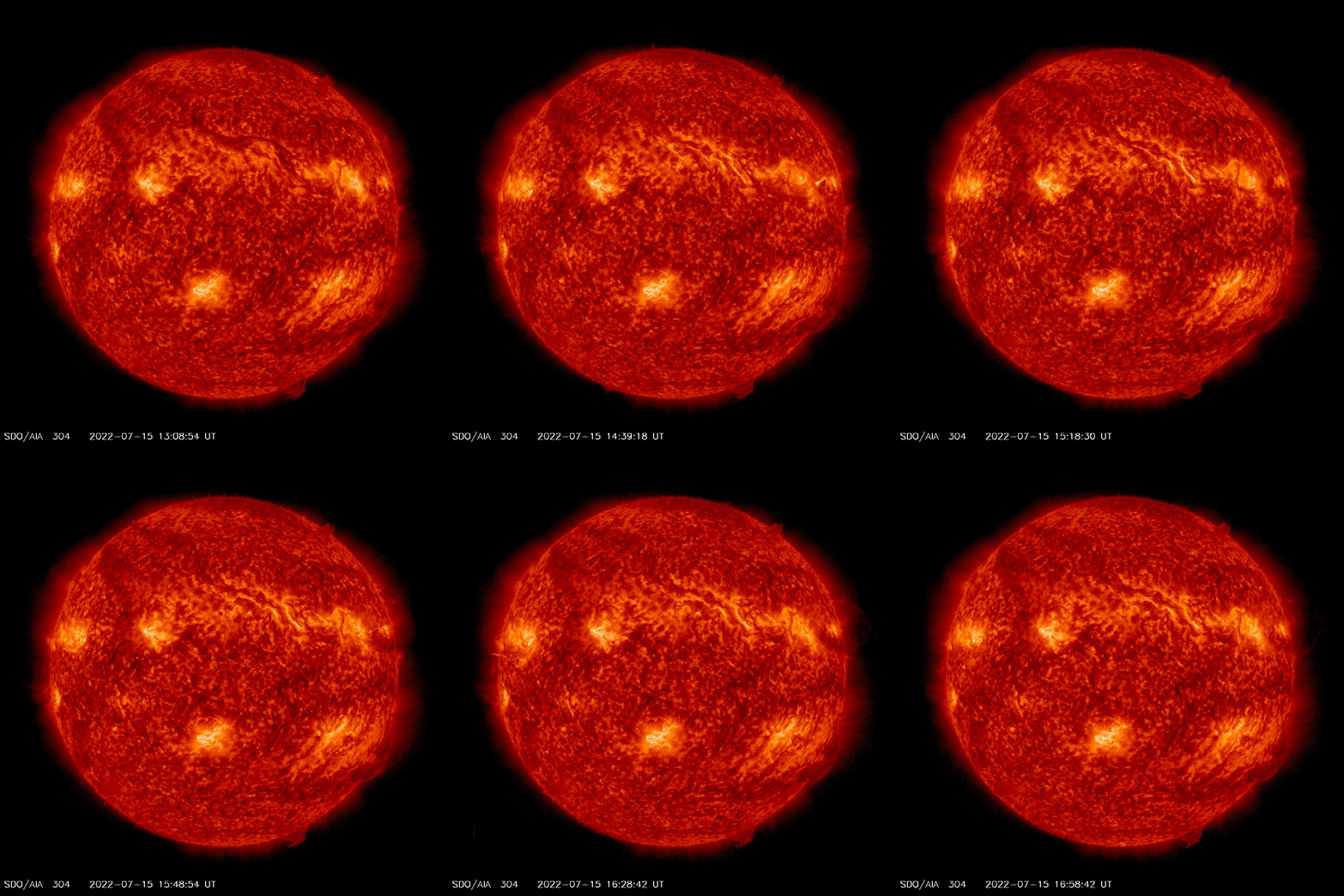
The walls of the canyon, which stretch diagonally across the video, are 20,000 km high and 10 times as long. They trace the channel where the filament was suspended by magnetic forces above the sun’s surface, before instabilities flung it skyward.
Soon after the eruption, the Solar and Heliospheric Observatory (SOHO) saw a partial halo CME emerging from the sun’s northern hemisphere. Play the movie. NOAA analysts say the CME could hit Earth’s magnetic field on July 20th or 21st. The CME is a slow mover, but even slow CMEs can cause minor geomagnetic storms.
-
24 augustus 2022 om 07:59 #9992Anna@akrasko97
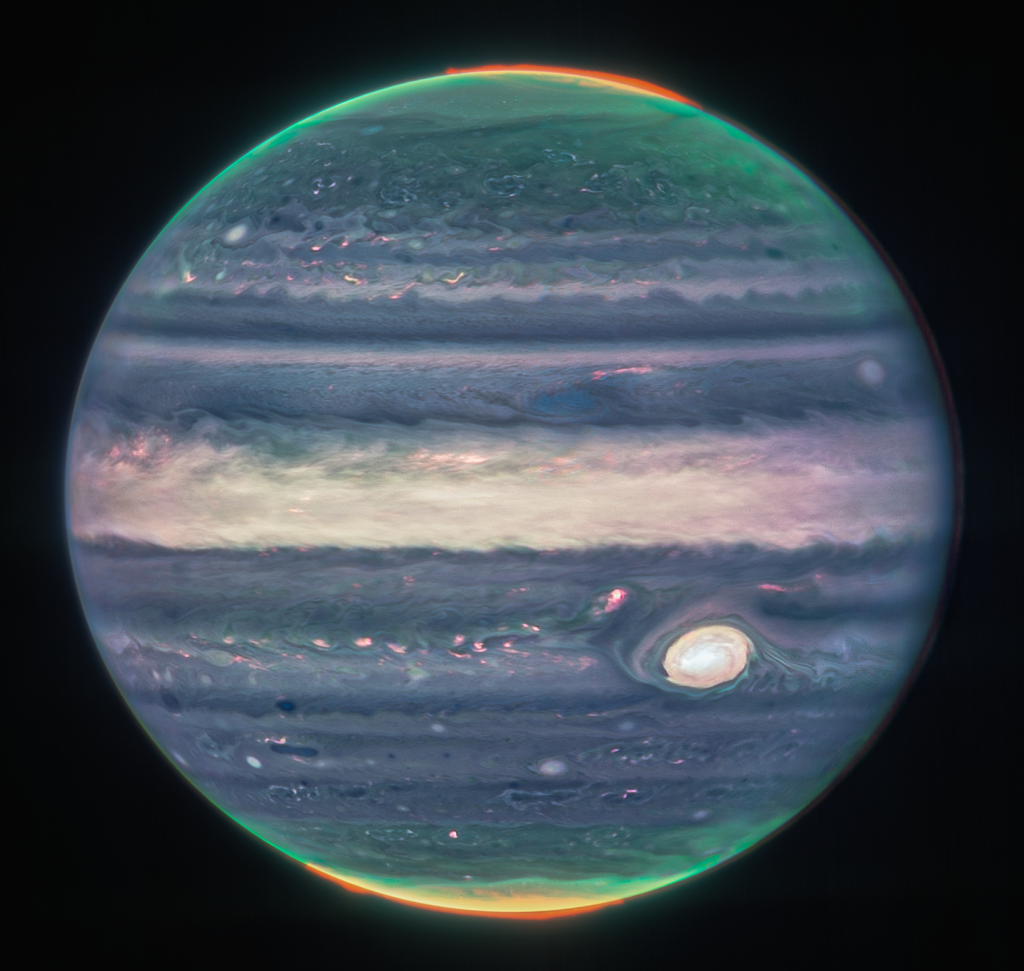
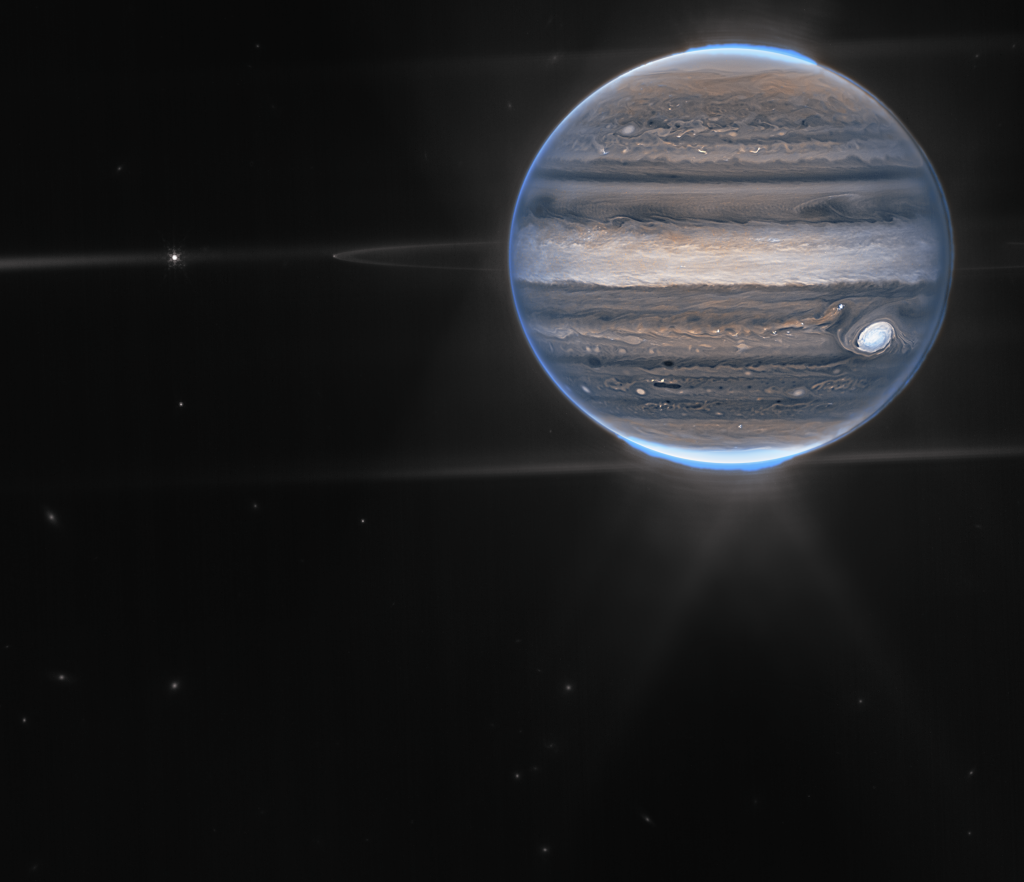
James Webb telescope – nieuwe beelden van Jupiter
Source: https://blogs.nasa.gov/webb/2022/08/22/webbs-jupiter-images-showcase-auroras-hazes/
In het NL: https://www.nu.nl/tech/6219288/nasa-toont-spectaculaire-nieuwe-beelden-van-planeet-jupiter.html
-
13 oktober 2022 om 11:54 #10534Anna@akrasko97
Solar Orbiter speeds towards its next rendezvous with the Sun
The ESA-led Solar Orbiter mission arrives at its next close approach to the Sun on 12 October 2022 at 19:12 UTC (21:12 CEST). This sequence of images shows the progress of the ESA/NASA spacecraft as it heads inwards on its voyage of discovery. The sequence begins on 20 September and finishes on 10 October.
The sequence was taken by the Extreme Ultraviolet Imager (EUI) using the Full Sun Imager (FSI) telescope, and shows the Sun at a wavelength of 17 nanometers. This wavelength is emitted by gas in the Sun’s atmosphere with a temperature of around one million degrees. The colour on this image has been artificially added because the original wavelength detected by the instrument is invisible to the human eye. From: https://www.esa.int/ESA_Multimedia/Videos/2022/10/Solar_Orbiter_speeds_towards_its_next_rendezvous_with_the_Sun
☀️⤴️🛰 #SolarOrbiter is making a close approach of the Sun NOW!
This sequence shows the approach using data from 20 Sept-10 Oct 👇
📹https://t.co/GhTJXIT5j9 #WeAreAllSolarOrbiters #ExploreFarther pic.twitter.com/4iuknjKDet
— ESA's Solar Orbiter (@ESASolarOrbiter) October 12, 2022
-
14 april 2023 om 14:07 #13179Anna@akrasko97
What time is the rare hybrid solar eclipse on April 20 2023?
On April 20, 2023, there will be a rare hybrid solar eclipse.
Unfortunately for the vast majority of the world, it won’t be observable. However, for those in Western Australia, East Timor, and the eastern Indonesian islands, get ready to see the show of a lifetime.
This eclipse is known as a hybrid eclipse because it will shift from a total eclipe to an annular solar eclipse as the moon’s shadow races over Earth. For some locations in the solar eclipse’s path, viewers will witness a total solar eclipse, whereas in other parts, they’ll witness the ring-like annular solar eclipse. In both cases, the moon will pass between the Earth and the sun, blocking out all or most of the sun’s light across a portion of the Earth’s surface.
The eclipse will begin at 9:36 p.m. EDT on April 19 (0136 GMT on April 20) and end at 2:59 a.m. EDT (0659 GMT) on April 20, according to In the Sky(opens in new tab). Because the eclipse will be visible first in the Indian Ocean and then over the Pacific, it will already be April 20 local time during the event.
Totality will occur in the following locations and times:
Western Australia: From 10:29 p.m. to 10:35 p.m. EDT on April 19 (0229 to 0235 GMT on April 20)
East Timor: From 11:19 p.m. to 11:22 p.m. EDT on April 19 (0319 to 0322 GMT on April 20)
Indonesia: From 11:23 p.m. to 11:58 p.m. EDT on April 19 (0323 to 0358 GMT on April 20)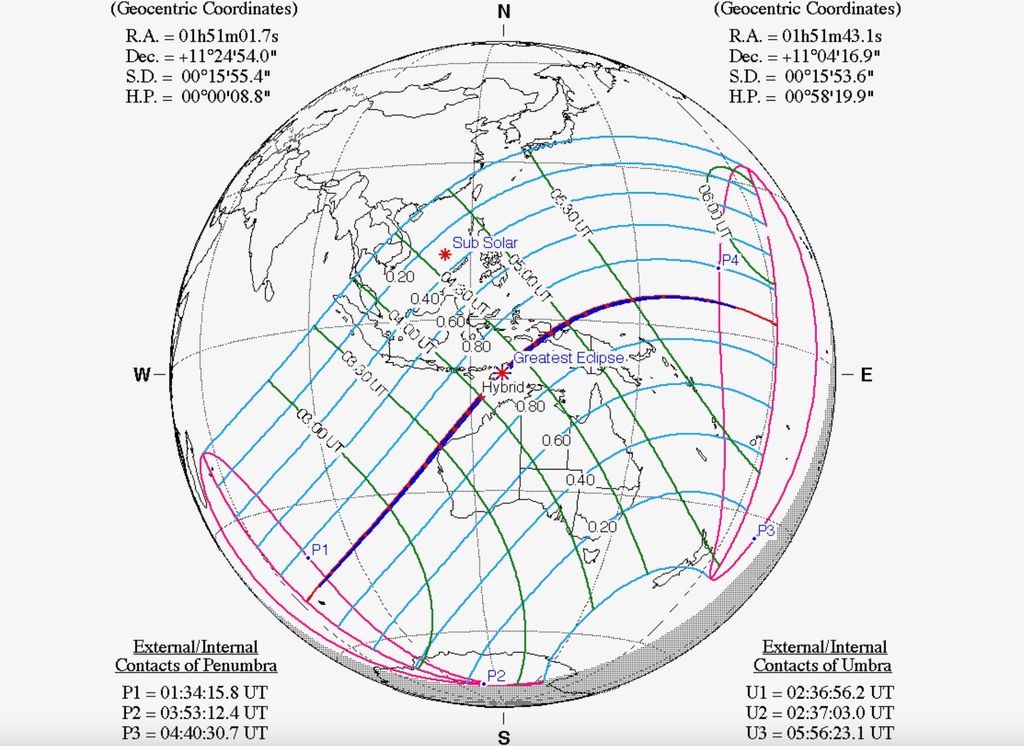
Map showing where the hybrid solar eclipse of April 20, 2023 will be visible. (Image credit: Fred Espenak/NASA Goddard Space Flight Center)Timeanddate.com, for instance, will be streaming the solar eclipse live, which you can watch here .
Source: https://www.space.com/hybrid-solar-eclipse-what-time-april-2023
-
31 juli 2023 om 21:17 #14125Anna@akrasko97
Naar de Zon kijken – Watching the Sun
Simon maakt regelmatig afbeeldingen en ook korte filmpjes die heel scherp de oppervlakte en verschillende verschijnselen op de Zon laten zien. En hij deelt zijn techniek en beeldmateriaal.
Het is prachtig om te zien.
-
-
AuteurBerichten
- Je moet ingelogd zijn om een antwoord op dit onderwerp te kunnen geven.