
Tags: brain, English, neuroscience
- Dit onderwerp bevat 0 reacties, 1 deelnemer, en is laatst geüpdatet op 2 januari 2022 at 19:22 door Anna.
-
AuteurBerichten
-
-
2 januari 2022 om 19:22 #7288Anna@akrasko97
(in English / NL machinevertaling onder) Neuroscientists Uncover A Sensory “Gateway” in the Brain
(by Elana Spivack, Inverse) AT ANY GIVEN MOMENT, your brain notes millions of observations: the music in your headphones, the temperature of your water as you sip it, the proximity of the stranger next to you on the subway. If you noticed every single thing the brain picks up on, you’d be overwhelmed in seconds. So, why aren’t you? What’s filtering the “good” information from the “unnecessary” information?
The brain, of course. Yet how the brain manages to filter sensory stimuli to let only the most important pass into conscious noticing is a long-standing mystery in neuroscience — but a discovery made earlier this year could unravel the enigma once and for all.
THE DISCOVERY — In a study published earlier this year in the journal Cell Reports, neuroscientists reveal the location of the brain’s consciousness filter — a region the paper’s authors call a “gateway” to consciousness.
“The findings reveal a gateway in the cortex where sensory information has to pass through in order to reach its destination (conscious access),” co-author Zirui Huang told Inverse at the time. Huang is a research investigator at the University of Michigan Medical School.
DIGGING INTO THE DETAILS — According to the study, information processing in the brain is a two-step process:
Step 1: The body processes external stimuli — everything you see, hear, smell, touch, and taste — on an unconscious level
Step 2: The brain sorts through these signals and chooses which information is most important to bring to consciousness — like a bird flying straight into your face
The team wanted to pinpoint the exact mechanism that made the leap from Step 1 to Step 2 — what brought unconscious sensory stimuli to light? To answer this question, they conducted two experiments using brain scans called functional magnetic resonance imaging (fMRI).
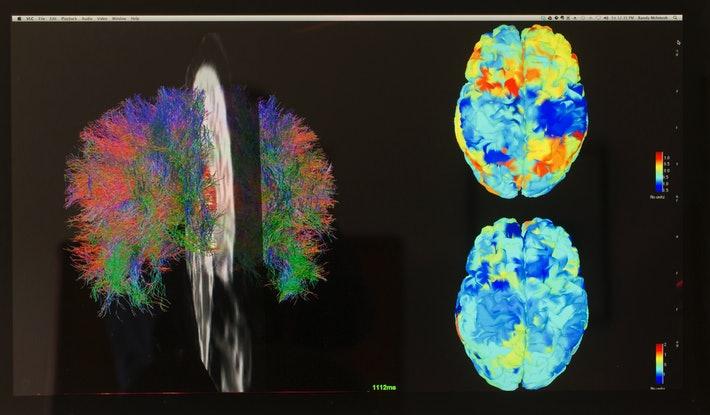
An fMRI of a brain. Rick Madonik/Toronto Star/Getty Images
EXPERIMENT ONE — Participants were asked to imagine doing three complex tasks: playing tennis, navigating a place, and squeezing someone’s hand, and then asked to do a motor task (squeezing a ball).
When someone imagines executing an action, the brain region in charge of controlling movement becomes active, but other parts of the brain remain active, too. But when someone actually does a motor task, these other parts of the brain quieten — our focus prioritizes the activity.
During the experiment, the participants received various doses of an anaesthetic to see if this might reveal where in the brain the switch between conscious and unconscious processing might lie. Interestingly, this move highlighted activity in a brain area called the anterior insular cortex.
EXPERIMENT TWO — In the second experiment, participants watched a screen on which a face appeared for three-hundredths of a second, before switching to a high contrast image for much longer. The participants who reported seeing a face were found to have greater activity in their anterior insular cortex than those who didn’t.
WHY IT MATTERS — The anterior insular cortex is thought to regulate emotions, like fear and love. More recently, other research suggests the area also directs “interoceptive” attention, which is the focus that we pay to certain sensory information. These fMRI findings confirm that hypothesis.
The anterior insular cortex requires more understanding in its role for human cognition and consciousness. But the next time you notice a cyclist who came out of nowhere or a dog that’s about to round the corner, you can thank your anterior insular cortex for it.
Source: INVERSE https://www.inverse.com/mind-body/sensory-gateway-brain
==========================================================
NL machinevertaling Neurowetenschappers ontdekken een sensorische “poort” in de hersenen
(door Elana Spivack, Inverse) OP ELK MOMENT noteren je hersenen miljoenen observaties: de muziek in je koptelefoon, de temperatuur van je water terwijl je eraan nipt, de nabijheid van de vreemdeling naast je in de metro. Als je alles zou opmerken dat de hersenen oppikken, zou je binnen enkele seconden overweldigd zijn. Dus, waarom ben jij dat niet? Wat filtert de “goede” informatie uit de “onnodige” informatie?
De hersenen natuurlijk. Maar hoe het brein erin slaagt om zintuiglijke prikkels te filteren om alleen de belangrijkste bewust te laten worden, is een al lang bestaand mysterie in de neurowetenschappen – maar een ontdekking die eerder dit jaar werd gedaan, zou het raadsel voor eens en voor altijd kunnen ontrafelen.
DE ONTDEKKING – In een studie die eerder dit jaar in het tijdschrift Cell Reports werd gepubliceerd, onthullen neurowetenschappers de locatie van het bewustzijnsfilter van de hersenen – een gebied dat de auteurs van de krant een “toegangspoort” tot bewustzijn noemen.
“De bevindingen onthullen een poort in de cortex waar sensorische informatie doorheen moet om zijn bestemming (bewuste toegang) te bereiken”, vertelde co-auteur Zirui Huang destijds aan Inverse. Huang is onderzoeker aan de University of Michigan Medical School.
GRAAG IN DE DETAILS — Volgens de studie is informatieverwerking in de hersenen een proces in twee stappen:
Stap 1: Het lichaam verwerkt externe prikkels – alles wat je ziet, hoort, ruikt, voelt en proeft – op een onbewust niveau
Stap 2: De hersenen sorteren deze signalen en kiezen welke informatie het belangrijkst is om naar het bewustzijn te brengen – zoals een vogel die recht in je gezicht vliegt
Het team wilde het exacte mechanisme lokaliseren dat de sprong van stap 1 naar stap 2 maakte – wat bracht onbewuste zintuiglijke prikkels aan het licht? Om deze vraag te beantwoorden, voerden ze twee experimenten uit met behulp van hersenscans, functionele magnetische resonantie beeldvorming (fMRI) genaamd.
Een fMRI van een brein. Rick Madonik/Toronto Star/Getty Images
EXPERIMENT EEN – De deelnemers werd gevraagd zich drie complexe taken voor te stellen: tennissen, een plaats navigeren en iemands hand knijpen, en vervolgens werd gevraagd om een motorische taak uit te voeren (in een bal knijpen).
Wanneer iemand zich voorstelt een actie uit te voeren, wordt het hersengebied dat verantwoordelijk is voor het regelen van beweging actief, maar andere delen van de hersenen blijven ook actief. Maar wanneer iemand daadwerkelijk een motorische taak uitvoert, worden deze andere delen van de hersenen rustiger – onze focus geeft prioriteit aan de activiteit.
Tijdens het experiment kregen de deelnemers verschillende doses verdoving om te kijken of dit zou kunnen onthullen waar in de hersenen de omschakeling tussen bewuste en onbewuste verwerking zou kunnen zitten. Interessant genoeg benadrukte deze beweging activiteit in een hersengebied dat de voorste insulaire cortex wordt genoemd.
EXPERIMENT TWEE — In het tweede experiment keken de deelnemers driehonderdste van een seconde naar een scherm waarop een gezicht verscheen, voordat ze veel langer overschakelden naar een afbeelding met hoog contrast. De deelnemers die aangaven een gezicht te zien, bleken meer activiteit te hebben in hun voorste insulaire cortex dan degenen die dat niet deden.
WAAROM HET BELANGRIJK IS – Men denkt dat de voorste insulaire cortex emoties reguleert, zoals angst en liefde. Meer recentelijk suggereert ander onderzoek dat het gebied ook “interoceptieve” aandacht richt, wat de focus is die we besteden aan bepaalde zintuiglijke informatie. Deze fMRI-bevindingen bevestigen die hypothese.
De voorste insulaire cortex vereist meer begrip in zijn rol voor menselijke cognitie en bewustzijn. Maar de volgende keer dat je een fietser opmerkt die uit het niets komt of een hond die op het punt staat de hoek om te gaan, kun je je voorste insulaire cortex daarvoor bedanken.
-
-
AuteurBerichten
- Je moet ingelogd zijn om een antwoord op dit onderwerp te kunnen geven.
Dit delen:
- Delen op X (Wordt in een nieuw venster geopend) X
- Share op Facebook (Wordt in een nieuw venster geopend) Facebook
- Delen op LinkedIn (Wordt in een nieuw venster geopend) LinkedIn
- Delen op Telegram (Wordt in een nieuw venster geopend) Telegram
- E-mail een link naar een vriend (Wordt in een nieuw venster geopend) E-mail