
- Dit onderwerp bevat 0 reacties, 1 deelnemer, en is laatst geüpdatet op 15 juli 2023 at 10:47 door Anna.
-
AuteurBerichten
-
-
15 juli 2023 om 10:47 #13950Anna@akrasko97
Moon Heat Anomaly Appears to Be a New Form of Lunar Volcanism
(ScienceAlert 7 July 2023) – vlakbij noordpool op de maan er is een plek gedetecteerd met een abnormaal hoge geothermische bron, zal het door graniet komen?
Graniet is bijna afwezig in het zonnestelsel buiten de aarde. Het bereiken van granietsamenstellingen in magmatische systemen vereist smelten en fractioneren in meerdere fasen, wat ook de concentratie van radiogene elementen verhoogt. Overvloedig water en platentektoniek vergemakkelijken deze processen op aarde en helpen bij het omsmelten. Hoewel deze drivers afwezig zijn op de maan, zijn er kleine granietmonsters gevonden, maar details over hun oorsprong en de schaal van de systemen die ze vertegenwoordigen zijn onbekend2. Hier rapporteren we microgolfgolflengtemetingen van een abnormaal hete geothermische bron die het best kan worden verklaard door de aanwezigheid van een granieten systeem met een diameter van ongeveer 50 kilometer onder de thoriumrijke farside-functie die bekend staat als Compton-Belkovich. Passieve microgolfradiometrie is gevoelig voor de geïntegreerde thermische gradiënt tot verschillende golflengten. Met de antennetemperaturen van 3–37 gigahertz van de Chang’e-1 en Chang’e-2 microgolfinstrumenten kunnen we een piekwarmteflux van ongeveer 180 milliwatt per vierkante meter meten, wat ongeveer 20 keer hoger is dan die van het gemiddelde maan hooglanden3,4. De verrassende omvang en geografische omvang van dit kenmerk impliceert een aardachtig, geëvolueerd granietsysteem dat groter is dan voor mogelijk werd gehouden op de maan, vooral buiten het Procellarum-gebied5. Bovendien zijn deze methoden generaliseerbaar: soortgelijk gebruik van passieve radiometrische gegevens zou onze kennis van geothermische processen op de maan en andere planetaire lichamen enorm kunnen vergroten. (Nature)
* * *
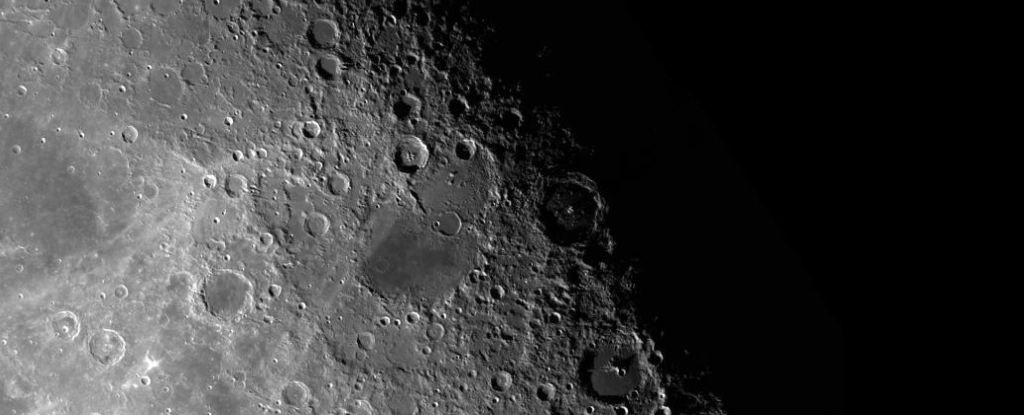
A massive blob of ancient granite has been found lurking beneath the Moon’s surface, evidence of a type of volcanism we’ve never seen there before.
Analysis suggests it’s a deeply buried giant mass of solidified magma, or batholith, deposited some 3.5 billion years ago. We see this on Earth fairly frequently, but planetary scientists are excited to observe it on the Moon.
“Any big body of granite that we find on Earth used to feed a big bunch of volcanoes, much like a large system is feeding the Cascade volcanoes in the Pacific Northwest today,” says planetary scientist Matthew Siegler of Southern Methodist University and the Planetary Science Institute.
“Batholiths are much bigger than the volcanoes they feed on the surface. For example, the Sierra Nevada mountains are a batholith, left from a volcanic chain in the western United States that existed long ago.”
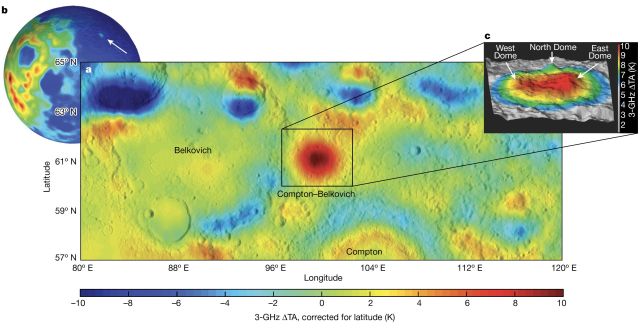
The Compton-Belkovich hotspot. (Siegler et al., Nature, 2023)
Granite is abundant on Earth but extremely rare elsewhere in the Solar System since it requires specific conditions to form.Those conditions include a lot of liquid water, and plate tectonics, which help melt and recycle material in the planet’s crust. Granite production requires multi-stage remelting of basaltic rock, or crystal fractionation in liquid basalt.
The Moon has neither liquid water, nor plate tectonics.
Yet beneath a volcanic region known as Compton-Belkovich, close to the north pole on the Moon’s far side, microwave instruments on China’s Chang’e 1 and Chang’e 2 orbiters picked up something strange. They detected anomalous heat, around 20 times higher than average for the lunar highlands.
The researchers were able to analyze the publicly available data from the China National Space Administration, and the findings surprised them.
“What we found was that one of these suspected volcanoes, known as Compton-Belkovich, was absolutely glowing at microwave wavelengths,” Siegler says. “What this means is that it is hot, not necessarily at the surface, as you would see in the infrared, but under the surface.
“The only way to explain this is from extra heat coming from somewhere below the feature within the deeper lunar crust. So Compton-Belkovich, thought to be a volcano, is also hiding a large heat source below it.”
A geophysical model of the Compton-Belkovich batholith. (Siegler et al., Nature, 2023)
Compton-Belkovich is notable because the region contains a great deal of thorium, a product of radioactive decay. The analysis conducted by Siegler and his colleagues indicates that radioactive elements in a granite matrix are likely the source of the heat beneath it.That granite matrix is much larger than they would have expected, too – around 50 kilometers (31 miles) across.
This, the researchers say, is evidence for an evolved magma plumbing system much larger than expected for the Moon.
A system this large needs one of three things: a large mantle plume feeding in magma from within the Moon; an anomalously wet pocket inside the Moon in that location; or a patch of elements that could provide enough radiogenic material to produce enough heat for consistent re-melting.
All three imply large-scale compositional inconsistencies within the Moon that need to be explained.
“If you don’t have water it takes extreme situations to make granite. So, here’s this system with no water, and no plate tectonics – but you have granite,” Siegler says.
“Was there water on the Moon – at least in this one spot? Or was it just especially hot?”
The research has been published in Nature.
-
-
AuteurBerichten
- Je moet ingelogd zijn om een antwoord op dit onderwerp te kunnen geven.
Dit delen:
- Delen op X (Wordt in een nieuw venster geopend) X
- Share op Facebook (Wordt in een nieuw venster geopend) Facebook
- Delen op LinkedIn (Wordt in een nieuw venster geopend) LinkedIn
- Delen op Telegram (Wordt in een nieuw venster geopend) Telegram
- E-mail een link naar een vriend (Wordt in een nieuw venster geopend) E-mail