
- Dit onderwerp bevat 0 reacties, 1 deelnemer, en is laatst geüpdatet op 16 februari 2022 at 23:18 door Anna.
-
AuteurBerichten
-
-
16 februari 2022 om 23:18 #7862Anna@akrasko97
A New Phase for Superfluid Helium-3
December 23, 2021• Physics 14, s156Confining helium-3 in an aerogel container and subjecting it to a magnetic field reveals a long-predicted superfluid phase.
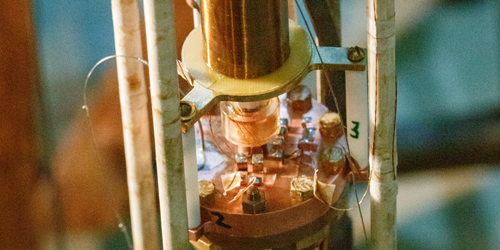
A. Yudin/P. L. Kapitza Institute for Physical Problems
Superfluidity is a familiar phenomenon in helium-4 ( 4He4He), whose individual atoms are bosons. It can also occur in helium-3 ( 3He3He), when individual (fermionic) atoms pair up to make bosonic complexes called Cooper pairs. Because in 3He3He these Cooper pairs have nonzero total spin, superfluid 3He3He has a richer phase space than superfluid 4He4He. Now, Vladimir Dmitriev at the P. L. Kapitza Institute for Physical Problems, Russia, and colleagues have added to that richness, observing the long-predicted, but never-before-seen, superfluid β𝛽 phase of 3He3He [1].
The main factors that determine the phase of superfluid 3He3He are its temperature and pressure. But additional factors also play a role. One factor is the presence of a magnetic field, which has previously been shown to split the so-called A phase into two phases that contain Cooper pairs with different spin compositions. Another factor, which also changes the structure of the Cooper pairs, is the symmetry of the geometry in which the superfluid is confined. In a previous study, Dmitriev and colleagues confined superfluid 3He3He in an aerogel whose pores were much longer than they were wide. In doing so, they were able to observe the superfluid’s so-called polar phase.
The researchers have now studied this anisotropically confined superfluid in a magnetic field. They find that the magnetic field changes the superfluid’s phase-transition path. Instead of reaching the polar phase via a single transition as the temperature drops, the superfluid goes through two phase transitions. In between these two transitions it forms a previously unseen β𝛽 phase. The researchers say that their results could provide insight into the behaviors of other Cooper-pair-containing systems, such as unconventional superconductors, quantum gases, and, possibly, neutron stars.
–Marric Stephens
Source: https://physics.aps.org/articles/v14/s156
-
-
AuteurBerichten
- Je moet ingelogd zijn om een antwoord op dit onderwerp te kunnen geven.
Dit delen:
- Delen op X (Wordt in een nieuw venster geopend) X
- Share op Facebook (Wordt in een nieuw venster geopend) Facebook
- Delen op LinkedIn (Wordt in een nieuw venster geopend) LinkedIn
- Delen op Telegram (Wordt in een nieuw venster geopend) Telegram
- E-mail een link naar een vriend (Wordt in een nieuw venster geopend) E-mail