Tags: rocket thruster, technologie
- Dit onderwerp bevat 0 reacties, 1 deelnemer, en is laatst geüpdatet op 4 februari 2021 at 21:46 door Anna.
-
AuteurBerichten
-
-
4 februari 2021 om 21:46 #3813Anna@akrasko97
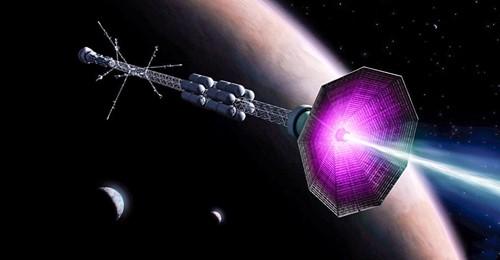
Nuclear Fusion Inspires New Rocket Thruster Design
A new rocket propulsion system harnesses the same process behind solar flares.
By Kristin HouserIt’ll take about seven months to send humans to Mars using today’s spaceships. That’s not exactly a quick jaunt, but it is doable.
Trips to other planets could take years, though, and if we want to explore the rest of our solar system — or the places beyond it — we’re going to need a faster way to travel.
Now, a physicist has designed a new rocket thruster that could potentially allow humans to travel 10 times faster in space — and it’s inspired by nuclear fusion.
Rocket Propulsion 101
One of the simplest ways to understand rocket propulsion is to consider a balloon.If you fill a balloon up with air and then release its nozzle, the air will escape through the hole, and the balloon will go flying in the opposite direction — the force with which that balloon moves is its thrust.
Most rockets also expel gas at one end to create thrust and move through space, and their speed is determined by their size and the amount of thrust they produce.
To create the exhaust gas, most rocket thrusters burn chemicals, and while that can produce a lot of thrust, it’s generally short-lived — all the propellant is quickly used up.
“Long-distance travel takes months or years because the (propellant efficiency) of chemical rocket engines is very low, so the craft takes a while to get up to speed,” Fatima Ebrahimi, a physicist at Princeton Plasma Physics Laboratory (PPPL), said in a press release.
Now, Ebrahimi has revealed a new type of plasma-based rocket thruster that could allow for faster space travel.
Magnetic Reconnection
Plasma is a state of matter sort of similar to gas but with electrically charged atoms. Plasma thrusters expel particles of plasma (instead of gas) to propel spacecraft.
Space agencies have been using plasma thrusters since the 1960s, but all of the tried-and-true devices rely on electric fields to push the plasma particles out of the back of the rocket.
Ebrahimi’s plasma thruster uses magnetic fields or, more specifically, a process involving those fields called “magnetic reconnection.”
This happens anywhere plasma is present, including on the surface of the sun. Magnetic field lines get so close to one another that they connect at one point and cancel each other out.
“At that point of contact, magnetic energy is annihilated, and the energy is converted to kinetic energy (mostly),” Ebrahimi told Freethink.
“The process of magnetic reconnection happens during the eruption of solar flares,” she added, “when mass and energy is ejected from the solar surface into space.”
Magnetic reconnection also happens in the fusion reactor at Ebrahimi’s lab, which is what inspired her to consider applying the process to a rocket thruster.
“During its operation, this (device) produces magnetic bubbles called plasmoids that move at around 20 kilometers per second, which seemed to me a lot like thrust,” she said in the press release.
…
-
-
AuteurBerichten
- Je moet ingelogd zijn om een antwoord op dit onderwerp te kunnen geven.