Weer de hoeders van de Aarde worden

Voor ons Mensen, menselijke wezens, welke dingen moeten veranderen in wie we zijn om voor het leven te zorgen?  

–Manari Ushigua

Wat is er nodig, wat moet anders? Deze en andere krachtvragen hebben mensen uit inheemse culturen gesteld op de site flourishingdiversity.com (https://flourishingdiversity.com/a-living-invitation-to-respond/ )

Een aantal mensen hebben hun antwoord opgenomen en gedeeld, het is prachtig om naar ze te luisteren. Ze praten over verbinding en volgen van je gevoel, ze praten over hoe alles, alles met elkaar verbonden is, met elkaar communiceert en elkaar kan ondersteunen, als er wijze keuzes in het klein en in het groot gemaakt worden. Ze praten over de rol van kunst en ook van rechtvaardigheid en herziening van bewuste en onbewuste keuzes gebaseerd op materieel gewin en consumentisme.

Deze vraag is voor mij een mooie uitnodiging om naar binnen te gaan, met aandacht ernaar te kijken.

Er was ook nog een inspirerend interview over wat mensen, die al jaren bezig zijn met projecten die natuurbehoud en natuurhoederschap bij inheemse volkeren ondersteunen, als belangrijke punten en uitdagingen zien. Erkenen de heelheid en eenheid van alles wat leeft en loslaten van de achterhaalde illusie van afgescheidenheid, daar uit – de waarde van diversiteit (in soorten, maar ook in menselijke culturen), aandacht, samenwerking en open dialoog.  

Hieronder is een fragment uit dit interview, de hele interview is te vinden op de site en in dit document.


Uit interview Biologische en culturele diversiteit omarmen: een interview met dr. Jerome Lewis

Vraag: Kunt u een voorbeeld geven van lokaal geleide natuurbescherming die u hebt gezien en die bijzonder effectief is geweest?

Dr Jerome Lewis: Helaas niet in Centraal-Afrika, maar ik heb op andere plaatsen zeer succesvolle pogingen tot natuurbehoud gezien. Ik heb bijvoorbeeld onlangs een inheems gebied in het Braziliaanse Amazonegebied bezocht, genaamd Apwitxa, waarop de lokale bevolking, de Ashaninka, formeel landrecht hebben verkregen.

Toen ze voor het eerst de titel (landrecht) kregen, was het land zo zwaar beschadigd dat het niet eens geschikt was voor veeweide. Toch hebben ze deze ruimte in 30 jaar getransformeerd tot een van de mooiste diverse bossen die ik ooit heb gezien.

Door middel van een zeer zorgvuldig proces hebben ze inheemse soorten geplant – of herbeplant – maar ook de voedselproductie van het bos verbeterd door bepaalde fruit- en notenbomen te introduceren die bijzonder productieve voedselproducenten zijn voor mens en dier. Het denken dat is besteed aan het koesteren van deze prachtige ruimte is gebaseerd op de wens om harmonieuze relaties te bereiken met de diversiteit van planten en andere soorten die op elkaar inwerken om hun bos gezond te maken en zo hun levensonderhoud en dat van hun kinderen na hen te ondersteunen. Het is een zeer autonoom volk, dus elk huis ligt 50-100 meter van de andere huizen, maar ze hebben ook een diep gevoel voor natuurlijke esthetiek, dus omzoomden ze de paden tussen huizen met een soort palm met een witte, enigszins lichtgevende huid, zodat u bij maanlicht duidelijk kunt zien waar u heen moet. Er was een soort progressief gevoel van de ruimte die zijn vitaliteit in de menselijke gemeenschap ademde, en de menselijke gemeenschap die hun vitaliteit in die ruimte ademde, wat absoluut prachtig was.

Ze hebben nu kwekerijen voor veel van de inheemse planten die ze aan hun buren geven, die ze nu ook zijn gaan planten. Ze nodigen buitenstaanders uit – naburige rubbertappers en andere inheemse groepen – om hen te bezoeken om te leren hoe ze zichzelf hebben georganiseerd om hun territorium te onderhouden, omdat ze redeneren dat hun bos kwetsbaar zal blijven als hun buren hetzelfde doen. Het is echt opmerkelijk wat ze hebben bereikt.
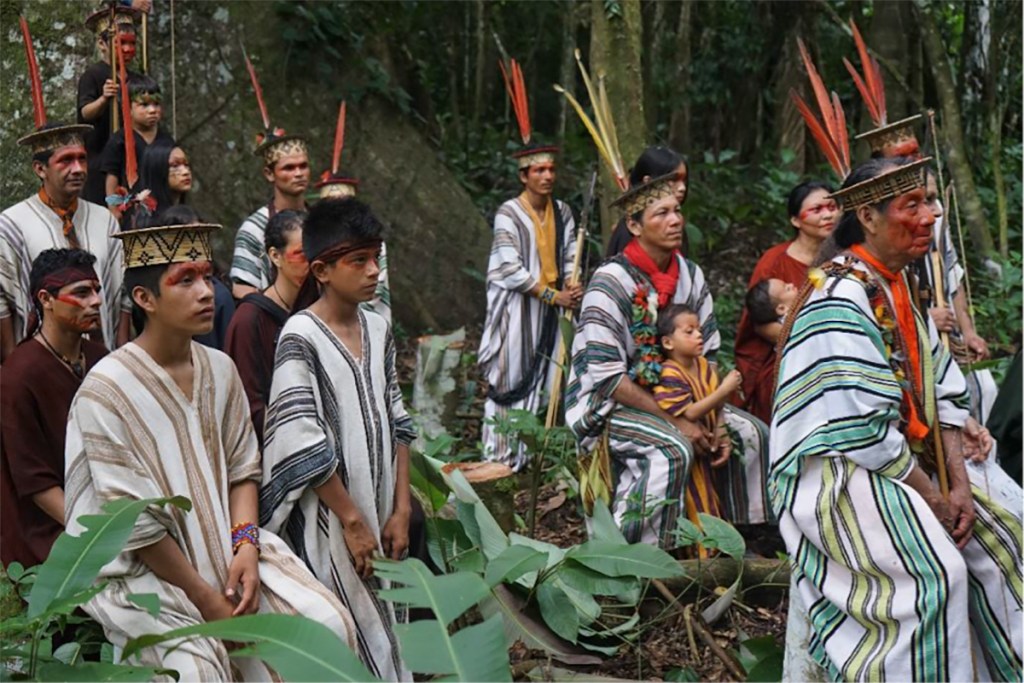
Ashaninka: De Piyako-familie. Afbeelding © Carolina Commandulli

Vraag: En dit wordt allemaal gedaan zonder tussenkomst van westerse NGO’s, helemaal vanaf de basis?

Dr Jerome Lewis: Ja, de Ashaninka hebben hun eigen zeer duidelijke aanpak. Na generaties slachtoffer te zijn geweest van de geschiedenis, hebben ze de leiding genomen over hun toekomst. Ze hebben voor sommige van hun projecten subsidies aangevraagd en gekregen van verschillende fondsen, maar de visie is absoluut van hen. Ze vroegen bijvoorbeeld het Centrum voor Antropologie van Duurzaamheid om met hen samen te werken om uitwisselingsbezoeken te financieren aan de inheemse Guarani-bevolking, wiens Atlantische bos nu is teruggebracht tot 8% van zijn vroegere omvang en die land verliezen aan uitbreidingen van de agribusiness. De uitwisselingen omvatten zaden, vaardigheden, kennis en netwerken om landrechten veilig te stellen, en ze zijn een groot succes geweest.

Wat voor mij het meest opwindende is aan de benadering van de Ashaninka, is dat het laat zien hoe je kunt ontsnappen aan de beperkingen van je geschiedenis om je de toekomst die je zoekt voor te stellen en vervolgens te realiseren. Om de klimaatverandering hier in het westen aan te pakken, moeten we dringend met dergelijke processen beginnen.

Hun sjamanen leiden regelmatig rituelen met de hele gemeenschap waar ze communiceren met en zingen voor de geesten van de rivier, het bos, vogels of hogere wezens. Ze hebben visioenen in deze ceremonies die hen begeleiden om zich de toekomst voor te stellen. Als een van hen eenmaal zo’n visie heeft, delen ze die met iedereen. Met zo’n overvloedig bos kunnen ze dan gaan zitten om de visie te bespreken – desnoods meerdere dagen of zelfs een week – en beslissen wat ze kunnen doen en welke “best practices” ze moeten gebruiken om die visie te in het echt te realiseren. Hun prestaties zijn ronduit verbluffend.

Vraag: Dus ze zijn erin geslaagd om dat te doen ondanks de talloze bedreigingen waarmee ze worden geconfronteerd – de goudzoekers, stropers – en alle andere krachten waar ze tegenaan kunnen lopen?

Dr Jerome Lewis: Ik denk dat ze het hebben gedaan vanwege die druk en bedreigingen, omdat ze echt een leefbare ruimte willen hebben waar hun kinderen kunnen gedijen, en die leefbare ruimte kennen ze uit het verleden. Ze hebben besloten dat ze die ruimte opnieuw willen creëren, maar op een zeer gevoelige manier. Ze vroegen ons bijvoorbeeld om met hen in zee te gaan omdat ze problemen hadden met overbevissing door stropers in hun rivier. Ze wilden een manier vinden om precies in kaart te brengen waar op hun land deze invallen plaatsvonden, zodat ze druk konden uitoefenen op de lokale politie om actie te ondernemen. Toevallig was het niet erg succesvol, deels omdat de lokale politie geen actie ondernam, maar ook omdat het proces van het in kaart brengen te lang duurde, ze moesten het sneller doen.

Dus vormden ze een groep jonge mannen uit de gemeenschap. Wanneer er invallen plaatsvinden, brengen de Ashaninka hen een bezoek, gewapend met hun bogen en gewone pijlen, en ze filmen ze. Ze vertellen hen dat ze hen filmen, dat ze hebben gezien wat ze doen en dat het land van hen is.

Ze waarschuwen de ‘indringers’ dat als ze hun land niet verlaten, ze de volgende dag terug zullen zijn met hun bogen en gifpijlen. Ze hebben ontdekt dat dit heel effectief werkt om mensen van hun land te krijgen! Ze hebben dus hun eigen oplossingen gevonden in hun eigen context, maar we proberen ze op alle mogelijke manieren te ondersteunen met de kennis die we hebben – waaronder een promovenda, Carolina Comandulli – een lid van de Extreme Citizen Science-onderzoeksgroep, die is geweest die de afgelopen drie jaar bij hen hebben gewoond om hun aanpak te documenteren.

** Dr. Jerome Lewis is lector sociale antropologie aan University College London. Hij heeft een bachelor- en doctoraat in sociale antropologie van de London School of Economics en 25 jaar onderzoekservaring in het werken met pygmeeënjager-verzamelaars en voormalige jager-verzamelaars in het Congobekken.

Bron: https://www.synchronicityearth.org/embracing-biological-and-cultural-diversity-an-interview-with-dr-jerome-lewis/

Cover image: Paul Mulliner 3_5_19


From an interview

Embracing biological and cultural diversity: An interview with Dr Jerome Lewis

Q: Can you give an example of locally-led conservation you have seen that has been particularly effective?

Dr Jerome Lewis: Sadly, not in Central Africa, but I have seen very successful conservation efforts in other places. For example, I recently visited an indigenous territory in the Brazilian Amazon called Apwitxa to which the local people, the Ashaninka, have obtained formal land title.

When they first got the title, the land was so badly damaged that it wasn’t even good for cattle pasture. Yet in 30 years they have transformed this space into one of the most beautifully diverse forests I have ever seen.

Through a very careful process they have been planting – or replanting – indigenous species, but also enhancing the food production of the forest by introducing certain fruit and nut trees that are particularly prolific food producers for people and for animals. The thinking that has gone into nurturing this beautiful space is based on the desire to achieve harmonious relations with the diversity of plants and other species that interact to make their forest healthy, and so support their livelihoods and those of their children after them. They are a very autonomous people, so each house is 50-100 m from the other houses, but they also have a profound sense of natural aesthetics, so they lined the pathways between houses with a type of palm that has a white, slightly luminous skin, so that in moonlight you can clearly see where to go. There was a kind of progressive sense of the space breathing its vitality into the human community, and the human community breathing their vitality into that space, which was absolutely beautiful.

They now have nurseries for many of the indigenous plants that they give to their neighbours, who have now started planting them too. They invite outsiders – neighbouring rubber tappers and other indigenous groups – to visit them to learn about how they’ve organised themselves to support their territory since they reason that unless their neighbours do the same, their forest will remain vulnerable. It really is remarkable what they’ve achieved.

Ashaninka: The Piyako family. Image © Carolina Commandulli

Q: And this is all done without intervention from any Western NGOs, completely from the ground up?

Yes, the Ashaninka have their own very clear approach. After generations of being victims of history they have taken charge of their future. They have applied for and benefitted from grants from various funds for some of their projects, but the vision is absolutely theirs. For instance, they asked the Centre for the Anthropology of Sustainability to collaborate with them to fund exchange visits to the Guarani indigenous people whose Atlantic forest is now reduced to 8% of its former size and who are losing land to agribusiness expansions. The exchanges have included seeds, skills, knowledge and networks to secure land rights, and they have been a great success.

For me, what is most exciting about the Ashaninka’s approach is that it demonstrates how you can escape the constraints of your history to imagine and then realise the future you seek. To address climate change here in the west, we urgently need to begin such processes.

Their shamans lead regular rituals with the whole community where they commune with and sing to the spirits of the river, forest, birds or higher beings. They have visions in these ceremonies that guide them to imagine the future. Once one of them has such a vision, they share it with everyone. With such an abundant forest they can then sit down to hold a meeting to talk over the vision – for several days of even a week if necessary – and decide on what they can do and the best practices they need to employ in order to make that vision real. Their achievements are quite astounding.

Q: So they have managed to do that despite the numerous threats they face – the gold-diggers, poachers – and all the other forces they might be up against?

I think they have done it because of those pressures and threats, because they really want to have a liveable space for their children to thrive in, and that liveable space is one that they know from the past. They’ve decided that they want to recreate that space, but in a very sensitive way. For instance, they asked us to get involved with them because they were having trouble with poachers overfishing in their river. They wanted to find a way to map exactly where on their land these incursions were occurring so that they could put pressure on the local police to take action. As it happens, it wasn’t very successful, partly because the local police didn’t take action, but also because the process of mapping was too long, they needed it to be more immediate.

So they formed a group of young men from the community. When incursions take place, the Ashaninka pay them a visit, armed with their bows and ordinary arrows, and they film them. They tell them that they’re filming them, that they’ve seen what they are doing and that the land belongs to them. They warn the ‘invaders’ that if they don’t leave their land, they will be back the next day with their bows and poison arrows. They’ve found that this works very effectively to get people off their land! So they’ve found their own solutions in their own context, but we try to support them in whatever ways we can with knowledge we have – including a PhD student, Carolina Comandulli – a member of the Extreme Citizen Science research group, who has been living with them for the past three years to document their approach.

** Dr Jerome Lewis is a Reader in Social Anthropology at University College London. He has undergraduate and doctoral degrees in Social Anthropology from the London School of Economics and 25 years of research experience working with Pygmy hunter-gatherers and former hunter-gatherers in the Congo Basin.

Source: https://www.synchronicityearth.org/embracing-biological-and-cultural-diversity-an-interview-with-dr-jerome-lewis/

As human beings what things would need to change about who we are to be able to care for life?

–Manari Ushigua

Manari’s full question – “My question isn’t for indigenous or non-indigenous. It is a question for all human beings. We need to share and exchange knowledge and understanding. Sure most indigenous people in the Amazon where I come from are forest protectors and they follow the instructions and guidance that they receive from their dreams, they don’t forget their past, their ancestors and they take actions in the present so that there will be a future. In the modern world, humans develop a strong instinct for the material world of wealth and possessions which they see as reality and which is damaging life beyond words. In contrast, we enter dream world and we remember our dreams and base our decisions and actions on them. As human beings what things would need to change about who we are to be able to care for life?”

Source: https://flourishingdiversity.com/a-living-invitation-to-respond/

Cover image: Paul Mulliner 3_5_19


De spirituele crisis van een leraar

(een blog over lesgeven door Jennifer Hurley)

De paradox van mijn leven als leraar is dat ik het gevoel heb dat dit werk me doodt, maar ik hou ook obsessief van dit werk, met een soort waanzin. Ik droom over lesgeven, en in mijn dromen ben ik soms een betere leraar dan in het echte leven.

De paradox is ook dat ik nog nooit zo goed ben geweest in lesgeven als nu, en toch brengt mijn toewijding aan het werk mijn toekomst erin in gevaar. Ik ben zo door en door uitgeput en diepbedroefd: door het systeem en zijn onzinpraat over normen en beoordeling, en door de samenleving die onze studenten verslaafd heeft gemaakt aan apparaten en ze vervolgens heeft verlaten.

Lesgeven begon voor mij niet als een spirituele oefening, maar het is er een geworden, en nu is dit de enige reden waarom ik lesgeef. Ik geef les om studenten te helpen hun ware zelf te ontdekken en om dat zelf vollediger in de wereld te brengen. We oefenen dit door te lezen, diepe contemplatie, discussie en de creatieve handeling van “het op schrift zetten” van ideeën. Dit werk vereist openheid en moed, en mijn studenten hebben beide. Ze willen hun geest dieper leren kennen. Ze zijn bereid om naar de mening van anderen te luisteren. Ze hunkeren wanhopig naar een educatieve ervaring die hen als hele mensen ziet.

En toch is het onderwijssysteem in de kern onmenselijk. Als docenten wordt ons gevraagd om grote aantallen studenten te beoordelen alsof ze vee zijn; het wordt als een zwakte gezien als we te veel betrokken raken of toestaan dat emoties onze ‘beoordelingen’ verstoren. Als studenten wordt ons gevraagd een overvloed aan losstaande taken uit te voeren, waarvan sommige alleen bestaan om een bureaucratisch idee van wat leren is te vervullen. Het systeem behandelt rubrieken eigenlijk alsof ze feedback vormen, en dat moet ook, want welke leraar heeft tijd om met elk van zijn leerlingen een echt gesprek aan te gaan?

Er zijn talloze bronnen over ‘formatieve beoordelingen’, talloze technologische hulpmiddelen, talloze webinars en hoog geprijsde workshops voor professionele ontwikkeling, maar niemand beantwoordt de essentiële vragen: waar doen we dit allemaal voor? Waarom is onderwijs belangrijk, in een wereld waar alles kan worden gegoogeld? Wat voor mensen zijn wij? En op wat voor wereld bereiden we onze studenten voor?

Een andere paradox vertroebelt de wateren: onderwijs zou ons capabeler moeten maken, maar kan een geschoold persoon echt omgaan met de wereld waarin we leven, een wereld van geweld, onwaarheid, lafheid en afleiding? Een deel van mij vraagt zich af of we onze studenten echt willen onderwijzen, of dat we er de voorkeur aan geven om gewoon door de bewegingen te gaan en nooit echt de sluier op te trekken. We sturen ‘inhoud’ naar onze studenten, testen ze erop en doen dan alsof het allemaal iets belangrijks betekent.

En toch verschijnt de aanwezigheid van goddelijke liefde elke dag in mijn klaslokaal, uitgenodigd door onze openingsmeditatie. Ik kan voelen hoe dingen in de kamer veranderen als we stil zijn. Ik heb soms het gevoel dat het enige goede dat ik als leraar doe, is om die korte momenten van stilte te bewaren, waarin we onze eigen waarheid kunnen horen die ons leidt, als we luisteren.

Bron: Teaching With Trust  https://professorhurley.com/


Image: foto met het gedicht “De Hemelse wind” (Muurhuizen, Amsersfoort)

De Hemelse wind

De hemelse wind
waait over de aardbol
en kust de aarde
wakker

alles wordt klank
de tak het dode blad
gras en water
ze spreken


A Teacher’s Spiritual Crisis

(from a blog about teaching by Jennifer Hurley)

The paradox of my life as a teacher is that I feel this work is killing me, yet I also love this work obsessively, with a kind of madness. I dream about teaching, and in my dreams I am sometimes a better teacher than I am in real life.

The paradox, too, is that I have never been better at teaching as I am now, yet my devotion to the work imperils my future in it. I am so thoroughly exhausted and heartbroken: at the system and its nonsense talk of standards and assessment, and at the society that has addicted our students to devices and then abandoned them.

Teaching did not start out for me as a spiritual practice, but it has become one, and now, this is the only reason I teach. I teach in order to help students discover their truest selves and to bring those selves more fully into the world. We practice this through reading, deep contemplation, discussion, and the creative act of putting ideas into writing. This work requires openness and courage, and my students have both. They want to know their minds more deeply. They are willing to listen to others’ perspectives. They desperately crave an educational experience that sees them as whole humans.

And yet the education system is at its core dehumanizing. As teachers we’re asked to evaluate large numbers of students as if they were cattle; it’s seen as a weakness if we get too involved or allow emotions to interfere with our “assessments.” As students we’re asked to complete a plethora of disconnected tasks, some of which exist only to fulfill a bureaucratic notion of what learning is. The system actually treats rubrics as if they constitute feedback, and it has to, because what teacher has time to engage with each of their students in true conversation?

There are countless resources on “formative assessments,” countless technological tools, countless webinars and highly priced professional development workshops, but no one is answering the essential questions: What are we doing all of this for? Why is education important, in a world where everything can be Googled? What kind of people do we be? And what kind of world are we preparing our students for?

Another paradox muddies the waters: Education is supposed to make us more capable, but can an educated person truly cope with the world we are living in, a world of violence, untruth, cowardice, and distraction? Part of me wonders if we really want to educate our students, or whether we prefer just to go through the motions, never really pulling back the veil. We transmit “content” to our students, test them on it, and then pretend that it all means something important.

And yet the presence of divine love shows up every day in my classroom, invited in by our opening meditation. I can feel how things shift in the room when we are quiet. I sometimes feel that the only good thing I do as a teacher is to preserve those brief moments of quiet, where we can hear our own truth guiding us, if we listen.

Source: Teaching With Trust https://professorhurley.com/


Een wereldwijde, planetaire gemeenschap worden: onze relatie met de Aarde herzien

(door Ilchi Lee, uit het boek “Change: Realizing Your Greatest Potential”.)

Tot nu toe hebben wij mensen onszelf geplaatst – en gevierd! – als de laatste scheidsrechter van alle levende wezens op Aarde, en organiseerde onze wereld dienovereenkomstig. We hebben onze relatie met anderen, en met de Aarde, gebaseerd op de veronderstelling dat we afzonderlijke individuen zijn, in oorlog met elkaar en de wereld, overlevend door onophoudelijke concurrentie, onze waardestandaard afhankelijk van steeds veranderende trends, grillen, manipulaties, en zelfs persoonlijke emoties en stemmingen. Dit zijn de beperkingen van ons waardesysteem. Dat is het leven dat we vandaag leiden.


Als mensen te subjectief en te vol van zichzelf zijn om objectieve universele waarden te beoordelen, hoe zit het dan met de wetenschappen, waarvan lang werd gedacht dat ze objectief waren? Of religies? Of zelfs politiek?

Relatief gezien kan de wetenschap betrouwbare maatstaven bieden om de waarheid in fysieke, materiële zin te verifiëren, maar universele waarden zijn niet haar sterkste kant. Door de geschiedenis van de wetenschap te bestuderen weten we, dat wetenschap, net als andere kennissystemen, niet vrij is van vooringenomenheid. En de waarheden van de wetenschap zijn een steeds veranderende, steeds evoluerende hoeveelheid informatie en kennis. Wat de ene generatie voor waar houdt, wordt ontkracht en achterhaald door nieuwe ontdekkingen naarmate we van gedeeltelijke kennis overgaan op meer volledige kennis. Elke wetenschapper zal de eerste zijn om toe te geven dat ondanks de enorm grote vooruitgang die we hebben geboekt in het begrijpen van ons Universum, onze kennis verre van volledig is.

Religies, aan de andere kant, beweren de eeuwige waarheid te onthullen. Maar, zoals we allemaal weten, lijkt elke religie, en de god of goden die ze eerbiedigt, valide en krachtdragend te zijn alleen voor een bepaalde natie of volk, niet voor iedereen, ondanks aanspraken op universaliteit en absolute autoriteit. We hebben nog geen enkele vertegenwoordigende god van de Aarde, of een religieus geschrift of gedragscode die door alle volkeren en culturen wordt geaccepteerd.

Hoe zit het met de concepten van rechtvaardigheid en vrijheid, waarvan het nastreven wordt geprezen als een universele menselijke eigenschap? Wat we in de wereld zien, is dat het ene gevoel van vrijheid tegen het andere vecht en het ene gevoel van rechtvaardigheid het andere treft. Dit komt omdat zelfs vrijheid en rechtvaardigheid onderhevig zijn aan de interpretatie van een bepaalde groep of volk. Wat in de ene cultuur de ‘vrijheid’ is is voor de andere de “teugelloosheid”, en de ‘rechtvaardigheid’ van de ene cultuur kan hard en wreed lijken wanneer ze vanuit een ander cultureel standpunt wordt bekeken.

Zo zien we een wereld vol verwarde en tegenstrijdige waarden, ideologieën en dogma’s die onenigheid, conflicten en zelfs geweld en oorlog veroorzaken, allemaal vanwege de verschillend gekleurde lenzen die door verschillende groepen worden gedragen. Kortom, alles, inclusief de zelfverklaarde universele waarheden van natuurwetenschappen, religies en politiek, zit gevangen in de kooi van een bevooroordeeld waardesysteem, geconditioneerd door onze lang gedragen gekleurde lenzen. We hebben een grotere visie nodig.

Hoeveel tijd kostte het mensen, afstammelingen van apen met een geavanceerd intellectueel potentieel, om vooruitgang te boeken vanaf hun eerste verschijning op Aarde en zich te verwonderen over de mysteries van de sterren, maan en zon, om te beseffen dat ze niet in het middelpunt stonden van de kosmos? In het begin was het waarschijnlijk vernederend en angstaanjagend om het idee los te laten dat het Universum om hen draaide. Nu wordt dit begrip gezien als bewijs voor de volwassenheid van het menselijk bewustzijn.


Het is tijd om opnieuw bewijs te leveren voor onze voortdurende groei. We hebben nog één copernicaanse revolutie nodig. Om zo’n revolutie te doormaken, moeten we onze relatie met de Aarde heroverwegen. Gewoonlijk noemen we alles waar we betrekking op hebben ‘van ons’ alsof we eigenaar zijn van het object. Planeet Aarde is geen uitzondering. Met onze mentaliteit lijkt het erop dat we geloven dat we het recht hebben om de planeet te gebruiken zoals we willen. Hebben we überhaupt de mogelijkheid om de planeet te beschermen, laat staan het recht om haar te gebruiken? Als in de relatie tussen een deel en het geheel een deel voortdurend probeert het geheel op disharmonische wijze te beheersen, zal het uit het geheel worden verwijderd voordat het het geheel vernietigt. Dit is herhaaldelijk gebeurd in de geschiedenis van deze planeet.

Als we de 13,7 miljard jaar durende geschiedenis van deze planeet terugschalen naar 14 jaar, duurt de menselijke beschaving slechts 3 minuten en de moderne tijd slechts 6 seconden. Sommige soorten, zoals dinosaurussen, waren onvergelijkbaar veel langer dominant dan mensen. De grootste erfenis van de dinosaurussen voor alle andere soorten, vooral voor zoogdieren, was hun dood, want door te sterven openden ze een nieuwe fase van evolutionaire drang naar biologische diversiteit die ze 160 miljoen jaar lang tegenhielden, wat meer dan 50 keer langer is dan de hele evolutionaire geschiedenis van de menselijke soort. Als we onze relatie tot deze planeet in een breed en lang perspectief zien, is één ding heel duidelijk: we horen bij deze planeet, niet andersom, en de enige manier waarop we onszelf kunnen beschermen en gedijen, is door te leren leven met het geheel in harmonie.

Als we onze relatie tot deze planeet in een breed en lang perspectief zien, is één ding heel duidelijk: we horen bij deze planeet, niet andersom, en de enige manier waarop we onszelf kunnen beschermen en gedijen, is door te leren leven met het geheel in harmonie.


We maken deel uit van de enorme cirkel van leven die deze planeet bewoont. In het centrum of de basis van deze levenscirkel staat de Aarde. De centrale waardestandaard voor alle levensvormen hier op Aarde zou de Aarde zelf moeten zijn, niet onze ego’s, behoeften, wensen en vooroordelen. We kunnen de Aarde gebruiken als de standaard om alle handelingen die op onze planeet plaatsvinden te beoordelen. Vanuit zo’n gezichtspunt zijn we allemaal aardbewoners voordat we deel uitmaken van een groep, natie of religie.

Als er geen Aarde was, dan zouden er geen altaren kunnen bestaan om je god te aanbidden. Sterker nog, jij zou niet bestaan, noch je religie. Zonder de Aarde zou er geen natie bestaan, noch politieke ideologieën om een natie te regeren. Om de zuiverste “zero mind’ en ‘kosmisch bewustzijn’, moeten we eerst een planetair bewustzijn bereiken.


We moeten onze waardesystemen herzien en herijken op basis van de voor de hand liggende primaire waarde, onze Aarde.

De Aarde is de bron van leven voor alle levensvormen. Dit geeft de Aarde, de gezondheid en het welzijn van haar op de lange termijn, het recht om de primaire waarde te zijn, waaraan alle andere waarden moet worden gemeten. Het is de gemeenschappelijke basis voor alle waarden die we nastreven in ons leven, persoonlijk en collectief. Ondanks het overduidelijke belang ervan, is deze gemeenschappelijke basis en primaire waarde niet gewaardeerd en misbruikt, en loopt nu ernstig gevaar. We moeten onze waardesystemen herzien en herijken op basis van de voor de hand liggende primaire waarde, onze Aarde.

Dit artikel is een uittreksel uit Ilchi Lee’s boek “Change: Realizing Your Greatest Potential.”

Bron: https://brainworldmagazine.com/becoming-a-global-community-rethinking-our-relationship-to-the-earth/


Becoming a Global Community: Rethinking Our Relationship to the Earth

(by Ilchi Lee, from the book “Change: Realizing Your Greatest Potential.”)

Until now, we humans have placed ourselves — and celebrated ourselves! — as the final arbiter of all living things on Earth, and organized our world accordingly. We have dealt with others, and with the Earth, under the premise that we are separate individuals, at war with one another and the world, surviving through ceaseless competition, our standards of value at the whim of ever-changing trends, caprices, manipulations, and even personal emotions and mood. Such was the limit of our value system. Such is the life that we lead today.


If human beings are too subjective and full of themselves to be objective judges of values, then what about the sciences, long thought to be objective? Or religions? Or even politics?

Relatively speaking, science can provide reliable standards to verify truth in a physical, material sense, but values are not its strength. Through study of the history of science, we know that science, like other system of knowledge, is not free from bias. And the truths of science are an ever-changing, ever-evolving body of information and knowledge. What one generation takes to be true is debunked and made obsolete by new discoveries as we proceed from partial knowledge to more complete knowledge. Any scientist will be the first to admit that despite all the great progress we have made in understanding our universe, our knowledge is far from complete.

Religions, on the other hand, purport to reveal the everlasting truth. Yet, as we all know, despite claims of universality and absolute authority, each religion, and the god or gods that it upholds, seems to have validity and power only for a certain nation or people, not for everyone. We don’t yet have a single representative god of Earth, or a religious scripture or behavioral code accepted by all peoples and cultures.

How about the concepts of justice and freedom, whose pursuit is lauded as a universal human trait? What we see in the world is that one sense of freedom fights against another and one sense of justice strikes another. This is because even freedom and justice are subject to the interpretation of a particular group or people. One culture’s “freedom” is another’s unbridled license, and one culture’s “justice” may appear as harsh and cruel when considered from a different cultural standpoint.

Thus, we see a world filled with confused and conflicting values, ideologies, and dogma that create dissension, conflict, and even violence and war, all because of the different-colored lenses worn by different groups. In a word, everything, including the self-proclaimed universal truths of natural sciences, religions, and politics, is trapped within the cage of a biased value system, conditioned by our long-worn colored lenses. We need a bigger view.

How much time did it take for human beings, descendants of monkeys with an advanced intellectual potential, to progress from their initial appearance on Earth and wondering at the mysteries of the stars, moon, and sun, to realize that they were not at the center of the cosmos? In the beginning, it was probably humiliating and terrifying to relinquish the notion that the universe revolved around them. Now this understanding is seen as evidence for the maturity of human awareness.


It’s time to once again present evidence for our continuing growth. We need another Copernican Revolution. To make such a revolution, we have to rethink our relationship to the Earth. We usually call everything that we relate to “ours” as if we have ownership over the object. Planet Earth is not an exception. With our mentality, it seems that we believe we have the right to use the planet any way we want. Do we even have the ability to protect the planet, let alone the right to use it? In the relationship between a part and the whole, if a part persistently tries to control the whole inharmoniously, it will be removed from the whole before it destroys the whole. This has happened repeatedly in the history of this planet.

If we scale down the 13.7-billion-year history of this planet to 14 years, human civilization is only 3 minutes, and the modern age is only 6 seconds. Some species such as dinosaurs had been dominant for incomparably longer periods of time than human beings. The greatest legacy of the dinosaurs for all other species, especially for mammals, was their dying, because by dying they opened up another stage of evolutionary drive for biological diversity that they were holding back for 160 million years, which is more than 50 times longer than the entire evolutionary history of the human species. If we see our relationship to this planet in a wide and long perspective, one thing is very clear: we belong to this planet, not the other way around, and the only way we can protect ourselves and thrive is by learning how to live with the whole in harmony.

We are part of the vast circle of life that inhabits this planet. At the center or basis of this circle of life is the Earth. The central standard of value for all lifeforms here on Earth should be Earth herself, not our egos, needs, wants, and prejudices. We can use Earth as the standard by which to judge all actions transacted on our planet. From such a point of view, we all are Earth citizens before we are a part of any group, nation, or religion.

If there were no Earth, then no altars could exist for you to worship your god. Even more, you wouldn’t exist, nor your religion. Without Earth, no nation would exist, nor political ideologies with which to rule a nation. To recover the purest “zero mind” and “cosmic consciousness,” we first have to attain an Earth consciousness.


The Earth is the source of life for all forms of life. This entitles Earth, the long-term health and well-being of the Earth, to be the primary value, the most important consideration that all other values should be referred to for measurement. It is the common ground for all the values we pursue in our lives, personally and collectively. Despite its obvious importance, this common ground and primary value has been unappreciated and abused, and now is at serious risk. We have to revise and recalibrate our value systems based on the obvious primary value, our Earth.

This article is excerpted from Ilchi Lee’s book “Change: Realizing Your Greatest Potential.”

Source: https://brainworldmagazine.com/becoming-a-global-community-rethinking-our-relationship-to-the-earth/


Wat biochemie van de levende cel ons vertelt over Natuurkunde van Bewustzijn

(door Paul Mulliner)

De puzzel van coherentie

“Als een man die zijn hele leven heeft gewijd aan de meest nuchtere wetenschap, aan de studie van materie, kan ik je naar aanleiding van mijn onderzoek naar atomen zoveel zeggen: er is geen materie als zodanig. Alle materie ontstaat en kent bestaan alleen bij de gratie van een kracht die de deeltjes van een atoom in trilling brengt en dit allerkleinste zonnestelsel van het atoom bij elkaar houdt. We moeten aannemen dat achter deze kracht er een bewuste en intelligente geest bestaat. Deze geest is de matrix van alle materie.” Max Planck 1944. Winnaar van de Nobelprijs voor natuurkunde 1918.

Het wetenschappelijk denken is sterk verwijderd van de ideeën die in de observatie van Max Plancks uit 1944 tot uiting kwamen.

In de afgelopen jaren echter, toen onderzoek in de biochemie de verbazingwekkend nauwkeurige en coherente orkestratie van de interacties van eiwitten in levende cellen aan het licht heeft gebracht, rijzen er vragen die moeilijk te beantwoorden zijn binnen de gebruikelijke conceptuele kaders.

Met misschien wel een miljard reacties die per seconde plaatsvinden in een levende cel, moeten eiwit- en enzymmoleculen precies op het juiste moment door de cel bewegen om interactie aan te gaan met andere eiwitten en enzymen.

Deze in tijd gesynchroniseerde activiteit, het nauwkeurig georkestreerde samenkomen van grote aantallen door enzymen gekatalyseerde reacties op precies het juiste moment, wordt niet verklaard in de huidige beschrijvingen van biochemische processen.

Hedendaagse teksten over biochemie beschrijven de meervoudige, door enzymen versnelde reacties van moleculen in de cel als gevolg van willekeurige botsingen of als enzymen en eiwitten die hun eigen bewegingen rond de cel sturen om mee te doen met deze reacties.

Hoe weet een enzymmolecuul waar in een levende cel andere moleculen samenkomen, zodat het een reactie kan faciliteren die de gelijktijdige deelname van meerdere moleculen vereist?

Hoe weten deze meerdere grote moleculen wanneer ze door een levende cel moeten reizen om elkaar precies op bepaalde locaties te ontmoeten?

Hoe kunnen we de waargenomen in tijd gesynchroniseerde coherentie in een levende cel verklaren, die lijkt te functioneren als een georkestreerd geheel, in plaats van als een wirwar van afzonderlijke moleculen die willekeurige botsingen maken?

Misschien kunnen we een antwoord op deze vragen benaderen door wat natuurkunde aan te raken.

Al bijna een eeuw weten onderzoekers in de natuurkunde dat alle ‘materiële dingen’ eigenlijk bestaan uit grote clusters van golfpatronen op kwantumschaal in een kosmisch veld, bij natuurkundigen bekend als het nulpunt-veld of kwantumvacuüm.

Atomen zijn een cluster van driedimensionale dynamische resonantievormen binnen het vacuüm-energieveld, vergelijkbaar met de staande golven die worden gegenereerd binnen hoorbare geluidsfrequenties die we ervaren als muziek.

De moleculen waaruit de levende cellen van ons lichaam bestaan, zijn eigenlijk gelokaliseerde trillingsgolfpatronen binnen één uniform kosmisch veld in plaats van de afzonderlijke materiële objecten waarover we op school hebben geleerd.

Het zijn deze kosmische veldexcitaties (of activeringen) die prachtig gechoreografeerd en georkestreerd lijken te zijn in een coherent proces van precieze interactie met elkaar.

Wanneer we ons realiseren dat ons beeld van afzonderlijke materie-objectmoleculen die met elkaar interageren niet langer past bij wat nu bekend is over natuurkunde en scheikunde, kan er een interessante verschuiving in ons begrip plaatsvinden.

Zodra we moleculen beginnen te zien als gelokaliseerde patronen van golfvervormingen binnen een enkel continu veld, in plaats van als afzonderlijke objecten, wordt het voor ons gemakkelijker te begrijpen hoe coherentie in de biochemie van levende cellen tot stand komt.

We weten al uit de natuurkunde dat dit ene kosmische veld non-lokaliteit vertoont, de onmiddellijke samenhang van elk deel van het veld met elk ander deel.

We zouden kunnen afleiden dat dit vacuümenergie/nulpunt-veld ook een intrinsiek vermogen heeft voor in tijd gesynchroniseerde coherentie, of afstemming.

Deze aantoonbare intrinsieke samenhang kunnen we waarnemen in onderzoek naar het proces van fotosynthese.

Groene planten zijn in staat om de energie die uit zonlicht wordt geoogst veel efficiënter te verwerken dan we zouden verwachten vanwege een schijnbaar vermogen tot niet-lokale coherentie in het vacuüm-energieveld.

Deze niet-lokale coherentie maakt het mogelijk dat alle alternatieve energieoverdrachtsroutes in het fotosynthesesysteem tegelijkertijd bekend zijn en de meest efficiënte worden gebruikt.

Deze ontdekkingen helpen ons het begin te formuleren van een belangrijke verschuiving in ons begrip van de aard van het Heelal en roepen een reeks vragen op, niet alleen over biochemie maar ook over bewustzijn.

Misschien wijzen de non-lokaliteit en het vermogen tot dynamische coherentie die wordt getoond door de vacuümenergie/het nulpunt-veld erop dat het een rol speelt in het bewustzijn?

Het is mogelijk dat één uniform kosmisch veld zichzelf uitdrukt als alle materiële vorm en alle ervaring van die vorm.

Het transformeert zichzelf in de vorm van vibratie in de gelokaliseerde veld-activeringen die kenmerkend zijn voor de erdoor geweven orkestratie van de biochemie van levende cellen, terwijl het ook een niet-lokaal bewustzijn van zichzelf heeft.

Dit fundamentele veld, inherent aan het Heelal, heeft zowel een objectief aspect, bekend als het vacuümenergie/nulpuntveld, als een subjectief aspect, bekend als ons bewust-zijn.

Een eeuw geleden brachten de pioniers van de kwantumfysica, velen van hen winnaars van de Nobelprijs voor de natuurkunde, standpunten naar voren die wezen op de heelheid en eenheid van het kosmische veld dat aan alle leven en materie in het Universum ten grondslag ligt.

Hedendaagse wetenschappelijke artikelen lijkt dit diepere perspectief grotendeels te hebben verloren.

“Kwantumfysica onthult dus een fundamentele eenheid van het Universum” Erwin Schrödinger: Nobelprijs voor natuurkunde: 1933

Paul Mulliner 2020

Bron: https://medium.com/discourse/what-living-cell-biochemistry-reveals-about-the-physics-of-consciousness-b62ab1135eef

Photo by Philipp Deus on Unsplash


What Living-Cell Biochemistry reveals about the Physics of Consciousness

The puzzle of coherence

“As a man who has devoted his whole life to the most clear headed science, to the study of matter, I can tell you as a result of my research about atoms this much: There is no matter as such. All matter originates and exists only by virtue of a force which brings the particles of an atom to vibration and holds this most minute solar system of the atom together. We must assume behind this force the existence of a conscious and intelligent spirit. This spirit is the matrix of all matter.” Max Planck 1944. Winner of the Nobel Prize in Physics 1918.

Scientific thought has moved sharply away from the ideas expressed in Max Plancks’ 1944 observation.

In the past few years, however, as research in biochemistry has revealed the astonishingly precise and coherent orchestration of the interactions of living-cell proteins, questions are being raised that are difficult to answer within the usual conceptual frameworks.

With perhaps a billion reactions occurring per second in a living cell, protein and enzyme molecules have to move across the cell at precisely the right moment to interact with other proteins and enzymes.

This time-synchronized activity, the precisely orchestrated coming together of large numbers of enzyme catalysed reactions at exactly the right time, isn’t explained in current descriptions of biochemical processes.

Contemporary biochemistry texts describe the multiple, enzyme accelerated reactions of molecules in the cell as a consequence of random collisions or as though enzymes and proteins direct their own movements around the cell to join in with these reactions.

How does an enzyme molecule know where in a living cell other molecules are going to congregate, so it can facilitate a reaction which requires the simultaneous co-participation of multiple molecules?

How do these multiple large molecules know when to travel across a living cell so as to meet up precisely together at particular locations?

How can we explain the observed time-synchronized coherence in a living cell, which seems to function as a orchestrated whole, rather than as a jumble of separate molecules making random collisions?

Perhaps we can approach an answer to these questions by touching on some physics.

For nearly a century, researchers in physics have known that all ‘material stuff’ actually consists of large clusters of quantum-scale wave patterns in a cosmic field, known to physicists as the zero-point field or quantum vacuum.

Atoms are a cluster of three dimensional dynamic resonance-forms within the vacuum-energy field, not unlike the standing waves generated within audible sound frequencies which we experience as music.

The molecules that make up the living cells of our body are actually localized vibrational wave-patterns within a single cosmic field rather than the separate material objects we learned about in school.

It’s these cosmic field-excitations that seem to be exquisitely choreographed and orchestrated into a coherent process of precise interaction with each other.

When we realize our image of separate material-object molecules interacting with each other no longer fits with what is now known about physics and chemistry, an interesting shift in our understanding can occur.

Once we start to see a molecules as localized patterns of wave deformations within a single continuous field, rather than as separate objects, our understanding of the existence of coherence in the biochemistry of living cells becomes easier.

We already know from physics that this single cosmic field exhibits nonlocality, the instantaneous correlation of every part of the field with every other part.

We could speculate that this vacuum energy/zero point field also has an intrinsic capacity for time-synchronized coherence.

We can observe this apparent intrinsic coherence, in research into the process of photosynthesis.

Green plants are able to process the energy harvested from sunlight very much more efficiently than we might expect because of an apparent capacity for nonlocal coherence in the vacuum-energy field.

This nonlocal coherence enables all the alternative energy transfer pathways in the photosynthetic system to be simultaneously known and the most efficient ones used.

These discoveries help us to formulate the beginnings of an important shift in our understanding of the nature of the Universe and raise a series of questions, not just about biochemistry but also about consciousness.

Perhaps the nonlocality and capacity for dynamic coherence shown by the vacuum energy/zero point field point to it having a role in consciousness?

It’s possible that a single cosmic field is expressing itself as all material form and all experience of that form.

It’s vibrationally transforming itself into the localized field excitations characteristic of the interwoven orchestration of living-cell biochemistry while also having a nonlocal awareness of itself.

This fundamental field, intrinsic to the Universe, has both an objective aspect, known as the vacuum energy /zero-point field and a subjective aspect, known as our conscious awareness.

A century ago, the pioneers of quantum physics, many of them winners of the Nobel prize in physics, expressed views that pointed to the wholeness and oneness of the cosmic field underlying all life and matter in the Universe.

Contemporary writing in science seems largely to have lost this deeper perspective.

 Quantum physics thus reveals a basic oneness of the Universe” Erwin Schrödinger: Nobel prize in Physics : 1933

Paul Mulliner 2020

Source: https://medium.com/discourse/what-living-cell-biochemistry-reveals-about-the-physics-of-consciousness-b62ab1135eef

Photo by Philipp Deus on Unsplash


Koldashans

(a chapter from the book “The Extraterrestrial Species Almanac” by Craig Campobasso.)

Universal Origin: Koldashans are from Koldas, one of eight planets in their solar system. The Koldashans confirm that the warring people of Mars destroyed their civilization in a nuclear holocaust. The survivors were relocated to planet Siton, a world that is part of the galactic community.

Physical Characteristics: Koldashans are indistinguishable from Earth humans. Men and women are of average height, anywhere from five feet to six five. Their skin tones range from white to brown, with brown, blond, or red hair. They have the same eye colors as we do on Earth. Their uniforms are light blue.

Belief System: Koldashans follow the Cosmic Law of One. The beings of Koldas believe in One Supreme Consciousness, which they refer to as the Divine One, who created everything seen and unseen.

Cosmic Agenda: Koldashans first came to Earth in the times of Atlantis and again in the 1940s and 1960s. Future commanders who will be assigned to the outer space regions above Earth must first complete extensive training as an Earth person. They are required to learn the language and customs of the country in which they will live, secure regular jobs, and befriend the people. The future commander might reveal who he or she is to a Koldashan star seed, knowing it will elevate their consciousness and help them accept the true reality of the cosmos. Valdar began his two-year education on Earth in 1960 in South Africa, and then became a commander. Koldashans have approached governments on Earth for many years to share a better way of life for all humans, but were denied every time and chased off the planet. Koldashans maintain three hundred bases on Earth and also study planetary conditions. As of 1969, they had had 2,050 years of peace.

Technology: Astrael craft are disc-shaped and steel gray in color. The craft was named by its Koldashan engineer in honor of his wife, Astraelda. Each craft has eight magnetic motors: four in the front and four in the back. These colossal electromagnets are powered by solar energy. Magnetic fields run across the universe, and they travel through space along these invisible streams, lines, tunnels, and grids. The magnetic motors are able to adjust speed. The highest velocity can exceed the speed of light. Patrolling the Earth was conceived of in 1927 and began implementation in 1941 to record and eliminate meteorites that have entered the magnetic field around the planet and throughout the solar system. The Astrael ships are not weaponized, although they are out[1]fitted with a disintegrating ray or a charged particle beam that will destroy any object in a bright flash, its primary purpose to destroy asteroids. Corynthian Astrael craft (also disc-shaped) are the latest technological space cruisers, with automatic instrumentation and the ability to make an interdimensional leap in an instant, similar to Galacterian thought-jump technology, by programming the resonation field of the destination with the departure space time, and instantly jumping across space. Time machine craft bridge long space treks in an incredibly short time. Through the discovery of two pear-shaped polar universes linked together, the matter/antimatter universe, points close at the end, like tying the end of a balloon (an event horizon, if you will), preventing anything between the universes from escaping—including light. These craft can bypass the velocity of light and escape the velocity of the universe, enter the flowing magnetic fields, where time flows in reverse, passing from one dimension to another, one time period to another, backward and forward. This technology is also blended into the latest Astrael craft designs. Elongated craft are used for cargo and transporting passengers to and from stations and planets. Scout craft, also disc-shaped, collect specimens, or land missionaries or future commanders for their training cycles. They have eight seats for crew and a commanding officer who is located in a conning tower. Koldashans confine their industry on two neighboring planets. This is also where their craft are constructed. Other planets are used for agriculture and mining. Melchor is a gigantic halfway station built by the Koldashans and anchored in the far recesses of our solar system. Located at the top is a domed communications center. It’s a stopover for space travelers who need to rest and replenish supplies. It can also accommodate a great number of craft. Its main purpose is to guide and track Astrael craft along magnetic travel tunnels or gridlines. These trajectories must be cleared of all space debris, thus their meteorite patrol and disintegration of such debris around Earth and our solar system.

Consciousness Abilities: Koldashans are fully conscious, sovereign, and telepathic beings. They wear a lightweight silver helmet that assists in all forms of communication—interaction with the craft’s organic brain, its guidance system, language converters, and so on. They are waiting for us to evolve to a state of full consciousness so they can school us in cosmic consciousness and share the secrets of the universe, galaxies, and solar systems. They record messages through high vibratory crystals.

Dimensional Capacity: Koldashans have multidimensional commandership. When star nations prepare worlds for transition into the fifth dimension, it is said that our physicality becomes a less gross material body and is restored to divine perfection.


Koldashans (NL vertaling)

(een hoofdstuk uit het boek “The Extraterrestrial Species Almanac” door Craig Campobasso.)

Universele oorsprong: Koldashans komen uit Koldas, een van de acht planeten in hun zonnestelsel. De Koldashans bevestigen dat de oorlogvoerende mensen van Mars hun beschaving hebben vernietigd in een nucleaire holocaust. De overlevenden werden verplaatst naar de planeet Siton, een wereld die deel uitmaakt van de galactische gemeenschap.

Fysieke eigenschappen: Koldashans zijn niet te onderscheiden van aardse mensen. Mannen en vrouwen zijn van gemiddelde lengte, ergens tussen de 1,50 en 1,85 meter. Hun huidtinten variëren van wit tot bruin, met bruin, blond of rood haar. Ze hebben dezelfde oogkleuren als wij op Aarde. Hun uniformen zijn lichtblauw.

Geloofssysteem: Koldashans volgen de Kosmische Wet van Eén. De wezens van Koldas geloven in Eén Allerhoogste Bewustzijn, waarnaar ze verwijzen als de Goddelijke Ene, die alles wat zichtbaar en ongezien is, heeft geschapen.

Kosmische agenda: Koldashans kwamen voor het eerst naar de Aarde in de tijd van Atlantis en opnieuw in de jaren veertig en zestig. Toekomstige commandanten die zullen worden toegewezen aan de ruimtegebieden boven de Aarde, moeten eerst een uitgebreide training als aards persoon voltooien. Ze moeten de taal en gewoonten leren van het land waarin ze zullen wonen, vaste banen vinden en vriendschap sluiten met de mensen. De toekomstige commandant zou kunnen onthullen wie hij of zij is aan een Koldashan-sterrenzaad, wetende dat het hun bewustzijn zal verhogen en hen zal helpen de ware realiteit van de kosmos te accepteren.

Valdar begon zijn tweejarige opleiding op Aarde in 1960 in Zuid-Afrika en werd toen commandant. Koldashans hebben jarenlang regeringen op Aarde benaderd om een betere manier van leven voor alle mensen te delen, maar werden elke keer ontkend en van de planeet verjaagd. Koldashans onderhouden driehonderd bases op Aarde en bestuderen ook de planetaire stand van zaken. Vanaf 1969 hadden ze 2050 jaar vrede gehad.

Technologie: Astrael-vaartuigen zijn schijfvormig en staalgrijs van kleur. Het vaartuig werd genoemd door de Koldashan-ingenieur ter ere van zijn vrouw, Astraelda. Elk vaartuig heeft acht magnetische motoren: vier aan de voorkant en vier aan de achterkant. Deze kolossale elektromagneten worden aangedreven door zonne-energie. Magnetische velden stromen door het universum en reizen door de ruimte langs deze onzichtbare stromen, lijnen, tunnels en rasters. De magnetische motoren kunnen de snelheid aanpassen. De hoogste snelheid kan de snelheid van het licht overschrijden. Patrouilleren van de Aarde werd bedacht in 1927 en begon in 1941 met de uitvoering om meteorieten vast te leggen en te elimineren die het magnetische veld rond de planeet en het hele zonnestelsel zijn binnengedrongen.

De Astrael-schepen zijn niet bewapend, hoewel ze zijn uitgerust met een desintegrerende straal of een geladen deeltjesstraal die elk object in een heldere flits zal vernietigen, met als voornaamste doel asteroïden te vernietigen.

Corynthian Astrael-vaartuigen (ook schijfvormig) zijn de nieuwste technologische ruimtecruisers, met automatische instrumentatie en de mogelijkheid om in een oogwenk een interdimensionale sprong te maken, vergelijkbaar met Galacteriaanse gedachtesprongtechnologie, door het resonantieveld van de bestemming te programmeren met het vertrek ruimtetijd, en meteen door de ruimte springen.

Tijdmachinevaartuigen overbruggen lange ruimtereizen in een ongelooflijk korte tijd. Door de ontdekking van twee peervormige polaire universa die met elkaar verbonden zijn, het materie/antimaterie-universum, punten dicht bij het einde, zoals het uiteinde van een ballon vastbinden (een gebeurtenishorizon, als je wilt), waardoor wordt voorkomen dat iets tussen de universums ontsnapt – inclusief licht. Deze vaartuigen kunnen de snelheid van het licht omzeilen en ontsnappen aan de snelheid van het universum, de stromende magnetische velden binnengaan, waar de tijd in omgekeerde richting stroomt, van de ene dimensie naar de andere gaat, van de ene tijdsperiode naar de andere, achteruit en vooruit. Deze technologie is ook verwerkt in de nieuwste Astrael-vaaruigen ontwerpen. Langwerpige vaartuigen worden gebruikt voor vracht en het vervoeren van passagiers van en naar stations en planeten. Verkenningsvaartuigen, ook schijfvormig, verzamelen exemplaren, of landzendelingen of toekomstige commandanten voor hun trainingscycli. Ze hebben acht zitplaatsen voor de bemanning en een commandant die zich in een commandotoren bevindt.

Koldashans beperken hun industrie tot twee naburige planeten. Dit is ook waar hun vaartuigen worden gebouwd. Andere planeten worden gebruikt voor landbouw en mijnbouw. Melchor is een gigantisch tussenstation gebouwd door de Koldashans en verankerd in de uithoeken van ons zonnestelsel. Bovenaan bevindt zich een koepelvormig communicatiecentrum. Het is een tussenstop voor ruimtereizigers die moeten uitrusten en voorraden moeten aanvullen. Het is ook geschikt voor een groot aantal vaartuigen. Het belangrijkste doel is om Astrael-vaartuigen langs magnetische reistunnels of rasterlijnen te leiden en te volgen. Deze trajecten moeten worden vrijgemaakt van al het ruimtepuin, vandaar dat hun meteorietpatrouille en desintegratie van dergelijk puin rond de Aarde en ons zonnestelsel.

Bewustzijnsvermogens: Koldashans zijn volledig bewuste, soevereine en telepathische wezens. Ze dragen een lichtgewicht zilveren helm die helpt bij alle vormen van communicatie: interactie met het organische brein van het vaartuig en z’n besturingssysteem, taalomzetters, enzovoort. Ze wachten op ons om te evolueren naar een staat van volledig bewustzijn, zodat ze ons kosmisch bewustzijn kunnen leren en de geheimen van het universum, sterrenstelsels en zonnestelsels kunnen delen. Ze nemen berichten op via hoog vibrerende kristallen.

Dimensionale capaciteit: Koldashans hebben een multidimensionaal command. Wanneer sterrennaties werelden voorbereiden op overgang naar de vijfde dimensie, wordt er gezegd dat onze lichamelijkheid een minder grofmaterieel lichaam wordt en wordt hersteld tot goddelijke perfectie.


Intunen in het Bewuste Universum

Het vinden van onze eigen verbinding met universele intelligentie

(door Paul Mulliner)

“Voel je je niet eenzaam, het hele universum is in jou” Rumi

“De centrale orde maakt deel uit van zowel het subjectieve als het objectieve rijk” Werner Heisenberg: Nobelprijs voor natuurkunde: 1932

“We moeten onze ogen sluiten en een nieuwe manier van kijken oproepen, een staat van wakker zijn die het geboorterecht is van ons allemaal” Plotinus


Ieder van ons is volledig verweven in het hele bewuste Universum en alles wat leeft.

Dit is niet hoe we de wereld over het algemeen zien.

Een meer gebruikelijke kijk op onze menselijke realiteit is dat we volledig gescheiden zijn van elkaar en de wereld om ons heen.

Dit gevoel van afgescheidenheid kan echter worden opgelost als we aandacht besteden aan de bewuste ruimte in ons.

Wanneer we onze aandacht even binnen in onszelf richten, kunnen we intuïtief beseffen dat er een ruim universeel bewustzijn, de onbeschrijfelijke bron van al het leven bestaat, overal en in ons allemaal.

We kunnen onze intuïtieve verbinding met universeel bewustzijn ontdekken, het kosmische veld van intelligentie en energie dat al het leven in het hele Universum orkestreert en verbindt.

En we kunnen ook de intuïtieve begeleiding ontdekken die in ons leven plaatsvindt wanneer we afstemmen op de onderliggende synchronistische intelligentie van universeel bewustzijn.

Deze intuïtieve inzichten komen voor veel mensen tijdens hun leven vaak spontaan naar boven, maar zijn regelmatig voor ons beschikbaar enkel als we aandacht besteden aan het bewust-zijn in onszelf.

Opmerkelijk genoeg wordt deze mindfulness, het eenvoudige proces van bewust aanwezig zijn en regelmatig onze aandacht richten op de bewuste ruimte in onszelf, niet algemeen toegepast.

Het besef van een intuïtieve verbinding met het bewustzijn in het Universum blijft grotendeels onbekend, zelfs terwijl we op onze planeet met meerdere grote problemen worden geconfronteerd.

Velen van ons leven nog steeds met een mentaliteit die we geërfd hebben uit het verleden, een gemeenschappelijk wereldbeeld voor veel mensen vandaag, dat het leven ziet door het prisma van afscheiding, stelt dat materie de enige realiteit in de wereld is, en niet erkennen wat geen directe tactiele of visuele ervaring is.

Dit historische wereldbeeld gaat ervan uit dat bewustzijn wordt gegenereerd door ons afzonderlijke menselijke brein in plaats van te bestaan als een universeel kosmisch veld waarop ons brein afstemt en waar we allemaal aan deelnemen.


Deze overtuigende culturele normen en wijze van kijken zijn zo diep in ons verankerd dat ze onze manier van leven in de wereld blijven vervormen.

We blijven aandringen op het primaat van de materie en de scheiding van alle dingen van elkaar, ondanks het feit dat natuurkundigen al bijna een eeuw weten dat alle ‘materiële dingen’ eigenlijk bestaan uit clusters van kleine golfpatronen in een gebied van kosmische energie.

Het loslaten van het denken in afgescheidendheid gebeurt wanneer we ons bewust worden van de bewuste ruimte in ons die vóór alle gedachten bestaat.

Regelmatig mindfulness beoefenen is een goede manier om onze eigen verbinding te vinden met het evoluerende kosmische bewustzijn dat ons allemaal samenbrengt.

Door hier en nu bewust aanwezig te zijn, kunnen we het denken oplossen dat soms in ons opkomt om ons van de wereld en van elkaar te scheiden.

Als we alleen aandacht besteden aan onze gedachten, en nooit aandacht schenken aan de ene bewuste ruimte in ons allemaal waar onze gedachten uit voortkomen, kunnen we het contact met iets cruciaals voor ons welzijn verliezen.

We zijn de levende menselijke uitdrukkingen van een onbeperkt bewustzijn dat door het hele Universum bestaat, een onuitsprekelijke bewuste ruimte die zichzelf transformeert in de nauwkeurig georkestreerde biochemie van ons lichaam, waardoor we als mens kunnen leven.

We zijn hier op deze planeet, niet als gevolg van een willekeurig kosmisch ongeluk, maar omdat een veld van universeel bewustzijn en energie zichzelf voortdurend transformeert in al het leven in het hele Universum.

Dit ruimtelijke kosmische intelligentie-organisme is het primaire materiaal van het Universum en alles wat leeft is er een continu gegenereerde uitdrukking van, een trillingsverandering van zichzelf waardoor het zichtbaar en tastbaar wordt als bomen, bloemen, mensen en al het leven overal.

Een enkel kosmisch veld van bewustzijn drukt zichzelf uit als alle materiële vorm en alle ervaring van die vorm.

Net als een driedimensionale muziek die van moment tot moment zichtbaar wordt, komen de vloeiende stromen van kleine trillingsresonanties die we beschrijven als celbiochemie, voortdurend tevoorschijn uit een veld van kosmische energie en bewustzijn, en verschijnen als levende celbiochemie en levende wezens.

Triljoenen nauwkeurig georkestreerde biochemische reacties vinden elk moment in ons menselijk lichaam plaats, zodat we ons leven als mens kunnen ervaren.

We horen hier op planeet Aarde thuis, en ieder van ons heeft een inherente verbinding met het bewustzijn in het Universum.

Elk van ons is een intrinsiek en essentieel onderdeel van het levende kosmische netwerk van bewustzijn, intelligentie en energie dat alle levende wezens overal in het hele Universum samenbrengt in een enkel coherent organisme.

Het regelmatig beoefenen van mindfulness is een goede manier om onze eigen verbinding te vinden met dit zich ontwikkelende kosmische bewustzijn dat ons allemaal samenbrengt.

Door onze aandacht naar binnen te richten, kunnen we de verschuiving maken van afgescheidenheid naar heelheid, en onszelf intuïtief realiseren als unieke menselijke uitdrukkingen van één onbeperkt kosmisch bewustzijn, in plaats van onszelf als afgescheiden en alleen te zien.

Wanneer we aandacht besteden aan deze innerlijke bewuste ruimte, gaan wij in het op en het brengt inzicht en intuïties die eruit voortkomen in ons bewustzijn.


Sommige van deze inzichten en intuïties kunnen ons helpen onze eigen manier te vinden om bij te dragen aan het oplossen van enkele van de problemen die voortkomen uit de verschillende wereldwijde crises waarmee we nu worden geconfronteerd.

Zowel de pandemie van 2020 als de klimaatverandering herinneren ons eraan hoe klein de planeet werkelijk is en hoe we allemaal betrokken zijn bij het tot stand brengen van productieve verandering.

De realiteit van het leven in een afzonderlijk menselijk lichaam staat gewoonlijk zo centraal in onze mind dat het ons ervan overtuigt dat ons bewust-zijn ook gescheiden is.

Door onze aandacht enkele ogenblikken op de innerlijke kern van onszelf te richten, wordt deze illusie voorzichtig opgelost.

We kunnen intuïtief het diepste en meest universele bewustzijn realiseren dat in ons allemaal bestaat, het bewustzijn dat alle ogenschijnlijke scheiding tussen ons oplost.

In plaats van onszelf als afgescheiden en alleen te zien, kunnen we onszelf beginnen te zien als de levende uitdrukking van één zich ontwikkelend bewustzijnsveld in ons allemaal, en in alle ruimte overal.

Een enkel kosmisch veld van bewustzijn drukt zichzelf uit als alle materiële vorm en alle ervaring van die vorm.

We zijn de levende uitdrukkingen van een universele kosmische intelligentie die zichzelf transformeert in ons menselijk lichaam voor de duur van een mensenleven.


Paul Mulliner  2020


Tuning in to the Conscious Universe

Finding our own connection into the universal intelligence

“Do not feel lonely, the entire universe is inside of you” Rumi

“The central order is part of the subjective as well as the objective realm” Werner Heisenberg : Nobel prize in Physics : 1932

“We must close our eyes and invoke a new manner of seeing, a wakefulness that is the birthright of us all ” Plotinus


Each one of us is entirely woven into the whole conscious Universe and everything that lives.

This isn’t how we generally see the world.

A more usual take on our human reality is that we’re entirely separate from each other and the world around us.

This sense of separation can be dissolved however, when we pay attention to the conscious space inside us.

When we momentarily focus our attention inside ourselves, we can realize intuitively that a spacious universal awareness, the inexpressible source of all life, exists everywhere, and inside all of us.

We can discover our intuitive connection into universal consciousness, the cosmic field of intelligence and energy that orchestrates and joins all life throughout the Universe.

And we can also discover the intuitive guidance that happens in our life when we tune in to the underlying synchronistic intelligence of universal consciousness.

These intuitive insights often emerge spontaneously for many people during their life, but are only regularly available to us when we pay attention to the conscious awareness inside ourselves.

Remarkably though, this mindfulness, the simple process of being consciously present and regularly focusing our attention in the conscious space inside ourselves, isn’t widely practiced.

The realization of an intuitive connection into consciousness in the Universe remains largely unknown, even while we face multiple large issues on our planet.

Many of us are still living with a mindset we inherit from the past, a common worldview for many people today, that sees life through the prism of separation, holds that matter is the only reality in the world, and offers no recognition of anything that’s not an immediate tactile or visual experience.

This historical worldview assumes consciousness to be generated by our separate human brain rather than existing as a universal cosmic field our brain tunes into and we all participate in.


These persuasive cultural norms and ways of seeing are so deeply embedded in us that they continue to distort our way of living in the world.

We continue to insist on the primacy of matter and the separation of all things from each other, despite the fact that, for nearly a century, researchers in physics have known that all ‘material stuff’ actually consists of clusters of tiny wave patterns in a field of cosmic energy.

Letting go of separation thinking happens when we become aware of the conscious space inside us that exists prior to all thought.

Practicing mindfulness regularly is a good way to find our own connection into the evolving cosmic consciousness that joins all of us together.

Being consciously present here and now, helps us dissolve the thinking that sometimes emerges inside us to separate us from the world and each other.

If we only pay attention to our thoughts, and never pay attention to the one conscious space inside all of us that our thoughts emerge from, we can lose touch with something crucial to our well-being.

We’re the living human expressions of an unlimited consciousness existing throughout the Universe, an inexpressible conscious space transforming itself into the precisely orchestrated biochemistry of our bodies, allowing us to live life as a human being.

We’re here on this planet, not as a consequence of a random cosmic accident, but because a field of universal consciousness and energy is continuously transforming itself into all life throughout the Universe.

This spatial cosmic intelligence-organism is the primary stuff of the Universe and everything that lives is a continuously generated expression of it, a vibrational altering of itself that allows it to become visible and touchable as trees, flowers, human beings and all life everywhere.

A single cosmic field of consciousness is expressing itself as all material form and all experience of that form.

Like a three-dimensional music becoming visible moment by moment, the streaming flows of tiny vibrational resonances we describe as cell biochemistry, are emerging continuously out of a field of cosmic energy and consciousness, and coming into appearance as living-cell biochemistry and living beings.

Trillions of precisely orchestrated biochemical reactions are occurring throughout our human body every moment, just so we can experience our life as a human being.

We belong here on planet Earth, and each one of us has an inherent connection into consciousness in the Universe.

Each one of is an intrinsic and essential part of the living cosmic network of consciousness, intelligence and energy that joins all living beings everywhere into a single coherent organism throughout the Universe.

Practicing mindfulness regularly is a good way to find our own connection into this evolving cosmic consciousness that joins all of us together.

Focusing our attention inwardly helps us make the shift from separation to wholeness, and intuitively realize ourselves as unique human expressions of one unlimited cosmic consciousness, rather than seeing ourselves as separate and alone.

When we pay attention to this inner conscious space, it dissolves us into itself and brings insight and intuitions emerging from it into our awareness.


Some of these insights and intuitions may help us find our own way to contribute to solving some of the problems emerging from the several global crises we now face.

Both the 2020 pandemic and climate change remind us how small the planet really is and how we’re all involved together in bringing about productive change.

The reality of living in a separate human body is usually so at the center of our mind that it persuades us that our conscious awareness is also separate.

A few moments focusing our attention in the inner core of ourselves tends to gently dissolve this illusion.

We can intuitively realize the deepest and most universal consciousness that exists inside all of us, the conscious awareness that dissolves all apparent separation between us.

Rather than seeing ourselves as separate and alone, we can begin to see ourselves as the living expressions of one evolving field of consciousness inside all of us, and in all space everywhere.

A single cosmic field of consciousness is expressing itself as all material form and all experience of that form.

We’re the living expressions of a universal cosmic intelligence that’s transforming itself into our human body for the duration of a human life.


Paul Mulliner  2020

https://medium.com/mindfully-speaking/tuning-in-to-the-conscious-universe-84ca6c960657

Image: photo by David Clode on Unsplash


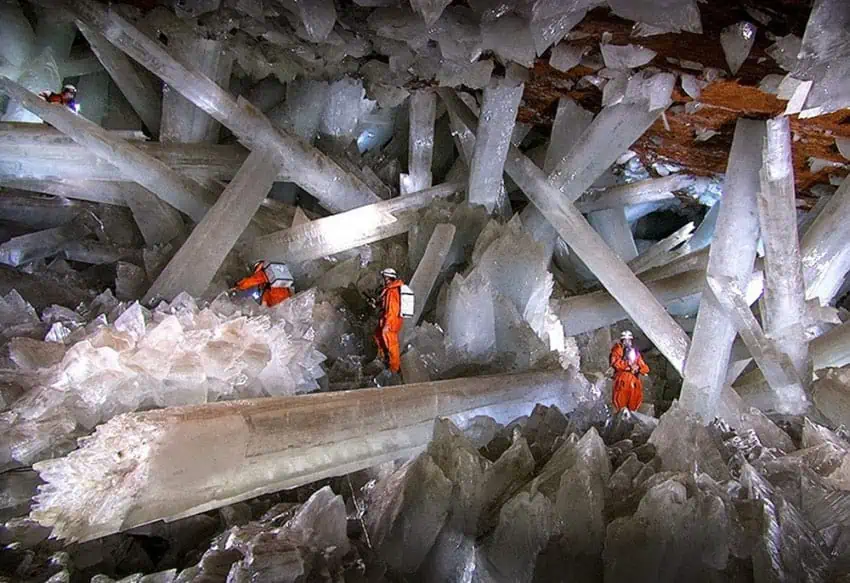
Reuze kristallen grotten van Naica (Mexico)

20 jaar na de ontdekking de mysterieuze Naica Kristallengrot verbaast ons nog steeds

(mexiconewsdaily.com) April 2, 2021

The Naica Crystal Cave, only ever accessible from a mine in Chihuahua but now completely submerged underwater, has bizarrely long, thick crystals.

De enorme kristallen waren tot 14 meter lang en twee meter dik, en bevonden zich in een grot die zo vijandig was dat niemand het langer dan een paar minuten kon uitstaan om erin te zijn: de hele wereld stond versteld toen de eerste foto’s van de Naica Crystal Cave ging viraal.

Terwijl we de 20e verjaardag van de ontdekking van de grot vieren, laat het ons nog steeds naar adem snakken van verbazing.

Deze ongelooflijke grot is een van de weinige plaatsen die – in één adem – “de mooiste plek op aarde” en “één stap verwijderd van de hel” kunnen worden genoemd. Het was alleen ooit toegankelijk via een tunnel in de Naica-mijn, de grootste lood-, zink- en zilvermijn in Mexico, geëxploiteerd in Chihuahua door Industrias Peñoles, maar vandaag staan zowel die tunnel als de grot volledig onder water. Maar dat kan juist in het voordeel van het natuurlijke fenomeen zijn.

Onlangs sprak ik met speleoloog en historicus Carlos Lazcano, de eerste wetenschapper ooit die voet zette in de Naica Crystal Cave. Hier is zijn herinnering aan die ervaring:

“Twintig jaar geleden werkten verschillende van mijn medestudenten geologie toevallig in de mijnen in Chihuahua, en op een dag ging ik daarheen om wat met ze om te gaan. Zo kwam ik de voorman van de Naica mijn tegen.

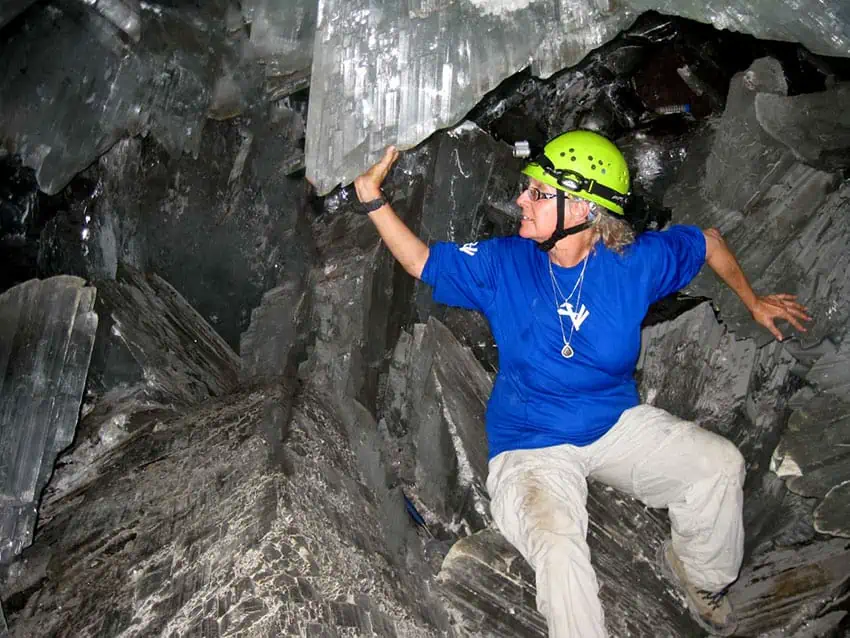
Penny Boston: “The crystals are amazingly sharp. I cut my hand on that one.”
Penny Boston: “The crystals are amazingly sharp. I cut my hand on that one.” Michael N. Spilde

“Terwijl we aan het praten waren, vertelde hij dat ze een nieuwe zijtunnel hadden gegraven met het idee om daar een airconditioning te installeren voor de diepste niveaus van het systeem. Daarbij, zei hij, hadden ze ingebroken in een nieuwe grot: zou ik die willen bekijken?

“Ik zei hem dat ik dat zeker zou doen, en wel zo snel mogelijk omdat ik wist dat de vorige grotten die ze in Naica hadden gevonden grote kristallen bevatten. De meest bekende was La Cueva de las Espadas, de Grot van Zwaarden, die in 1910 was ontdekt. Hoewel de grot al 100 jaar systematisch werd vernield, bevatte hij nog steeds kristallen van wel vier meter lang, en het was zo fascinerend dat Ik was echt benieuwd hoe het eruit moet hebben gezien toen ze er voor het eerst binnenkwamen.

Lazcano vond zijn antwoord toen hij La Cueva de los Cristales binnenstapte.

“Het was een verrassing met hoofdletters! Ik was niet alleen verbaasd over de grootte van de kristallen, maar ook over de agressiviteit van de omgeving eromheen. De temperatuur was 50 graden Celsius (122 F) met 100% luchtvochtigheid.”

Toevallig kreeg Lazcano bezoek van Claude Chabert, een van de beroemdste speleologen van Frankrijk.

“In april of mei 2000 kregen we volledige toestemming om de grot te verkennen, dus wij tweeën waren de eerste speleologen die probeerden hem te bestuderen. We waren allebei opgewonden door die bizarre gigantische kristallen, maar tegelijkertijd konden we gewoon niet geloven hoe vijandig de grot was. We konden er niet langer dan vijf minuten achter elkaar in blijven! Als we probeerden de zes minuten te halen, hadden we het gevoel dat we doodgingen!”

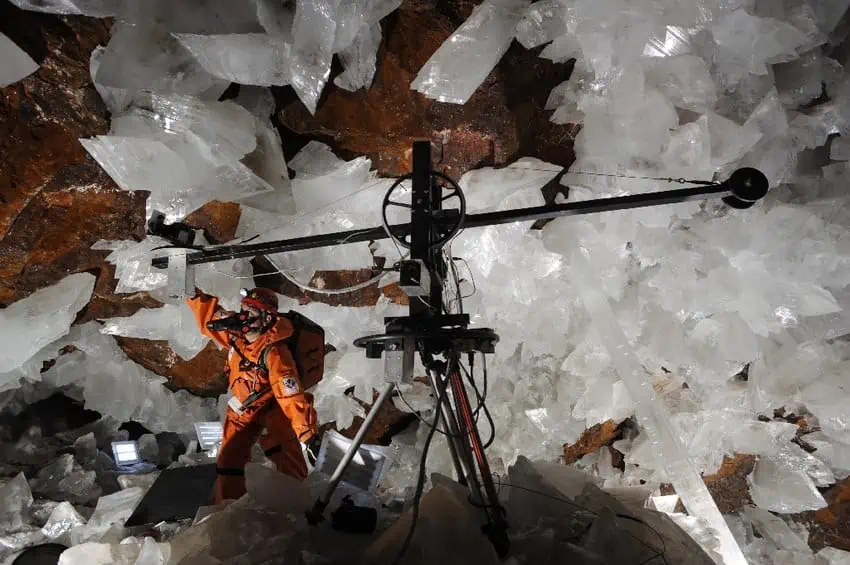
Due to the heat, Mexican filmmaker Gonzalo Infante’s robot camera had to shoot his documentary about the cave one frame at a time.

Toen kwam het bij hem op om contact op te nemen met zijn vrienden van de Italiaanse La Venta Association, die wetenschappelijke ondergrondse expedities organiseert. Hij wist dat ze daar vulkanische grotten hadden verkend waar de temperatuur rond de 80 graden Celsius was, dus schreef hij ze en stuurde ze foto’s.

“Ik kon niet geloven hoe snel ze hier kwamen opdagen … en zo begon Project Naica!”

Het Naica-project, dat bestond uit 12 werkreizen om de grot te verkennen en alles erin te bestuderen, werd georganiseerd door La Venta Exploring Team, dat zijn naam dankt aan een speleo-archeologisch project uit 1990 langs Rio La Venta in Chiapas. Hier ontdekte en bestudeerde het team tientallen grotten, waarvan de meeste al in het jaar voor Christus door de Zoque-indianen werden gebruikt. 300. Sindsdien heeft La Venta projecten uitgevoerd van Myanmar tot Patagonië.

(lees verder at https://mexiconewsdaily.com/mexicolife/mysterious-naica-crystal-cave-still-astonishes/ )


Deadly Crystal Cave | National Geographic (5:43)

https://www.youtube.com/watch?v=wgUFb_l4DLE


20 years after its discovery, mysterious Naica Crystal Cave still astonishes

April 2, 2021

The Naica Crystal Cave, only ever accessible from a mine in Chihuahua but now completely submerged underwater, has bizarrely long, thick crystals.

Its enormous crystals were up to 14 meters long and two meters thick, located inside a cave so hostile that no one could stand to be inside it for more than a few minutes: the whole world was stunned when the first pictures of the Naica Crystal Cave went viral.

As we celebrate the 20th anniversary of the cave’s discovery, it still leaves us gasping in astonishment.

This incredible cave is one of very few places that could be called — in the same breath — “the most beautiful place on earth” and “one step away from Hell.” It was only ever accessible from a tunnel in the Naica Mine, the largest lead, zinc and silver mine in Mexico, operated in Chihuahua by Industrias Peñoles, but today both that tunnel and the cave are entirely under water. But that may actually be to the natural phenomenon’s benefit.

Recently, I caught up with speleologist and historian Carlos Lazcano, the first scientist ever to set foot in the Naica Crystal Cave. Here is his recollection of that experience:

“Twenty years ago, several of my fellow students of geology happened to be working in mines in Chihuahua, and one day I went over there to hang out with them a bit. This is how I bumped into the foreman of the Naica mine.

Penny Boston: “The crystals are amazingly sharp. I cut my hand on that one.”
Penny Boston: “The crystals are amazingly sharp. I cut my hand on that one.” Michael N. Spilde

“As we were chatting, he mentioned that they had dug a new side tunnel with the idea of installing an air-conditioning unit there for the deepest levels of the system. In the process, he said, they had broken into a new cave: would I like to take a look at it?

“I told him I certainly would, and as soon as possible because I knew that the previous caves they had found in Naica contained large crystals. The most famous was La Cueva de las Espadas, the Cave of Swords, which had been discovered in 1910. Although the cave had been systematically trashed for 100 years, it still boasted crystals up to four meters in length, and it was so fascinating that I was really curious how it must have looked the first time they entered it.

Lazcano found his answer when he stepped into La Cueva de los Cristales.

“It was a surprise with capital letters! I was amazed not only at the size of the crystals but also at the aggressiveness of the environment surrounding them. The temperature was 50 degrees Centigrade (122 F) with 100% humidity.”

By chance, Lazcano got a visit from Claude Chabert, one of France’s most famous cavers.

“In April or May of 2000, we got full authorization to explore the cave, so the two of us were the first speleologists to try to study it. Both of us were excited by those bizarre giant crystals, but at the same time, we just couldn’t believe how hostile the cave was. We couldn’t stay in it for more than five minutes at a go! If we tried to make it to six minutes, we felt like we were dying!”

Due to the heat, Mexican filmmaker Gonzalo Infante’s robot camera had to shoot his documentary about the cave one frame at a time.

That’s when it occurred to him to contact his friends at Italy’s La Venta Association, which organizes scientific underground expeditions. He knew that they had explored volcanic caves there where the temperature was around 80 degrees Celsius (176 F), so he wrote to them and sent them pictures.

“I couldn’t believe how fast they showed up here … and that’s how Project Naica got started!”

The Naica Project, which consisted of 12 working trips to explore the cave and study everything in it, was organized by La Venta Exploring Team, which got its name from a 1990 speleo-archaeological project along Rio La Venta in Chiapas. Here, the team discovered and studied dozens of caves, most of them used by the Zoque Indians as long ago as B.C. 300. Since then, La Venta has carried out projects from Myanmar to Patagonia. (read more at https://mexiconewsdaily.com/mexicolife/mysterious-naica-crystal-cave-still-astonishes/ )


Synchroon leven met kosmische intelligentie

(door Paul Mulliner)

Bewustzijn wordt niet op de een of andere manier gecreëerd door onze hersenen, maar bestaat als een al omvattend bewustzijnsveld dat ons allemaal verbindt en het hele Universum orkestreert.

Een cruciaal besef dat we allemaal gemakkelijk kunnen verwerven, wanneer we aandacht besteden aan het bewust-zijn in onszelf, is dat we niet echt afgescheiden zijn van andere mensen als we lijken te zijn.

Het menselijk leven is een continue reeks voorbijgaande momenten en als we aandacht besteden aan gedachten uit het verleden of de toekomst, aan de woorden en afbeeldingen op onze schermen, of aan de wereld om ons heen, drijft onze gerichte aandacht weg van het bewust aanwezig zijn, hier en nu.

Onze gedachten over onszelf en ons leven kunnen gemakkelijk zo’n focus van onze aandacht worden dat we af en toe vergeten aandacht te schenken aan het bewustzijn in ons, de ruimte in ons, die gewoon rustig alles ervaart.

Wanneer we aandacht besteden aan deze innerlijke ruimte, kunnen we snel beseffen dat het lijkt te bestaan door de grens van ons menselijk lichaam heen en overal om ons heen, in alle anderen.

Deze bewuste, kosmische ruimte in ons allemaal, een veld van kosmisch bewustzijn, stelt ons in staat om te beseffen en te kennen wat bewust-zijn is binnen de context van een menselijk lichaam.

Het stelt ons in staat een mensenleven te ervaren, terwijl onze lichaamszintuigen van zien, aanraken en horen een stroom gegevens leveren die door onze hersenen worden verwerkt.


. . .

Door onze aandacht naar binnen te richten, kunnen we afstemmen op dit ruimtelijke kosmische bewustzijn, in de pas lopen met zijn synchronistische intelligentie en toegang krijgen tot een stroom van nuttige intuïtieve inzichten.


. . .

Van kinds af aan heeft dit bewustzijn denkgrenzen gecreëerd rond een persoonlijk zelf, een gevoel van afgescheidenheid van de mensen om ons heen.

Dit persoonlijke ego kan nuttig zijn voor ons in de wereld, maar kan gemakkelijk disfunctioneel worden als we onszelf niet toestaan het regelmatig voorzichtig op te lossen, door aandacht te schenken aan de ruime aanwezigheid van bewust-zijn in ons.

Ego is onzeker omdat het een persoonlijke gedachteconstructie of idee is, een oppervlakkige conceptuele fictie die sinds onze kindertijd is gecreëerd en die geen basis heeft in het diepere, intuïtief bekende, universele bewustzijn in ons allemaal.

Ideeën over onszelf die de kern van het ego vormen, bieden een vervormende lens waardoor we de wereld zien en de realiteit waarin we leven wordt gekleurd door onze interpretaties ervan.

Hoewel we verenigd zijn in één bewuste ruimte met iedereen om ons heen en nooit echt gescheiden zijn van andere mensen, kunnen we van hen gescheiden lijken te zijn als we ons in het prisma van het ego bevinden en onze aandacht richten op een onophoudelijke stroom van gedachten die onze beleving van de wereld vervormen.

Door de aandacht naar binnen te richten, kunnen we deze gedachtegrenzen oplossen, een gedachtevrije innerlijke ruimte beseffen en onze intuïtieve verbinding herontdekken met het ene weten dat ons allemaal kent als zichzelf, de kosmische intelligentie die al het leven tot stand brengt in het hele Universum .

Een enkel kosmisch zelf bestaat in ons allemaal en wordt kenbaar als we toestaan dat ons onophoudelijke denken oplost.


. . .


Bewustzijn in ons allemaal is een onverdeelde ervaringsruimte.


. . .


Wanneer we zachtjes onze aandachtsfocus vasthouden in de stille innerlijke rust van bewust-zijn, merken we dat de gebruikelijke stroom van gedachten over onszelf of andere mensen begint op te lossen.

We hebben de innerlijke aanwezigheid van een bewustzijn gevonden dat bestaat als een bewustzijnsruimte om en tussen ons en overal in ons gezamenlijk.

We realiseren ons dat er geen echt verschil is tussen het bewustzijn in onszelf en het bewustzijn in andere mensen en dit besef kan onze ervaring van het leven in de wereld ingrijpend veranderen.

We zijn allemaal samen ondergedompeld in één bewuste ervaringsruimte, een veld van kosmisch bewustzijn dat ons verbindt op de zinvolle en synchronistische manieren, zo lijkt het.

Eigenlijk is het juister om te zeggen dat wij dit kosmische bewustzijn zijn, deze bewuste ervaringsruimte, die verschijnt als afzonderlijke levende wezens.

Het besef van de essentiële eenheid van bewust-zijn helpt ons om de stammenscheiding die we kunnen voelen over mensen die anders zijn dan wij, op te lossen en wekt een kosmisch gevoel van relatie en verbondenheid met onze planeet en al haar levende wezens.

Door onze aandacht naar binnen te richten, kunnen we afstemmen op dit ruimtelijke kosmische bewustzijn, in de pas lopen met zijn synchronistische intelligentie en toegang krijgen tot een stroom van nuttige intuïtieve inzichten.


. . .


Ieder van ons is een oneindige, onbeperkte kosmische intelligentie die zichzelf transformeert in de levende vorm van een mens voor de duur van een mensenleven.


. . .

Als de continu gegenereerde uitdrukkingen van een oneindige intelligentie die in alle ruimten van het Universum bestaat, hebben we toegang tot de transformerende kracht van dit ruimtelijke bewustzijn wanneer we maar willen en kunnen we intuïtief inzichten en inspiratie doorkrijgen vanuit deze kosmische veldintelligentie die al het leven overal orkestreert en verbindt.

Door onze aandacht naar binnen te bewegen, kunnen we de aanwezigheid leren kennen van de scheppende bron-intelligentie die voortdurend de hele wereld uit zichzelf creert, zichzelf vibrerend transformeert in de verweven aansturing van de biochemie van levende cellen.

Een ruimtelijk kosmisch intelligentie-organisme is het primaire materiaal van het Universum en alles wat leeft is er een continu gegenereerde uitdrukking ervan, een trillingsverandering van zichzelf waardoor het zichtbaar en tastbaar wordt als bomen, bloemen, mensen en al het leven overal.

We zijn allemaal intrinsiek verbonden met deze expressieve, altijd evoluerende, kosmische intelligentie en door ons meer bewust te worden van deze realiteit kunnen we keuzes maken in de wereld die synchroon lopen met het welzijn van ons allemaal en onze planeet.

Naarmate we onze eigen voortdurende wording van moment tot moment voelen en onszelf kennen als een stroomproces dat kosmische energie transformeert in materiële menselijke wezens, komen we dichter bij het begrijpen wat onze wereld wezenlijk is.

Ieder van ons is een oneindige, onbeperkte kosmische intelligentie die zichzelf transformeert in de levende vorm van een mens voor de duur van een mensenleven.

We zijn kosmische wezens, uitdrukkingen van een intelligentie die in alle ruimten van het Universum bestaat en we hebben toegang tot de transformerende kracht van deze intelligentie wanneer we maar willen.

We kunnen afstemmen op een oneindig bewustzijn met onbeperkte capaciteit voor verandering en evolutie, een ruimtelijke kosmische intelligentie die alles wat we kennen als realiteit overal orkestreert en samenbindt.

Wanneer we onszelf bewust ervaren als uitdrukkingen van kosmische intelligentie, kunnen we een groter besef krijgen van wat het betekent om mens te zijn.

3_12_19
Paul Mulliner is schrijver en digitaal kunstenaar.
Lees meer op https://paul-mulliner.medium.com/

Bron: https://paul-mulliner.medium.com/getting-in-sync-with-synchronicity-8a56ed257cb1

Art: image: paul mulliner 26_10_19

============================== ==============================================

Living in Sync with Cosmic Intelligence


Conscious awareness isn’t somehow created by our brain, but exists as an immersive consciousness field which connects all of us and orchestrates the whole Universe.

A crucial realization that we can all find easily, when we pay attention to the conscious awareness inside ourselves, is that we’re not as separate from other people as we seem to be.

Human life is a continuous series of transient moments and as we pay attention to thoughts of past or future, to the words and pictures on our screens, or to the world around us, our focussed attention drifts away from being consciously present, here and now.

Our thoughts about ourself and our life can easily become such a focus of our attention that we forget to occasionally pay attention to the consciousness inside us, the space inside us, which is just quietly experiencing everything.

When we pay attention to this inner space, we can quickly realize that it seems to exist through the boundary of our human body and all around us, inside everyone else.

This conscious, cosmic space inside all of us, a field of cosmic consciousness, is allowing us to realize and know conscious awareness within the context of a human body.

It’s allowing us to experience a human life, as our body senses of sight, touch and hearing provide a stream of data to be processed by our brain.

. . .

Focussing our attention inwardly, helps us tune into this spatial cosmic consciousness, get in sync with its synchronistic intelligence and access a stream of helpful intuitive insights.

. . .

Since childhood, this conscious awareness has been creating thought boundaries around a personal self, a sense of separation from the people around us.

This personal ego can be useful to us in the world, but can easily become dysfunctional if we don’t allow ourselves to gently dissolve it regularly, by paying attention to the spacious presence of conscious awareness inside us.

Ego is insecure because it’s a personal thought-construct or idea, a shallow conceptual fiction created since childhood, which has no grounding in the deeper, intuitively known, universal consciousness inside all of us.

Ideas about ourself which make up the core of ego provide a distorting lens through which we see the world and the reality we live in becomes coloured by our interpretations of it.

Although we’re joined into one conscious space with everyone around us and never actually separate from other people, we can seem to be separate from them when we’re inside the prism of ego and we’re focussing our attention on an incessant stream of thoughts which are warping our experience of the world.

Taking a focus of attention inward helps us dissolve these thought boundaries, realize a thought-free inner space and rediscover our intuitive connection into the one knowing which knows all of us as itself, the cosmic intelligence which is bringing all life into being throughout the Universe.

A single cosmic self exists inside all of us and becomes knowable as we allow our incessant thinking to dissolve away.

. . .

Consciousness in all of us is a single experiencing space.

. . .

As we gently hold a focus of attention in the quiet inner stillness of conscious awareness, we find that the usual stream of thoughts about ourself or other people begins to dissolve away.

We’ve found the inner presence of a consciousness that exists as an awareness-space around and between us and inside all of us everywhere.

We realize there’s no actual difference between the conscious awareness inside us and the conscious awareness inside other people and this realization can profoundly alter our experience of living in the world.

We’re all immersed together in one conscious experiencing-space, a field of cosmic consciousness that connects us in ways that can appear meaningful and synchronistic.

Actually, it’s more accurate to say that we are this cosmic consciousness, this conscious experiencing-space, appearing as separate living beings.

Realizing the essential oneness of conscious awareness helps us begin to dissolve the tribal separation we may be feeling about people who are different than us and awakens a cosmic sense of relationship and connectedness with our planet and all its living beings.

Focussing our attention inwardly, helps us tune into this spatial cosmic consciousness, get in sync with its synchronistic intelligence and access a stream of helpful intuitive insights.

. . .

Each one of us is an infinite, unlimited cosmic intelligence transforming itself into the living form of a human being for the duration of a human life.

. . .

As the continuously generated expressions of an infinite intelligence existing in all space in the Universe, we can access the transformative power of this spatial consciousness whenever we choose and we can intuitively channel insights and inspiration from this cosmic field-intelligence which orchestrates and connects all life everywhere.

Moving our attention inward allows us to know the presence of the generative source-intelligence that is continuously making the whole world out of itself, vibrationally transforming itself into the interwoven orchestration of living-cell biochemistry.

A spatial cosmic intelligence-organism is the primary stuff of the Universe and everything that lives is a continuously generated expression of it, a vibrational altering of itself that allows it to become visible and touchable as trees, flowers, human beings and all life everywhere.

We’re all intrinsically connected into this expressive, always evolving, cosmic intelligence and becoming more conscious of this reality helps us make choices in the world which are in sync with the well-being of all of us and our planet.

As we sense our own continuous becoming moment by moment and know ourselves as a flow-process transforming cosmic energy into material human beings, we get closer to understanding the actuality of our world.

Each one of us is an infinite, unlimited cosmic intelligence transforming itself into the living form of a human being for the duration of a human life.

We’re cosmic beings, expressions of an intelligence existing in all space in the Universe and we can access the transformative power of this intelligence whenever we choose.

We can tune in to an infinite consciousness with unlimited capacity for change and evolution, a spatial cosmic intelligence which is orchestrating and binding together all of what we know as reality everywhere.

As we consciously realize ourselves as expressions of cosmic intelligence, we can find a larger sense of what it means to be human.

3_12_19

Paul Mulliner is a writer and digital artist.

Source: https://paul-mulliner.medium.com/getting-in-sync-with-synchronicity-8a56ed257cb1

Art: image: paul mulliner 26_10_19


Silence – Day of the Moon

Stel, we leven in een realiteit waar we niet alles kunnen zien. En ik heb het niet over hele kleine dingetjes of over de frequenties die buiten het zichtbare spectrum vallen. Stel, dat het gaat over een situatie waar hypnose van pas komt: elke keer als je iemand ziet, wordt je geheugen gewist specifiek gericht op een interactie met die “iemand”.

Dit is in het kort waar episode “Day of the Moon” van Doctor Who over gaat (seizoen 6, ep. 2).

Daar is het een beschaving die zichzelf Silence noemt geïnfiltreerd bij alle overheden en instituten op Aarde. Maar niemand weet het, omdat het geheugen van de mensen die ze zien en horen steeds gewist wordt. Doctor is een tijdreiziger, die in zijn multidimensionale ruimteschip Tardis reist. Het lijkt van buiten op een blauwe politie hokje maar is eigenlijk heel groot van binnen.

Doctor Who : Season 6 Episode 2 – Day of the Moon (BBC, 2011) – Trailer

Steven Moffat schreef het script van Day of the Moon en wilde per se beelden van Apollo 11, landing op de maan, van Area 51 en van Richard Nixon en de Oval Office erbij betrekken. Daarom was deze episode in de Verenigde Staten gefilmd, wat niet vaak gebeurde bij Britse Doctor Who serie.

The Doctor Defeats The Silence | Day Of The Moon | Doctor Who (3:50)


Arians

(a chapter from the book “The Extraterrestrial Species Almanac” by Craig Campobasso.)

Universal Origin: Arians come from the planet Arian, located in the Aldebaran system in the Taurus constellation.

Physical Characteristics: Arians are indistinguishable from Asian races on Earth. Women and men are slender and stand from five foot nine to six foot six. Their faces are oval-shaped with attractive features, and framed by lustrous, black hair. Their eyes are usually brown or black, and skin tones range from golden to yellow to tan. Their life spans are over four thousand years.

There is another Asian race, called the Gne, from planet Pall, in a neighboring system that is a part of their crew. The only difference in appearance is they have small, bud-shaped noses.

Belief System: Arians believe in the Cosmic Law of One. They believe all souls are comprised of the primordial cell, and because of this all are one and the same. Their advanced consciousness allows them awareness of the universe’s invisible and visible realms. They thrive on working with other races collectively, enjoying the bonds of universal brotherhood.

Cosmic Agenda: Arians are explorers of the galaxies, and their members include anthropologists, psychologists, biologists, geneticists, and gene specialists. They are experts of intergalactic languages—spoken word or telepathic. They study men and women from various civilizations across the universe, and collect genetic materials. When they come in contact with younger civilizations, such as Earth, they share their civilization’s history when they were at war with other worlds, and how they overcame their challenges. They warred for so long, and there was such a loss of life, that after countless years both sides came to realize how useless war was. They stopped manufacturing weapons and came together. They evolved, explored space, met their planetary neighbors, and built a cosmic community.

On worlds in conflict an emergency Melchizedek son is dispersed to be an intermediary between both sides. These sons function on many diverse levels of the universe, in this and other dimensional layers. They are able to do the impossible. One might think they are the very breath of God when in their presence.

Technology: Arian fleet craft use two fusion engines that operate in a vacuum, allowing them to travel through the antimatter universe. It takes two weeks to warm up their far-futuristic engines when they have been sitting for a time. Their elongated motherships are based on Galacterian technology and have extending appendages in the front, middle, and back. From tip to stern, the craft spans about 2,691 feet (ca 820 meters). They have eleven other races onboard their mothership from Aldebaran or neighboring systems.

Being language specialists, they have a translator box for every galactic language they have come across.

Arian healing machines are able to separate the physical and spiritual bodies, and then slice the pertinent elements for viewing. Once the source of a disease is isolated, colors and sounds are then employed for instant healing.

They are able to grow replacement limbs that function like natural limbs by using the patient’s own DNA.

They’re also genetically engineering new animal species that have a symbiotic relationship to the environment they are placed in.

Consciousness Abilities: Arians are fully conscious and sovereign beings. Their telepathic headgear amplifies brain frequencies 100,000 times to open channels of communication to the biological supercomputer onboard their craft.

Dimensional Capacity: Arians are multidimensional. They use the antimatter universe for travel, cutting travel time to a minimum.

From: The Extraterrestrial Species Almanac: The Ultimate Guide to Greys, Reptilians, Hybrids, and Nordics (MUFON) Paperback by Craig Campobasso