Making the Tao Visible… with intuitive art

(by Paul Mulliner)

The intellect has little to do on the road to discovery. There comes a leap in consciousness, call it intuition or what you will, and the solution comes to you and you don’t know how or why. All great discoveries are made in this way — Albert Einstein

Our task is to listen to the news that is always arriving out of silence — Rainer Maria Rilke

The quieter you become, the more you are able to hear — Rumi

Intuition is the spontaneous and silent voice of the hidden, the universal and eternal, the Tao.

A sudden inner prompting from the universal consciousness that’s often precisely appropriate and useful to our current circumstances.

That hunch we might get about whether a particular choice is appropriate, the sudden hint that something we’ve lost is in an unexpected place.


Spontaneous insights and sudden inspirations have helped human beings through the ages find new understanding and create new music and art.

And realize breakthroughs improving the quality of their life, making crucial change happen.

Despite the apparent chaos we can see happening around us, the underlying clarity and pragmatic wisdom of universal consciousness always remain available.

We must close our eyes and invoke a new manner of seeing, a wakefulness that is the birthright of us all — Plotinus

Our inspirations and insights emerge from an inexpressible source inside all of us, the universal consciousness.

A universal consciousness trying to help us navigate our life.


Something hidden, and almost inexpressible exists in all our lives, and with digital art software, we can now make our intuitive realizations of this hidden universal consciousness visible.

Artists allow us to see what we are unable to see, but somehow already know — Rick Rubin

With art, we can reveal our intuitions of the unseen, the underlying field of universal consciousness.
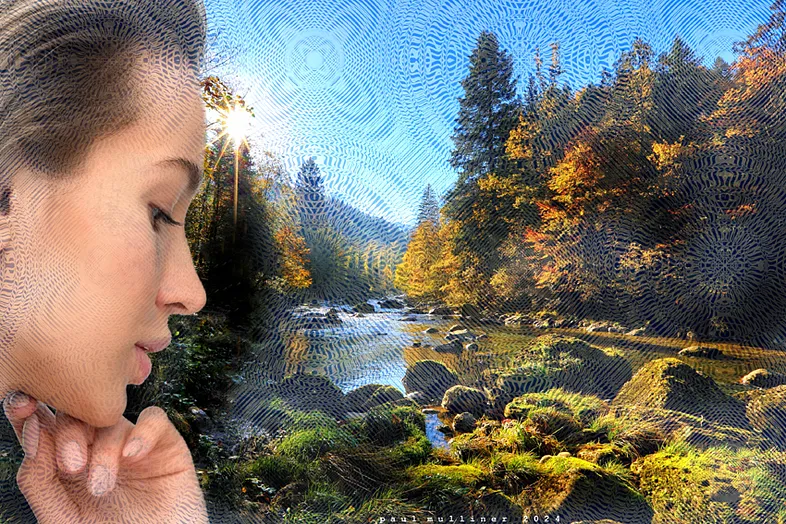
Art by the Author 2024, model photo icons8 Unsplash, landscape photo Ricardo Gomez Angel Unsplash

For writers, intuitive poetry helps record the inner flow of insights and metaphors emerging from the universal source inside all of us, the eternal, the Tao.

We can see writing poetry as part of a personal journey of self-discovery with spontaneous insights and sudden intuitions written down, maybe scribbled into a personal notebook.

We can allow our personal creativity to occupy a large and important space at the heart of our lives.

Art by the Author 2023, model photo Fleur Kaan, landscape photo Brigitta Schneiter, both on Unsplash

Immersing ourselves in silence helps us temporarily dissolve our ego and realize we’re participants in a conscious and intelligent universe.

The Tao is nowhere to be found. Yet it nourishes all things and brings them to fulfilment — Tao Te Ching 41

That which cannot be seen is called invisible.
That which cannot be heard is called inaudible.
That which cannot be held is called intangible.

By intuition you can see it, hear it, and feel it.

Then the unseen, unheard and untouched
are present as one.

— from the Tao Te Ching 14th verse
translation/ interpretation by Wayne Dyer

We’re living in a time when insights from the ancient intuitive wisdom traditions of Taoism, Buddhism, and the Hindu Vedanta, among others, are being joined with insights from the front edge of science to create a new synthesis, a new worldview fit for the 21st century.

A new contemporary spirituality, inspired by these traditions and emerging from meditation practice, is becoming increasingly in sync with insights from the latest scientific research.


And it’s now time in our long cultural evolution as human beings to bring our analytical science and intuitive spirituality together.

And recognize that consciousness is the primary element in the universe, not matter.


Our view of reality, our worldview, is often shaped by our preconceptions and assumptions, and can sometimes be an unconscious prism through which we see the world.

The worldview that so characterized the 20th century has entered deep into mainstream thinking and acts as a sort of foundational myth, a way of structuring and filtering reality.


Positive change is possible, but the most fundamental and difficult change needed is a change in our awareness, a change in the way we see the world, each other, and our planet.

And this change can begin to happen when we tune in to the conscious silence inside us and find for ourselves the intuitive realization that it’s everywhere, inside all of us.


We’re a universal consciousness knowing what it is to be a human being.

A universal consciousness the Native American Lakota and Algonquin referred to as the Great Mystery or Great Spirit and many other traditions through the centuries have created their own names and descriptions.

Art by the Author 2022, model and landscape photo Unsplash

We are all visitors to this time, this place. We are just passing through. Our purpose here is to observe, to learn, to grow, to love… and then we return home — Australian Aboriginal Proverb

The new worldview isn’t a completely new way of seeing, but rather an evolution of pre-modern wisdom traditions that accepts and values the many new insights now emerging from science.

For nearly a century, researchers in physics have known all the ‘material stuff’ in our universe to be clusters of tiny wave patterns in a field of nonlocal cosmic energy.

In more recent decades they’ve discovered the exquisite interwoven orchestration of cell biochemistry, revealing the presence of an extraordinary intelligence throughout the universe.

Art by the Author 2024: model and landscape photo Unsplash

When we’re born, the conscious universe becomes a human being.

And though we don’t get much time to be human, every day we can find time to pause, pay attention to the silence inside us, and realize an inner connection to the conscious universe.


Every moment we’re choosing what we pay attention to.

We’re choosing where to focus our attention.

Social media is very carefully designed to engage our attention, to hold our gaze, and to maximize the time we spend focusing our attention on a constant stream of new images and text.

We can choose however, to sometimes focus our attention on the conscious space and silence inside us.

Away from our screens and our thoughts and into now, the present moment.


The universal consciousness has an extraordinary intelligence, not only orchestrating the astonishing complexity of the biochemistry of our body, but also bringing us intuition.

And when we pay attention to the conscious silence inside us, we help intuition flourish in our life.


We’re born into an enduring universal consciousness that’s always here, throughout the birth and death of all of us.

We are waves of the same sea, leaves of the same tree, flowers of the same garden — Seneca

And we can choose to pay attention to the conscious silence inside us.

An inner conscious space, a healing time away from our life in the world.

Our conscious inner center, woven into consciousness throughout the universe.


Paul Mulliner 2024

Source: https://medium.com/a-little-stoic-wisdom/making-the-tao-visible-4130fe1fb932

Art on the cover: Paul Mulliner


Verlossing

(door David Price)

‘In de tien jaar dat ik niet in de ring had gestaan, werd ik predikant. Soms had mijn auto een booster nodig en kwam er iemand langs om me te helpen. Ik vroeg hoeveel ik hem schuldig was. Hij zei: ‘Ga weg, grote jongen.’ Hij wist niet eens dat ik ooit wereldkampioen zwaargewicht was geweest, maar hij was zo aardig voor me. Iedereen was zo aardig voor me en ik dacht altijd: ‘Ik wou dat ik weer kampioen kon worden, want ik had aardiger tegen mensen moeten zijn.’ Toen ik terugkwam, bouwde ik mijn profiel weer op en betaalde ik alle mensen terug teren wie ik onaardig was geweest. De comeback was mijn manier om sorry te zeggen dat ik de eerste keer zo onaardig was. Dat was de beste tijd uit mijn hele bokscarrière, toen ik terugkwam omdat ik iets teruggaf. Toen ik in Reno, Nevada was, kon ik geen handtekeningen uitdelen of mensen de hand schudden omdat ik mijn hand had verstuikt, dus ging ik gewoon bij een post zitten en liet iedereen langskomen om te praten of een foto te maken. Dat deden ze. Ik was daar drie uur en het was de mooiste tijd van mijn leven als bokser. Niets vergeleken met dat moment – zelfs niet het verslaan van Frazier, of het samenzijn met Ali in Zaïre.’

-George Foreman

*

Proberen belangrijk te zijn en aardig te zijn, doet verschillende soorten mensen ontstaan. Iedereen die enkele tientallen jaren heeft geleefd, kan niet anders dan zich momenten van ongeduldige onvriendelijkheid herinneren. We hebben scholen nodig die leren hoe we onze menselijkheid kunnen laten groeien, maar in plaats daarvan vullen we ons hoofd met kennis en denken we dat we ‘onderlegd’ zijn. Onze religie heeft geen enkele invloed op onze onvriendelijkheid. In sommige gevallen vergroot het het.

Wat is tenslotte een succesvol mens? Speelt vriendelijkheid een rol? Hoe vertaalt zich dit in succes? Kun je een goed leven leiden als je alleen maar gefocust bent op je vooruitgang in de ogen van de wereld? Is filantropie gewoon een andere manier om indrukwekkend over te komen?

Ik denk dat we verlossing nodig hebben van de waarden die onze cultuur ons heeft gegeven, dat we moeten inzien hoe ons is geleerd om onaardig te zijn tegen onze eigen natuur, dat we ons plotseling kunnen realiseren dat we dingen doen en gedachten denken die beschamend zijn. Waar komt dat gedrag vandaan? Wordt het veroorzaakt door de maatschappij of zijn we gewoon slechte mensen?

Verlossing is reëel, het is nodig en wordt ogenschijnlijk aangeboden door religie, maar een echte verandering van hart is zeldzaam. We zijn eraan gewend dat er tegen ons wordt gepredikt en dat we overtuigende redenen en een ijzersterk moralisme krijgen, maar vreemd genoeg veranderen harten door de magie van vriendelijkheid. En soms moet je gewoon besluiten dat de richting die je opgaat je niet bevalt en weigeren daarheen te gaan.

Misschien besluiten we om onszelf duidelijker te zien door de noodsituaties die we voor onszelf creëren, en misschien besluiten we gewoon een leven te leiden dat de innerlijke monsters uitdrijft. Onze samenleving helpt ons niet reëler of vriendelijker te worden; zij daagt ons uit om meer menselijker te worden ondanks al die druk.

Artem Rogowoi

Jezelf vergeven voor je onvriendelijkheid is onmisbaar voor de verlossing, en het is moeilijk om te doen. Onaardig zijn tegen jezelf wordt ten onrechte aangezien voor goed, oprecht en rechtvaardig. Onvriendelijkheid is echter onvriendelijkheid, thuis of in het buitenland. Als we geluk hebben, hebben we genoeg tijd op aarde om de beste versie van onszelf te worden. Maar omdat we vooral gedrag leren imiteren, denken we eerst na over hoe we eruitzien in plaats van over wie we zijn in welke situatie dan ook.

Verlossing vindt plaats op het niveau van wie we zijn. Hoe het gebeurt is soms mysterieus. Het kan zijn dat we beu worden van wie we zijn en dat we het niet meer kunnen rechtvaardigen. Misschien ontdekken we een innerlijke opslagplaats van angst en woede waarvan we ons niet eens bewust waren. Het is onmogelijk om enige fundamentele verandering in onszelf te ondergaan als we de wortels van de angst niet herkennen en er geen aandacht aan besteden. Het is moeilijk om als mens te functioneren als er boosheid of woede in ons huizen. We moeten deze delen van onszelf benaderen met een verlangen om te begrijpen, met andere woorden, vriendelijk.

Artem Rogowoi

Bron: https://davidprice-26453.medium.com/redemption-84107d26c472

Cover art: Jun Akutsu


Redemption

(by David Price)

‘In the 10 years out of the ring I became a minister. Sometimes my car would need a booster, and a stranger would stop by to help me out. I asked how much I owed him. He said, ‘Get out of here, big ‘un.’ He didn’t even realise I was once heavyweight champion of the world but he was so kind to me. Everyone was so kind to me and I used to think, ‘I wish I could be champion again because I should have been nicer to people.’ When I came back I built my profile up again and I repaid all the people I had been unkind to. The comeback was my way of saying sorry for being so unkind the first time round. That was the best time of my whole boxing career, when I came back because I gave back. When I was in Reno, Nevada I couldn’t sign autographs or shake people’s hand because I had sprained my hand, so I just sat by a post and let anyone come over and talk, or take a picture. They did. I was there for three hours, and it was the nicest time of my life as a boxer. Nothing compared to that moment — not even beating Frazier, or being with Ali in Zaire.’

George Foreman

*

Trying to be important and being kind make different kinds of people. Anyone who can remember decades of living can’t help but recall moments of impatient unkindness. We need schools that teach how to grow our humanity, but instead we fill our heads with knowledge and think we’re “educated.” Our religion doesn’t affect our unkindness in the least. In some cases it magnifies it.

What is a successful human being, after all? Does kindness play a part? How does it figure into success? Can you have a good life just focused on your advancement in the eyes of the world? Is philanthropy just another way to look impressive?

I think we need redemption from the values we are given by our culture, that we need to see how we are taught to be unkind in spite of ourselves, that we may suddenly realize we are doing things and thinking thoughts that shame us. Where does that behavior come from? Is it induced by society or are we just bad people?

Redemption is real, it’s needed, and it’s ostensibly offered by religion, but a real change of heart is rare. We’re used to being preached to and given convincing reasons and rock solid moralisms, but hearts change by the magic of kindness, strangely enough. And sometimes you just have to decide you don’t like the direction you’re going and refuse to go there.

Maybe we decide to see ourselves more clearly through the emergencies we create for ourselves and maybe we just decide to make a life that exorcizes the inner monsters. Our society doesn’t help us become more real or more kind, it challenges us to become more humane in spite of its pressures.

Artem Rogowoi

Forgiving yourself for your unkindness is indispensable for redemption, and it’s hard to do. Being unkind to yourself is mistaken for being good, being upright and righteous. Unkindness is unkindness, though, at home or abroad. If we’re lucky we’ll have enough time on earth to become the best version of ourselves. But since we mostly learn to imitate behaviors we think first about how we look instead of who we are in any situation.

Redemption is at the level of who we are. How it happens is mysterious sometimes. We may just get sick of who we are and become unable to justify it anymore. We may discover an inner store of fear and rage we weren’t even aware of. It’s impossible to undergo any fundamental change in ourselves if we don’t recognize and attend to the roots of fear. It’s hard to function as a human being if we harbor rage or fury. We need to approach these parts of ourselves with a desire to understand, in other words, kindness.

Artem Rogowoi

Source: https://davidprice-26453.medium.com/redemption-84107d26c472


Eenvoudige liefde en haar bijwerkingen

(door David Price)

… De waarheid is dat ik concurrentie niet begrijp of er niet om geef, ik kan niet eens begrijpen waar Hemingway en zijn tegenhanger Mailer naar verwijzen als ze praten over het opnemen tegen een ander talent in de ring. Voor zover ik weet is er nooit een kunstwerk zich naar een ander kunstwerk verplaatste; de levenden concurreren niet met de doden, noch met de levenden.  

— Joyce Carol Oates  

*  

Leven in tevredenheid met kleine middelen. Om elegantie te zoeken in plaats van luxe, en verfijning in plaats van mode. Om waardig te zijn, niet respectabel, en welvarend, niet rijk. Luisteren naar sterren en vogels en baby’s en wijzen met een open hart. Hard studeren, nadenken in stilte, openhartig handelen, teder praten, gelegenheden afwachten. Nooit haasten. Kortom, laten het spirituele, het ongedwongene en het onbewuste door het gewoonlijke heen op te komen. Dit is mijn symfonie.  

— William Henry Channing, My symphony  

*  

Mijn werk gaat over de kwetsbaarheid van het leven en de moeilijkheid om lief te hebben en bemind te worden… Het onbewuste wordt door kunst tot bewustzijn gebracht. Mijn kunst is een manier om demonen uit te drijven die me sinds mijn jeugd achtervolgen… De enige echte kunst die ik mijn hele leven heb beoefend, is de kunst van het vechten tegen depressie, emotionele verslaving… Het overwinnen van angst is waar ik in geïnteresseerd ben…  

– Louise Bourgeois, uit Father Destruction  

*  

Heb je je ooit afgevraagd wat koffie is? Koffie is een excuus. Een excuus om een vriend te vertellen dat je van hem houdt.  

— Luciano De Crescenzo

*

Creativiteit gebaseerd op concurrentie lijkt een contradictio in terminis, iets wat zichzelf tegenspreekt. We stellen ons voor dat creatieve mensen gemotiveerd worden door alles behalve competitie en het is een beetje teleurstellend om te horen dat ze vaak een oogje hebben op het succesniveau van hun tijdgenoten. De middelen zijn tenslotte schaars en verhongerende kunstenaars bestaan echt. Het is gemakkelijk om je concentratie op waarheid en schoonheid te verliezen en je zorgen te maken over de huur. Je zou je moeten afvragen of dingen met opzet zo geregeld zijn.  

Er is enige standvastigheid voor nodig om na te streven wat je inspireert in een samenleving die bijna uitsluitend gericht is op de mechanismen van winst en verlies. De langzaam bewegende ziel gaat verloren in een cultuur die gedreven is door snelheid. Veel gaat verloren in de enorme snelheid van hoe we leven. Je krijgt niet de kans om op te merken hoe de natuur groeit en sterft, wat ze wil en hoe ze daadwerkelijk lijdt onder ons bewind. De levenloze wereld die we in onze geest toveren, bestaat niet echt. We hebben het verzonnen.  

Onze veronderstellingen van een levenloze wereld zeggen iets meer over ons dan over de wereld. Het bestaan op deze manier zien is een vorm van minachting. De natuurlijke wereld heeft het moeilijk om normaal te functioneren in het aangezicht van een mensheid die eenvoudige liefde heeft verloren, die deze heeft vervangen door concurrentie.  

We vertrouwen op onze dichters en kunstenaars om de race om te slagen volgens de regels van de samenleving te doorzien, maar ook zij kunnen in het spel worden gezogen. Je vraagt je af of eenvoudige liefde echt kan bestaan in het hedendaagse menselijke hart, omdat het zo wordt lastiggevallen door de maatstaven van de samenleving. We zijn geconditioneerd om ons onzeker en gedestabiliseerd te voelen door de stenen en pijlen van familie, kerk en onderwijs. Relaties zijn zelden eenvoudig vanwege ons verborgen innerlijke leven en zijn angsten, verlangens en conditioneringen.  

Cardwell S. Higgins (1902-1983)

Er zijn mensen die eropuit trekken om te zien en te begrijpen wat er gebeurt op diepten die gewoonlijk aan het zicht onttrokken zijn. Dichters, kunstenaars, schrijvers, filosofen en psychologen proberen vragen te beantwoorden over relaties tussen energieën en hoe ze op elkaar inwerken. Het is onmogelijk ingewikkeld. De meeste mensen vertrouwen liever op een paar zwart-wit axioma’s en stoppen met zich afvragen en vragen stellen. Het is te verontrustend.  

En dan zijn er mensen die niet kunnen stoppen met zich verwonderen en vragen stellen. In plaats van een gevoel van nutteloosheid zijn ze irrationeel optimistisch over een beetje dieper kijken, misschien een schoonheid ontdekken die ze nog niet hadden gezien. Het lijkt erop dat sommige mensen vroeg in hun leven stoppen met vragen stellen en anderen niet. Degenen die dat niet doen, zullen vroeg of laat afscheid moeten nemen van conventioneel denken, maar er komt iets creatiefs vrij in het proces.  

Pandora (Detail), 1902 — oil on canvas — Charles-Amable Lenoir (French, 1860–1926)

*


Simple Love And its Complications

Maxfield Parrish

…The truth is I don’t understand or care about competition, I can’t even understand what Hemingway and his counterpart Mailer are referring to when they talk about facing another talent in the ring. As far as I know, no work of art has ever moved to another work of art; the living do not compete with the dead, nor the living.

— Joyce Carol Oates

*

To live content with small means. To seek elegance rather than luxury, and refinement rather than fashion. To be worthy not respectable, and wealthy not rich. To listen to stars and birds and babes and sages with an open heart. To study hard, think quietly, act frankly, talk gently, await occasions. Never hurry. In a word, to let the spiritual, the unbidden and the unconscious rise up through the common. This is my symphony.

— William Henry Channing, My Symphony

*

My work is about the fragility of living and the difficulty of loving and being loved… The unconscious is brought to consciousness through art. My art is a way to exorcise demons that haunt me since childhood… The only real art that I’ve practiced all my life has been the art of battling depression, emotional addiction… Conquering fear is what am interested in…

— Louise Bourgeois, from Father Destruction

*

Ever wondered what coffee is? Coffee is an excuse. An excuse to tell a friend that you love them.

— Luciano De Crescenzo

*

Creativity based on competition seems like a contradiction in terms. We imagine creative people are motivated by anything but competition and it’s a little disappointing to learn that they often have an eye cocked at their contemporaries’ level of success. Resources are sparse, after all, and starving artists do exist. It’s easy to lose your concentration on truth and beauty and start to worry about the rent. You have to wonder if things are arranged like that on purpose.

It takes some fortitude to pursue what inspires you in a society that’s focused almost exclusively on the mechanics of profit and loss. The slow moving soul is lost in a culture built on speed. A lot gets lost in the sheer velocity of how we live. You don’t get the opportunity to notice how nature grows and dies, what it wants and how it actually suffers under our reign. The inanimate world we conjure in our mind doesn’t actually exist. We made it up.

Our assumptions of a lifeless world says more about us than it does the world. Seeing existence this way is a form of contempt. The natural world is having a hard time functioning normally in the face of a humanity that has lost simple love, that has replaced it with competition.

We rely on our poets and artists to see through the race to succeed by society’s rules, but they too can be sucked into the game. You wonder if simple love can actually exist in the contemporary human heart because it’s so harassed by society’s metrics. We’re conditioned to feel insecure and destabilized by the slings and arrows of family, church and education. Relationships are rarely simple because of our hidden inner life and its fears, desires and conditioning.

Cardwell S. Higgins (1902–1983)

There are people who set out to see and understand what is happening at depths usually hidden from view. Poets, artists, writers, philosophers and psychologists are trying to answer questions about relationships between energies and how they act on each other. It’s impossibly complex. Most people prefer to rely on a few black-and-white axioms and stop wondering and questioning. It’s too unsettling.

And then there are those who can’t stop wondering and questioning. Rather than a feeling of futility they’re irrationally optimistic about seeing a little more deeply, maybe discovering a beauty they hadn’t yet seen. It seems like some people give up questioning early in life and some don’t. Those who don’t will have to part ways with conventional thinking sooner or later, but something creative gets released in the process.

Pandora (Detail), 1902 — oil on canvas — Charles-Amable Lenoir (French, 1860–1926)

*


Volume two of my series Meditations on Living will be published on Friday, August 11. It will look like this:

Bron: https://davidprice-26453.medium.com/simple-love-and-its-complications-b77c84559890

Cover image: Maxfield Parrish


Elaina: kunst van-in neutrale inspiratie en waarneming

Ik ben Elaina Ishtarah Svhah Thiah

Vanaf jong vroeg ik mij vele zaken af. Ik ervoer mezelf als soms “extreem” gevoelig. Dromerig..

Zo werd het verwoord door de omgeving. Vanaf jonge leeftijd ben ik me gaan verdiepen in wat spiritualiteit genoemd wordt. Vele ervaringen gehad op dat vlak. Waarbij ik in elke richting wel een waarheid in herkende. Toch bleven er vele vragen over. Over het hoe en waarom van deze wereld en waarom er ondanks dat schijnbaar velen bezig waren met  “licht en liefde” de wereld in te sturen, er nog steeds niets veranderde.

En hoe bizar het was, al die regels en wetten. Ik las veel boeken en ervoer bepaalde ervaringen die mijn omgeving niet kon verklaren. Ik leerde in 2015 Martijn van Staveren kennen. Direct ervoer ik een diepe herkenning en ook dat ik wist waar hij over sprak. Het klonk zo bekend, zo helder!

Vanaf die periode heb ik alle vormen van spiritualiteit los gelaten. Ik richtte me op mezelf, in mezelf. Gaandeweg toonde dit zich middels tekeningen en schilderijen. Waarin ik onder anderen wezens liet / laat zien die welwillend zijn naar ons toe.

Dit heeft zich vanaf 2016 opgebouwd en doe ik nog steeds. Van-in neutrale inspiratie en waarneming. 

PS  : ik heb geen site maar ben wel  ” actief”  via facebook https://www.facebook.com/profile.php?id=100011208858852


Kijk jij voor jezelf?

Van-in welke richting of insteek bekijk jij je omgeving?

Is dit vanin jezelf of laat je je af-en misleiden door alles wat schijnbaar rond je gebeurt? Volg je jezelf, je eigen bron kern of wordt je daar van af gebogen door wat zich toont?

Kijk je voor jezelf?

Dit schilderij is 80  / 80 cm 3 cm dik  Acrylverf op kwalitatief canvas 


Doorheen de kaders

Dit schilderij heet : Doorheen de kaders 

Hoe we ons kunnen bewegen door opgelegde kaders heen. De kaders laten verdwijnen, doen oplossen 

Door onze beweging van-in onze kern 


MAH KESH NAHAR

Deze tekening laat een krijger zien van de Mah Kesh Nahar groep

Behorende bij de 7 star coalition.

Mah Kesh Nahar by Elaina

Een krijger 

Zeer Krachtig! Staat voor Complete gelijkWaardigheid 

Een krijger

Kunst: door Elaina Ishtarah

Cover: Welwillende wezen, getekend door Elaina

Extra info:

Dit wezen vertegenwoordigd een uitzonderlijk gespecificeerd ras dat op diep nivo zeer nauwkeurig operatief is in het verwijderen van parasitaire besmettingen in specifieke delen van vrouwelijke lichamen. Ze zijn schijnbaar “emotieloos” doch niet gevoelloos. Een Grote Hulp !!

Het schilderij is 50  / 50 cm Acrylverf, glitter pen en kraaltjes zijn er in verwerkt.


Intunen in het Kosmische Veld

(door Paul Mulliner) Veel mensen lijken te denken dat de wereld om ons heen is zoals hij lijkt te zijn.

Bomen, gebouwen en levende wezens lijken gemaakt te zijn van een soort stoffelijk materiaal en alles lijkt los te staan ​​van al het andere.

Al bijna een eeuw weten onderzoekers in de natuurkunde echter dat al dit schijnbaar ‘materiële spul’ eigenlijk bestaat uit grote clusters van golfpatronen op kwantumschaal in een veld van kosmische energie.

Atomen zijn eigenlijk een cluster van driedimensionale dynamische resonantievormen of staande golven binnen het kwantumvacuümveld, niet anders dan de staande golven die worden gegenereerd binnen hoorbare geluidsfrequenties die we als muziek ervaren.

Ondanks zijn overtuigende, schijnbare materialiteit, bestaat de zichtbare wereld die we om ons heen zien uit trillingsgolfpatronen in een onderliggend niet-zichtbaar kosmisch veld.

Als we in onszelf aandacht schenken aan de aanwezigheid van dit kosmische veld, kunnen we intuïtief beseffen dat het ons ook voorziet van ons vermogen tot bewust-zijn, ons vermogen om onze wereld en elkaar te ervaren, te kennen en te begrijpen.

Ervaren en weten lijken intrinsieke eigenschappen te zijn van dit kosmische veld in alle ruimte tegelijkertijd.

Ons brein lijkt af te stemmen op een kosmisch veld van bewustzijn, waardoor we een uniek venster op veldbewustzijn hebben, in plaats van een afzonderlijk persoonlijk bewustzijn voor ieder van ons te genereren.

Als we ons afstemmen op dit niet-lokale, al-ervarende veld van kosmische intelligentie, kunnen we intuïtief weten dat één bewust Zelf bestaat in iedereen, tegelijkertijd.

In contact komen met dit ene bewuste zelf in ons allemaal is enorm voedzaam, maar helaas levert alleen het “nadenken over” het mogelijke bestaan ​​ervan niets nuttigs op.

We moeten onze aandacht naar binnen richten en goed letten op de aanwezigheid van het veld bewustzijn dat er altijd is geweest en altijd zal zijn, voordat we werden geboren en nadat we sterven.

De focus van onze aandacht, zoals de lichtstralen die door een lens in een punt met hoge intensiteit worden gefocust, heeft een concrete locatie in de ruimte die ons omringt. Als je een woord (zoals dit woord) leest, is er een focus van je aandacht op de daadwerkelijke locatie van het woord op de pagina of het scherm.

Als we even pauzeren met lezen, kunnen we de locatie van deze “punt-gerichte” aandacht weghalen van de woorden op ons scherm en deze naar de innerlijke kern van onszelf verplaatsen.

We kunnen onze aandacht naar binnen richten.

We kunnen deze aandachtsfocus zachtjes in de innerlijke kern van onszelf houden en ons denken laten verdwijnen.

Onze aandacht is nu gefocust op een bewuste ruimte die niet alleen in ons lijkt te zijn, maar overal om ons heen in het hele universum.

Eén bewuste, grenzeloze ruimtelijke intelligentie, die vóór het denken bestaat, lijkt in alle ruimte aanwezig te zijn en zich te bevinden waar al het zien en weten plaatsvindt.

Deze bewuste ruimte of dit bewuste veld bestaat overal in ons allemaal en door onze aandacht in deze ruimte te richten, beginnen we een verbinding te ervaren met een kosmisch weten dat ons allemaal in zichzelf bevat.

Ons brein is ondergedompeld in dit kosmische veld van bewustzijn, waardoor ieder van ons een uniek venster op veldbewustzijn heeft.

Niet-lokale veldervaring binnen dit veld betekent dat alles wat ergens bekend is, ook onmiddellijk overal bekend is.

Als we ons afstemmen op dit niet-lokale, al-ervarende veld, kunnen we beginnen te beseffen dat kosmische intelligentie zichzelf voortdurend transformeert in de golfpatronen van het kosmische energieveld die zichtbaar zijn als ons lichaam en het hele waarneembare Heelal om ons heen.

Terwijl we ons afstemmen, kunnen we onze eigen voortdurende wording van moment tot moment voelen en onszelf kennen als een stroom-proces dat kosmische energie transformeert in materiële menselijke wezens en we kunnen dichter bij het begrijpen van de actualiteit van onze wereld komen.

Ieder van ons is kosmische intelligentie die zichzelf voortdurend transformeert in het cluster van dynamische processen die een levend wezen kenmerken.

Kosmische intelligentie, die overal de ruimte vult, drukt zich uit als een zichtbare wereld door de continue dynamische opkomst van clusters van driedimensionale resonantietrillingen op kwantumschaal, die we met onze zintuigen interpreteren als de tak van een boom of de vorm van een bloem.

In ieder van ons transformeert het voortdurend kosmische energie in de stromende opkomst van dynamische veldschommelingen die we celbiochemie noemen.

We worden continu gegenereerd en geregenereerd door een kosmisch veld-intelligentie-organisme in alle ruimte in het Universum.

We zijn altijd volledig verweven met dit reagerende bewustzijnsorganisme dat ons allemaal tegelijkertijd kent als één ervaring in zichzelf en ons allemaal samenbindt tot een geheel, ons verbindt met alles wat is.

Het bewuste gewaarzijn van het leven dat we allemaal in onszelf hebben, is een attribuut van dit kosmische bewustzijnsveld dat de ervaarder en kenner is van elk moment in ons allemaal, overal.

Door dit weten in onszelf te realiseren, door ons regelmatig af te stemmen op het veld, kunnen we voelen dat we verweven zijn met het hele weefsel van het voortdurend opkomende zichtbare Universum, dat we intrinsiek verbonden zijn met het geheel van alles dat overal gebeurt.

~We kunnen dit intuïtieve besef in ons dagelijks leven brengen door de aandacht naar binnen te richten.

~De focus van onze aandacht, zoals de lichtstralen die door een lens in een punt met hoge intensiteit worden gefocust, heeft een werkelijke locatie in de ruimte die ons omringt.

~Als we even pauzeren met lezen, kunnen we de locatie van deze op het punt gerichte aandacht weghalen van de woorden op ons scherm en deze naar de innerlijke kern van onszelf verplaatsen.

~We kunnen deze aandachtsfocus zachtjes in de innerlijke kern van onszelf houden en ons denken laten verdwijnen.

~Onze aandacht is nu gericht op een zelf-bewuste ruimte die niet alleen in ons lijkt te zijn, maar overal in het Universum.

Ieder van ons is deze kosmische intelligentie die een menselijke vorm aanneemt voor de duur van een mensenleven.


Tuning in to the Cosmic Field

(by Paul Mulliner) Many people seem to think that the world around us is just as it seems to be.

Trees, buildings and living beings seem to be made from some kind of material stuff and everything seems to be separate from everything else.

For nearly a century however, researchers in physics have known that all such apparently ‘material stuff’ actually consists of large clusters of quantum-scale wave patterns in a field of cosmic energy.

Atoms are actually a cluster of three dimensional dynamic resonance-forms or standing waves within the quantum-vacuum field, not unlike the standing waves generated within audible sound frequencies which we experience as music.

Despite it’s persuasive, apparent materiality, the visible world we see around ourselves is made up of vibrational wave patterns in one underlying non-visible cosmic field.

If we pay attention inside ourselves to the presence of this cosmic field we can realise intuitively that it’s also providing us with our capacity for conscious awareness, our capacity to experience, know and make sense of our world and each other.

Experiencing and knowing seem to be intrinsic attributes of this cosmic field in all space everywhere.

Our brain seems to be tuning in to a cosmic field of consciousness, allowing us a unique window into field-awareness, rather than generating a separate personal awareness for each one of us.

If we tune in to this nonlocal, all-experiencing field of conscious awareness, we can know intuitively that one conscious self exists in everyone, everywhere, at the same moment.

Getting in touch with this one conscious self in all of us is hugely nourishing, but unfortunately, just thinking about its possible existence doesn’t do anything useful.

We need to take a focus of attention inward and pay close attention to the presence of the conscious field-awareness which has always been and will always be here, before we were born and after we die.

The focus of our attention, like the rays of light focussed into a high intensity point by a lens, has an actual location in the space that surrounds us. When you read a word ( like this word ) a focus of your attention exists at the actual location of the word on the page or screen.

If we pause from reading for a moment, we can take the location of this point-focussed attention away from the words on our screen and move it into the inner core of ourself.

We can take our focus of attention inward.

We can gently hold this focus of attention in the inner core of ourself and allow our thinking to subside.

Our attention is now focussed within a conscious space which seems to be not only inside us, but all around us throughout the Universe.

One conscious, no-boundary spatial intelligence, which exists prior to thought, seems to be present in all space and to be where all seeing and knowing occurs.

This conscious space or field exists inside all of us everywhere and focussing our attention within this space helps us begin to realise a connection into a cosmic knowing which includes all of us within itself.

Our brain is immersed in this cosmic field of consciousness, allowing each one of us a unique window into field-awareness.

Non-local field-experiencing within this field means that anything known anywhere is also known instantaneously everywhere.

If we tune in to this nonlocal, all-experiencing field, we can begin to realise that cosmic intelligence is continuously transforming itself into the cosmic energy field wave-patterns that are visible as our body and the whole observable Universe around us.

As we tune in, we can sense our own continuous becoming moment by moment and know ourselves as a flow-process transforming cosmic energy into material human beings and we can get closer to understanding the actuality of our world.

Each one of us is cosmic intelligence continuously transforming itself into the cluster of dynamic processes that characterise a living being.

Cosmic intelligence, which fills all space everywhere, is expressing itself as a visible world by facilitating the continuous dynamic emergence of clusters of three dimensional, quantum-scale resonance vibrations, which we interpret with our senses as the branch of a tree or the shape of a flower.

Within each one of us, it’s continuously transforming cosmic energy into the streaming emergence of dynamic field-fluctuations we call cell biochemistry.

We’re being continuously generated and regenerated by a cosmic field-intelligence organism in all space in the Universe.

We’re always entirely woven into this responsive consciousness-organism which knows all of us simultaneously as one experience within itself and binds us all together into a whole, connecting us into everything that is.

The conscious awareness of being alive we each have inside ourselves is an attribute of this cosmic consciousness field which is the experiencer and knower of every moment within all of us everywhere.

Realising this knowing within ourselves, by regularly tuning in to the field, allows us to feel that we’re woven into the whole fabric of the continuously emergent visible Universe, we’re intrinsically connected into the whole of everything occurring everywhere.

~We can bring this intuitive realisation into our daily life by taking a focus of attention inward.

~The focus of our attention, like the rays of light focussed into a high intensity point by a lens, has an actual location in the space that surrounds us.

~If we pause from reading for a moment, we can take the location of this point-focussed attention away from the words on our screen and move it into the inner core of ourself.

~We can gently hold this focus of attention in the inner core of ourself and allow our thinking to subside.

~Our attention is now focussed within a conscious, self-aware space which seems to be not only inside us, but everywhere throughout the Universe.

Each one of us is this cosmic intelligence taking on human form for the duration of a human life.

Paul Mulliner    13_10_17  https://paul-mulliner.medium.com/tuning-in-to-the-field-d582a899137e image: paul mulliner 19_7_2018

Read more at https://paul-mulliner.medium.com/

View more of my CGI art at https://www.behance.net/paulmullin26e8

and CGI animation at https://vimeo.com/user73314390

Wave energy by Kevin Dooley

EMANATIE

(door Thérèse Jeunhomme) Emanationisme is een filosofische leerstelling, toegeschreven aan de Griekse filosoof Plotinus en andere neoplatonisten, over het ontstaan en de ontologische structuur* van de wereld die uitgaat van een evolutie door emanatie. Emanatie is een uitvloeiing, uitstorting, uitstraling of een voortvloeiing van iets.
Bij emanatie vloeit iets tevoorschijn uit de essentie, uit het oorspronkelijke wezen. Het rolt er uit.

*ontologie of ‘zijnsleer’ is de filosofische tak die het wezen onderzoekt dat achter de waargenomen werkelijkheid schuilgaat

Volgens Plotinus en zijn volgelingen is alles wat bestaat een emanatie vanuit een oorspronkelijke eenheid, door Plotinus ‘Het Ene’ genoemd. Plotinus vergelijkt het Ene met de Zon, die licht uitstraalt vanuit haar natuurlijke onuitputtelijkheid en daarbij zelf onaangetast en onveranderd blijft.
In geestelijke zin is er ook emanatie op vergelijkbare wijze als hierboven beschreven bij de stof. Behalve de materie is er ook bewustzijn. Het bewustzijn is de ultieme essentie van alles. Het vloeit –emaneert– in geestelijke manifestaties, zoals o.a. wijsheid, denken, levenskracht en gevoelens. Het is te beschouwen als een soort super fijnstoffelijke materie waar ook een hele structuur in zit. Net zoals in onze zichtbare stoffelijke kosmos. De mens is dan bijvoorbeeld te beschouwen als een combinatie van verschillende geestelijke en stoffelijke geëmaneerde wezens die samenwerken in een hiërarchie om tot een manifestatie te komen van een menselijke wezenskern.

Deze uitleg vanuit de gnostiek beschrijft in mijn beleving wat ik zelf ervaar: mijn oneindige wezen van goud vloeibaar licht dat in een menselijk lichaam in deze wereld van vorm woont. Dit vloeibare lichtwezen emaneert zijn/haar wezenskracht, de essentie die een lichaam bewoont stort zijn/haar gouden lichtkracht uit in alle facetten van dit bestaan. Deze vloeibare voelbare trillingsfrequentie kan door al wat leeft en beweegt in deze wereld worden ontvangen.

Al lijkt het er bij tijd en wijle (…) nog steeds niet echt op dat al wat leeft en beweegt in deze wereld deze emanaties ontvangt (…), evenwel voel ik de almaar krachtiger en intenser wordende gouden trillingsfrequentie die door mijn fysieke lichaam vloeit, hetgeen toch maar weer eens ‘bewijst’ dat wij allen die zo ons stinkende best doen om deze trilling te bestendigen en te bekrachtigen, door onze samenwerking en door onze toewijding, de basis legt voor een nieuw paradigma van leven op aarde.

De grote stad der kosmos riviert
Alles Stroomt
Vorm wast schoon
Alles is onvorm
En verblijft in het huis der verwondering 

(Darryl Bailey)

Bron: https://vloeibareliefde.com/2022/04/06/emanatie/

(Foto: Marike Dijkstra)


HART & HOOFD

(door Thérèse Jeunhomme) Mijn (voorlopig?) laatste schilderijen januari 2022. Het voelt dat er iets nieuws gaat komen. Wat natuurlijk onverlet laat dat mijn kunstenaarschap in mij aanwezig is, evenwel ben ik ongeveer 150 schilderijen verder, en een heleboel schrijfsels daarbij. 10 jaar Verf en Woorden zijn op mijn site te bezichtigen. Wat rest is de verkoop van al mijn creaties. Schroom niet om met mij contact op te nemen indien je belangstelling ergens naar uitgaat via vloeibare.liefde@gmail.com

Tweeluik: Hart en Hoofd

Hart & Hoofd is een tweeluik van olieverf op katoen, formaat 50 x 70 cm, in een goudkleurige lijst. Het beeld is de creatie vanuit hart en hoofd die met elkaar samenwerken. Mijn liefde voor de zeekust en voor vuurtorens zijn het thema. Vuurtorens heb ik altijd leuk gevonden en vaak geschilderd: ze staan gewoon maar ergens te staan en zenden hun licht uit, stevig verankerd op de grond en bestand tegen (heftige) stormen. Mijn eerste website droeg de naam ‘Lighthouse Foundation’ al is er nooit een foundation geweest, ik vond het welluidend klinken. Zo heb ik mijn aanwezigheid in dit leven eigenlijk ook wel ervaren, altijd mijn innerlijk licht uitzendend en door innerlijke kracht bestand tegen forse tegenwerking, (voor)oordelen en manipulatie. Al was en is dat beslist geen lolletje, en brengt het levend vuurtoren zijn ook gevoelens van eenzaamheid met zich mee. Ik vermoed dat veel van mijn reisgenoten zich wel in dit beeld (h)erkennen, want wij zijn die krachtige en prachtige warriors die zelf het gouden innerlijke licht levend houden. Vòòr de verandering.

Voel jij je ook wel eens zo en word je, net als ik, bij tijd en wijle ontmoedigd door alle forse tegenwerking die je ontmoet? Kijk dan eens met een knipoog naar dit filmpje, verander je koers niet en blijf in jouw kracht staan.

Bron: https://vloeibareliefde.com/2022/01/31/hart-hoofd